



 Chat with AI
Exam 17: The Land Market and Natural Resources

Exam 1: Economics: The World Around You90 Questions
Exam 2: Choice, opportunity Costs, and Specialization95 Questions
Exam 3: Markets, Demand and Supply, and the Price System98 Questions
Exam 4: The Market System and the Private and Public Sector100 Questions
Exam 5: Elasticity: Demand and Supply132 Questions
Exam 6: Consumer Choice142 Questions
Exam 7: Supply: The Costs of Doing Business106 Questions
Exam 8: Profit Maximization122 Questions
Exam 9: Perfect Competition135 Questions
Exam 10: Monopoly118 Questions
Exam 11: Monopolistic Competition and Oligopoly114 Questions
Exam 12: Antitrust and Regulation100 Questions
Exam 13: Market Failures, Government Failures, and Rent Seeking121 Questions
Exam 14: Resource Markets112 Questions
Exam 15: The Labor Market117 Questions
Exam 16: Capital Markets100 Questions
Exam 17: The Land Market and Natural Resources55 Questions
Exam 18: Aging, Social Security and Health Care88 Questions
Exam 19: Income Distribution,Poverty and Government Policy115 Questions
Exam 20: World Trade Equilibrium112 Questions
Exam 21: International Trade Restrictions109 Questions
Exam 22: Exchange Rates and Financial Links Between Countries132 Questions
Select questions type


The supply curve of land in the market for uses of land is:
(Multiple Choice)
4.9/5  (79)
(79) For any particular period of time,say a year,the supply of exhaustible resources:
(Multiple Choice)
4.9/5 (81)
(81) Anything that affects the marginal revenue product of a nonrenewable resource will affect the demand for that resource.
(True/False)
5.0/5 (71)
(71) As extraction of a nonrenewable resource increases,the supply curve shifts up because:
(Multiple Choice)
4.9/5 (74)
(74) When does the entire earning of a resource comprise of economic rent?
(Multiple Choice)
4.8/5 (84)
(84) Common ownership may fail to ensure that harvesting of renewable resources does not exceed the maximum sustainable yield.
(True/False)
4.7/5 (94)
(94) The figure given below represents an imperfectly competitive resource market.Here common land (and not land used for specific purpose) is under consideration. Figure 17.1 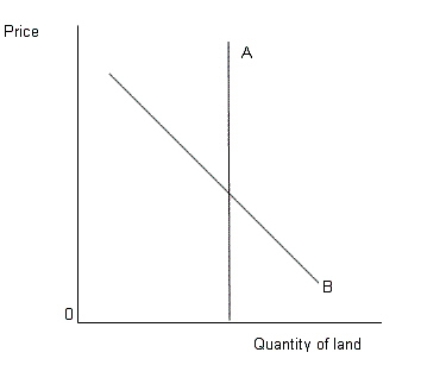 - In Figure 17.1,the curve B indicates:
 (Multiple Choice)
4.7/5 (86)
(86) A fisherman will catch and sell all the fishes in his pond in response to a substantial increase in the price of the fish even if he wishes to remain in the fishing business.
(True/False)
4.8/5 (60)
(60) For resources with vertical supply curves,earnings comprise of both economic rent and transfer earnings.
(True/False)
4.9/5 (85)
(85) The returns that skilled engineering professionals earn consist of both transfer earnings and economic rent.This implies:
(Multiple Choice)
4.9/5 (79)
(79) If a nonrenewable resource is used more in the current period,the return on saving the resource for future falls.
(True/False)
4.7/5 (74)
(74) The figure given below represents an imperfectly competitive resource market.Here common land (and not land used for specific purpose) is under consideration. Figure 17.1 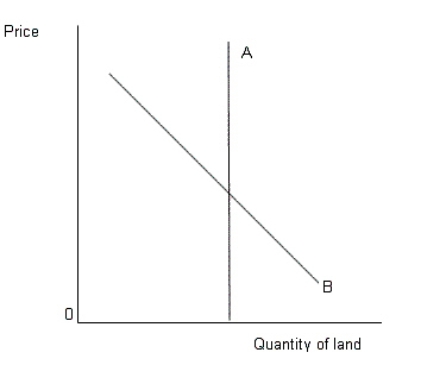 - In Figure 17.1,the curve A indicates:
 (Multiple Choice)
4.7/5 (73)
(73) Extraction of petroleum in the current period will shift the supply curve of petroleum outward in the future resulting in a fall in price of petroleum.
(True/False)
4.8/5 (74)
(74) 
Filters
- Essay(0)
- Multiple Choice(0)
- Short Answer(0)
- True False(0)
- Matching(0)