



 Chat with AI
Exam 18: Aging, Social Security and Health Care

Exam 1: Economics: The World Around You90 Questions
Exam 2: Choice, opportunity Costs, and Specialization95 Questions
Exam 3: Markets, Demand and Supply, and the Price System98 Questions
Exam 4: The Market System and the Private and Public Sector100 Questions
Exam 5: Elasticity: Demand and Supply132 Questions
Exam 6: Consumer Choice142 Questions
Exam 7: Supply: The Costs of Doing Business106 Questions
Exam 8: Profit Maximization122 Questions
Exam 9: Perfect Competition135 Questions
Exam 10: Monopoly118 Questions
Exam 11: Monopolistic Competition and Oligopoly114 Questions
Exam 12: Antitrust and Regulation100 Questions
Exam 13: Market Failures, Government Failures, and Rent Seeking121 Questions
Exam 14: Resource Markets112 Questions
Exam 15: The Labor Market117 Questions
Exam 16: Capital Markets100 Questions
Exam 17: The Land Market and Natural Resources55 Questions
Exam 18: Aging, Social Security and Health Care88 Questions
Exam 19: Income Distribution,Poverty and Government Policy115 Questions
Exam 20: World Trade Equilibrium112 Questions
Exam 21: International Trade Restrictions109 Questions
Exam 22: Exchange Rates and Financial Links Between Countries132 Questions
Select questions type


The following figure shows the demand (D) and supply (S) curves of human organs Figure 18.5
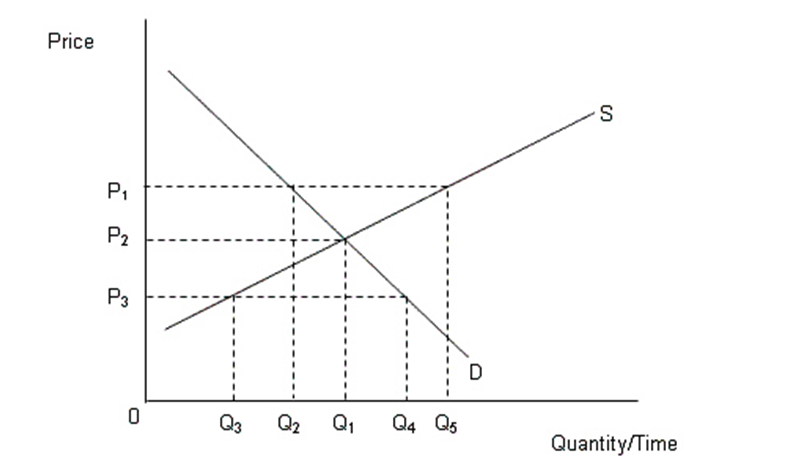 -In Figure 18.5,the equilibrium quantity of human organs in the market is:
 (Multiple Choice)
4.8/5  (77)
(77) If a futures market for human organs can be developed,everyone would tend to volunteer to donate organs as they would receive some income for almost no cost.
(True/False)
4.8/5 (76)
(76) The social security system in the United States,which covers both social security and hospital insurance is financed by a:
(Multiple Choice)
4.9/5 (83)
(83) A part of the supply to the human organs market comes from the organs harvested from people who die suddenly,such as those killed in accidents.
(True/False)
4.8/5 (95)
(95) Which of the following statements is true of the market for prescription drugs in the U.S.?
(Multiple Choice)
4.7/5 (75)
(75) Medical care in the United States is not only expensive but also technologically backward than other nations.
(True/False)
4.8/5 (80)
(80) Empirical evidences suggest that the expenditure on prescription drugs grew by an annual average of 15 percent since 1995.In the light of this observation which of the following statements is true?
(Multiple Choice)
4.8/5 (75)
(75) _____ account for a majority of the health care expenditure in the United States.
(Multiple Choice)
4.8/5 (76)
(76) The figure given below shows the demand (D1 and D2) and supply (S) curves of medical care. Figure 18.1
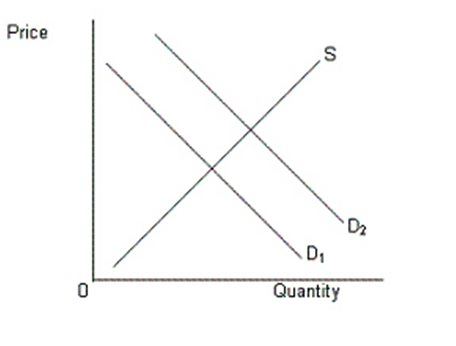 -Refer to Figure 18.1.One possible reason for the shift of the demand curve from D1 to D2 is the:
 (Multiple Choice)
4.8/5 (80)
(80) Which of the following is the most controversial proposal suggested for making the system of social security more efficient?
(Multiple Choice)
5.0/5 (76)
(76) The demand for unskilled workers is highly price elastic.This means that a tax imposed partly on unskilled workers and partly on their employers:
(Multiple Choice)
4.8/5 (77)
(77) In the context of the hospitals in the United States,which of the following statements is correct?
(Multiple Choice)
4.8/5 (60)
(60) The results of privatizing the social security system has been negative at large in most of the economies.
(True/False)
4.8/5 (83)
(83) Privatization of the social security system would lead to which of the following adverse outcomes?
(Multiple Choice)
4.9/5 (88)
(88) Government programs like Medicaid and Medicare have been created as per the belief that everyone has an inalienable right to medical care.
(True/False)
4.9/5 (88)
(88) The bulk of the cost of hospital care is borne by third-parties.Such third-parties are:
(Multiple Choice)
4.8/5 (73)
(73) The existence of new drugs reduces the demand for drugs as they are highly expensive.
(True/False)
4.8/5 (65)
(65) 
Filters
- Essay(0)
- Multiple Choice(0)
- Short Answer(0)
- True False(0)
- Matching(0)