



 Chat with AI
Exam 15: Thermodynamics

Exam 11: Fluids65 Questions
Exam 13: The Transfer of Heat42 Questions
Exam 14: The Ideal Gas Law and Kinetic Theory55 Questions
Exam 15: Thermodynamics79 Questions
Exam 17: The Principle of Linear Superposition and Interference Phenomena51 Questions
Exam 20: Electric Circuits100 Questions
Exam 22: Electromagnetic Induction71 Questions
Exam 25: The Refl Ection of Light: Mirrors43 Questions
Exam 26: The Refraction of Light: Lenses and Optical Instruments102 Questions
Exam 29: Particles and Waves54 Questions
Select questions type


A system containing an ideal gas at a constant pressure of 1.42 × 10⁵ Pa gains 2320 J of heat.During the process,the internal energy of the system increases by 2540 J.What is the change in volume of the gas?
(Multiple Choice)
4.9/5  (70)
(70) A heat engine operates between a hot reservoir at 1500 K and a cold reservoir at 500 K.During each cycle,1.0 × 10⁵ J of heat is removed from the hot reservoir and 5.0 × 10⁴ J of work is performed.
-Determine the change in entropy of the cold reservoir.
(Multiple Choice)
4.8/5 (65)
(65) What are the SI units of the product of pressure and volume,PV?
(Multiple Choice)
4.8/5 (77)
(77) A match ignites within in an oxygen-filled cylinder that has a movable piston.The piston is moved so quickly that no heat escapes.What kind of change is demonstrated in this process?
(Multiple Choice)
4.8/5 (74)
(74) Which one of the following statements is true concerning the ratio of the molar heat capacities Cp/Cᵥ for an ideal gas?
(Multiple Choice)
4.8/5 (87)
(87) Which one of the following statements is not a consequence of the second law of thermodynamics?
(Multiple Choice)
4.8/5 (75)
(75) An ideal monatomic gas expands isothermally from state A to state B.The gas then cools at constant volume to state C.The gas is then compressed isobarically to D before it is heated until it returns to state A.
 -What is the temperature of the gas when it is in state C?
 (Multiple Choice)
4.8/5 (63)
(63) An ideal monatomic gas expands isothermally from state A to state B.The gas then cools at constant volume to state C.The gas is then compressed isobarically to D before it is heated until it returns to state A.
-What is the ratio of the internal energy of the gas in state C to that in state A?
-What is the ratio of the internal energy of the gas in state C to that in state A? (Multiple Choice)
4.8/5 (94)
(94) An ideal gas is taken from state A to state B through process shown on the pressure-volume graph.How much heat is added to the gas in this process? 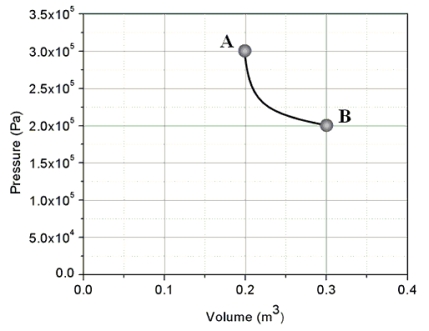
(Multiple Choice)
4.8/5 (91)
(91) A container holding 1.2 kg of water at 20.0 °C is placed in a freezer that is kept at -20.0 °C.The water freezes and comes into thermal equilibrium with the interior of the freezer.
-Which one of the following statements is true concerning this process?
(Multiple Choice)
4.9/5 (74)
(74) A 1.00-kg sample of steam at 100.0 °C condenses to water at 100.0 °C.What is the entropy change of the sample if the heat of vaporization of water is 2.26 × 10⁶ J/kg?
(Multiple Choice)
4.9/5 (83)
(83) One mole of a monatomic gas at 433 K is reversibly taken to half of its original volume by an isobaric process.How much work is done by the gas?
(Multiple Choice)
4.9/5 (82)
(82) Which one of the following statements best describes the operation of a heat engine?
(Multiple Choice)
4.8/5 (78)
(78) Rick spends four hours researching on the internet and does 1090 J of work.In the process,his internal energy decreases by 2190 J.Determine the value of  ,including the algebraic sign.
 (Multiple Choice)
5.0/5 (74)
(74) A heat engine operates between a hot reservoir at 1500 K and a cold reservoir at 500 K.During each cycle,1.0 × 10⁵ J of heat is removed from the hot reservoir and 5.0 × 10⁴ J of work is performed.
-A heat pump extracts 7.0 × 10⁶ J of heat per hour from a well at 280 K and delivers its output heat into a house at 320 K.If the heat pump uses an ideal Carnot cycle in its operation,what minimum work must be supplied to the heat pump per hour?
(Multiple Choice)
4.9/5 (79)
(79) Which one of the following processes represents a decrease in entropy?
(Multiple Choice)
4.9/5 (76)
(76) A heat engine operates between a hot reservoir at 1500 K and a cold reservoir at 500 K.During each cycle,1.0 × 10⁵ J of heat is removed from the hot reservoir and 5.0 × 10⁴ J of work is performed.
-What is the actual efficiency of this engine?
(Multiple Choice)
4.8/5 (74)
(74) An ideal gas absorbs 750 J of heat as it performs 625 J of work.What is the resulting change in temperature if there are 1.3 moles of the gas in the system?
(Multiple Choice)
4.9/5 (69)
(69) Two moles of an ideal gas have an initial Kelvin temperature Tᵢ and absolute pressure Pᵢ.The gas undergoes a reversible isothermal compression from an initial volume Vᵢ to a final volume 0.5Vᵢ.
-Which one of the following expressions represents the final pressure of the gas?
(Multiple Choice)
4.8/5 (79)
(79) 5.00 kg of liquid water is heated to 100.0 °C in a closed system.At this temperature,the density of liquid water is 958 kg/m³.The pressure is maintained at atmospheric pressure of 1.01 × 10⁵ Pa.A moveable piston of negligible weight rests on the surface of the water.The water is then converted to steam by adding an additional amount of heat to the system.When all of the water is converted,the final volume of the steam is 8.50 m³.The latent heat of vaporization of water is 2.26 × 10⁶ J/kg.
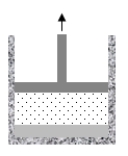 -How much work is done by this closed system during this isothermal process?
 (Multiple Choice)
4.9/5 (84)
(84) 
Filters
- Essay(0)
- Multiple Choice(0)
- Short Answer(0)
- True False(0)
- Matching(0)