



 Chat with AI
Exam 15: Thermodynamics

Exam 11: Fluids65 Questions
Exam 13: The Transfer of Heat42 Questions
Exam 14: The Ideal Gas Law and Kinetic Theory55 Questions
Exam 15: Thermodynamics79 Questions
Exam 17: The Principle of Linear Superposition and Interference Phenomena51 Questions
Exam 20: Electric Circuits100 Questions
Exam 22: Electromagnetic Induction71 Questions
Exam 25: The Refl Ection of Light: Mirrors43 Questions
Exam 26: The Refraction of Light: Lenses and Optical Instruments102 Questions
Exam 29: Particles and Waves54 Questions
Select questions type


In which one of these processes will there be no net change in the entropy of the system?

Free
(Multiple Choice)
5.0/5  (75)
(75) Correct Answer: Verified
E
5.00 kg of liquid water is heated to 100.0 °C in a closed system.At this temperature,the density of liquid water is 958 kg/m³.The pressure is maintained at atmospheric pressure of 1.01 × 10⁵ Pa.A moveable piston of negligible weight rests on the surface of the water.The water is then converted to steam by adding an additional amount of heat to the system.When all of the water is converted,the final volume of the steam is 8.50 m³.The latent heat of vaporization of water is 2.26 × 10⁶ J/kg.
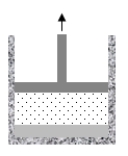 -How much heat is added to the system in the isothermal process of converting all of the water into steam?
Free
(Multiple Choice)
4.9/5 (69)
(69) Correct Answer:Verified
VerifiedE
A block that slides on a rough surface slows down and eventually stops.The reverse process never occurs.That is,a block at rest never begins to move and accelerate on a rough surface without the action of an external agent.The second situation is forbidden because it would violate
Free
(Multiple Choice)
4.8/5 (77)
(77) Correct Answer:Verified
VerifiedD
Two moles of an ideal gas have an initial Kelvin temperature Tᵢ and absolute pressure Pᵢ.The gas undergoes a reversible isothermal compression from an initial volume Vᵢ to a final volume 0.5Vᵢ.
-What is the change in entropy of the sample?
(Multiple Choice)
4.8/5 (87)
(87) An ideal monatomic gas expands isothermally from state A to state B.The gas then cools at constant volume to state C.The gas is then compressed isobarically to D before it is heated until it returns to state A.
 -What is the internal energy of the gas at point B?
 (Multiple Choice)
4.9/5 (92)
(92) A fixed amount of ideal gas is compressed adiabatically.Which entry in the table below correctly indicates the sign of the work done,the change in the internal energy,and the heat exchanged with the environment?
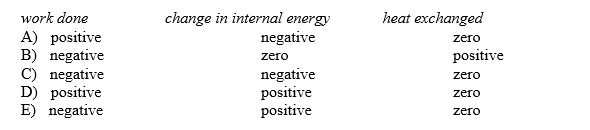
(Short Answer)
4.9/5 (84)
(84) During one stage of a reversible process,the temperature of an ideal gas remains constant as its volume is decreased.Which one of the following statements concerning this situation is true?
(Multiple Choice)
4.8/5 (87)
(87) When the gas enclosed beneath the piston shown in the figure receives 2170 J of heat, ,from its surroundings,it performs 2840 J of work in raising the piston.What is the change in the internal energy of the gas?
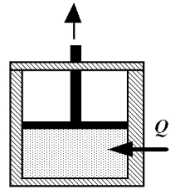
,from its surroundings,it performs 2840 J of work in raising the piston.What is the change in the internal energy of the gas? (Multiple Choice)
4.8/5 (78)
(78) Complete the following statement: Walls that separate a system from its surroundings and permit heat to flow through them are called
(Multiple Choice)
4.8/5 (78)
(78) An ideal monatomic gas expands isobarically from state A to state B.It is then compressed isothermally from state B to state C and finally cooled at constant volume until it returns to its initial state A.
 -How much work is done by the gas in expanding isobarically from A to B?
 (Multiple Choice)
4.8/5 (87)
(87) A container is divided into two chambers that are separated by a valve.The left chamber contains one mole of a monatomic ideal gas.The right chamber is evacuated.At some instant,the valve is opened and the gas rushes freely into the right chamber.Which one of the following statements concerning this process is true? 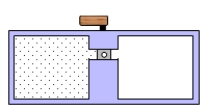
(Multiple Choice)
4.9/5 (91)
(91) An engine is used to lift a 2700-kg truck to a height of 3.0 m at constant speed.In the lifting process,the engine received 4.18 × 10⁵ J of heat from the fuel burned in its interior.What is the efficiency of the engine?
(Multiple Choice)
4.8/5 (86)
(86) An ideal monatomic gas originally in state A is taken reversibly to state B along the straight-line path shown in the pressure-volume graph.
 -How much heat,in calories,was exchanged during this process?
 (Multiple Choice)
4.8/5 (74)
(74) An ideal monatomic gas expands isothermally from state A to state B.The gas then cools at constant volume to state C.The gas is then compressed isobarically to D before it is heated until it returns to state A.
-How much work is done on the gas as it is compressed isobarically from state C to state D?
-How much work is done on the gas as it is compressed isobarically from state C to state D? (Multiple Choice)
4.7/5 (89)
(89) An isobaric process is represented on a pressure-volume graph by which one of the following curves?
(Multiple Choice)
4.9/5 (84)
(84) Neon is a monatomic gas with a molar heat capacity at constant volume of 12.66 J/(mol · K).Two moles of neon gas enclosed in a constant volume system receive 4250 J of heat.If the gas was initially at 293 K,what is the final temperature of the neon?
(Multiple Choice)
4.8/5 (90)
(90) A fixed amount of ideal gas is compressed isothermally.Which entry in the table below correctly depicts the sign of the work done,the change in the internal energy,and the heat exchanged with the environment?
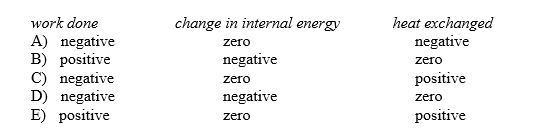
(Short Answer)
4.8/5 (75)
(75) What is the maximum possible efficiency of an engine operating between the boiling and freezing points of water at sea level?
(Multiple Choice)
4.9/5 (74)
(74) Which one of the following situations is a direct application of the Zeroth Law of Thermodynamics?
(Multiple Choice)
4.8/5 (90)
(90) A Carnot engine operates between hot and cold reservoirs with temperatures 527 °C and -73.0 °C,respectively.If the engine performs 1000.0 J of work per cycle,how much heat is extracted per cycle from the hot reservoir?
(Multiple Choice)
4.9/5 (80)
(80) 
Filters
- Essay(0)
- Multiple Choice(0)
- Short Answer(0)
- True False(0)
- Matching(0)