



 Chat with AI
Exam 17: Environmental Hazards and Human Health

Exam 1: Science and the Environment83 Questions
Exam 2: Economics, Politics, and Public Policy81 Questions
Exam 3: Basic Needs of Living Things89 Questions
Exam 4: Populations and Communities87 Questions
Exam 5: Ecosystems: Energy, Patterns, and Disturbance83 Questions
Exam 6: Wild Species and Biodiversity82 Questions
Exam 7: The Use and Restoration of Ecosystems92 Questions
Exam 8: The Human Population78 Questions
Exam 9: Population and Development84 Questions
Exam 10: Water: Hydrologic Cycle and Human Use86 Questions
Exam 11: Soil: Foundation for Land Ecosystems85 Questions
Exam 12: The Production and Distribution of Food84 Questions
Exam 13: Pests and Pest Control91 Questions
Exam 14: Energy From Fossil Fuels96 Questions
Exam 15: Nuclear Power77 Questions
Exam 16: Renewable Energy92 Questions
Exam 17: Environmental Hazards and Human Health84 Questions
Exam 18: Global Climate Change89 Questions
Exam 19: Atmospheric Pollution89 Questions
Exam 20: Water Pollution and Its Prevention78 Questions
Exam 21: Municipal Solid Waste: Disposal and Recovery78 Questions
Exam 22: Hazardous Chemicals: Pollution and Prevention80 Questions
Exam 23: Sustainable Communities and Lifestyles71 Questions
Select questions type


Consulting government data and other scientific studies,Jasmine considers the different ways that she might commute to her job in downtown Toronto,Canada.She might walk 20 blocks or so through a busy downtown,which means crossing many city streets every day.If she drives a car to work,it could be difficult and dangerous in the traffic.Taking a bus might be best,but she once had her purse stolen on a bus and remains concerned about riding a bus again.As Jasmine considers her options,she is engaging in
(Multiple Choice)
4.8/5  (78)
(78) Some milk becomes contaminated with mercury.If each of the following people consume 16 ounces of this contaminated milk each day for a month,who will most likely be impacted by this poison?
(Multiple Choice)
4.7/5 (89)
(89) The WHO World Health Report uses the DALY as a common unit of different types of risks.The DALY is a measurement of the loss of
(Multiple Choice)
4.8/5 (87)
(87) A pharmacist asks a mother about a new prescription for an antibiotic,wanting to be sure that the drug is for the mother.The pharmacist is most likely concerned because
(Multiple Choice)
4.8/5 (77)
(77) People suffering from AIDS have a weakened immune system.Because of their disease,AIDS patients are
(Multiple Choice)
4.8/5 (79)
(79) More than anything else,the greatest adult mortality from infectious disease in the world can be traced to
(Multiple Choice)
4.8/5 (82)
(82) The greatest public health concerns about the H5N1 bird flu virus,as recently highlighted in the potentially dangerous dual-use experiments,is that it will
(Multiple Choice)
4.9/5 (67)
(67) 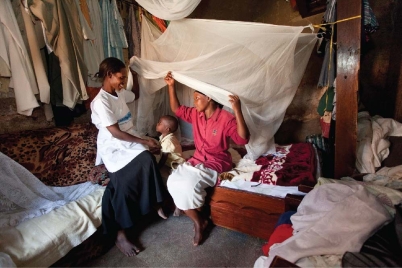 -The people in this photograph are using
One of the greatest risks of diarrheal disease outbreaks in industrialized countries,for example,from Salmonella,results from
(Multiple Choice)
4.7/5 (89)
(89) Which of the following is a good example of a chemical hazard to public health?
(Multiple Choice)
4.9/5 (73)
(73) Being exposed to secondhand smoke by living with a person who smokes
(Multiple Choice)
4.8/5 (78)
(78) Developing countries are said to face double jeopardy for environmental hazards because of the threats of
(Multiple Choice)
4.8/5 (79)
(79) Although all of the following have had positive effects,the most effective way to reduce smoking in children in the United States has been to
(Multiple Choice)
4.8/5 (68)
(68) Initial testing on mice indicates that a new food coloring is a carcinogen.Now the researchers hope to examine the effects of different concentrations of the carcinogen on mice in a type of
(Multiple Choice)
4.9/5 (79)
(79) When an herbicide is typically sprayed on a field,it breaks down in the presence of sunlight into a new molecule.Researchers hope to investigate whether the new molecule occurs in municipal water samples and well water in a rural community in Minnesota.This water testing,and a determination of the amount of chemical ingested by members of the community,represents a type of
(Multiple Choice)
4.9/5 (67)
(67) The greatest risk of death from an infectious disease for people living in northern Eurasia and Africa is most likely
(Multiple Choice)
5.0/5 (74)
(74) A recent study indicated that more than 60% of human pathogens are zoonotic,meaning that they
(Multiple Choice)
4.7/5 (77)
(77) The most effective antimalarial strategies involve the use of
(Multiple Choice)
4.7/5 (81)
(81) 
Filters
- Essay(0)
- Multiple Choice(0)
- Short Answer(0)
- True False(0)
- Matching(0)