



 Chat with AI
Exam 16: Biogeographic Processes

Exam 1: Discovering the Earths Dimensions104 Questions
Exam 2: The Earths Global Energy Balance129 Questions
Exam 3: Air Temperature157 Questions
Exam 4: Atmospheric Moisture and Precipitation132 Questions
Exam 5: Global Atmospheric and Oceanic Circulation138 Questions
Exam 6: Weather Systems130 Questions
Exam 7: Global Climates and Climate Change148 Questions
Exam 8: Earth From the Inside Out79 Questions
Exam 9: Plate Tectonics, Earthquakes, and Volcanoes79 Questions
Exam 10: Weathering and Mass Wasting56 Questions
Exam 11: Fresh Water of the Continents67 Questions
Exam 12: Land-Forms Made by Running Water59 Questions
Exam 13: Landforms Made by Wind and Waves65 Questions
Exam 14: Glacial and Periglacial Landforms105 Questions
Exam 15: Global Soils137 Questions
Exam 16: Biogeographic Processes105 Questions
Exam 17: Global Biogeography142 Questions
Select questions type


In many cases, wildfires are beneficial to forests and grasslands.
(True/False)
4.9/5  (86)
(86) The creation of diversity of life-forms through the process of natural selection is:
(Multiple Choice)
4.9/5 (74)
(74) When new land forms and plant and animal communities begin to develop, the process is called:
(Multiple Choice)
5.0/5 (77)
(77) The condition of the disappearance of a gene pool from Earth is called:
(Multiple Choice)
4.8/5 (77)
(77) 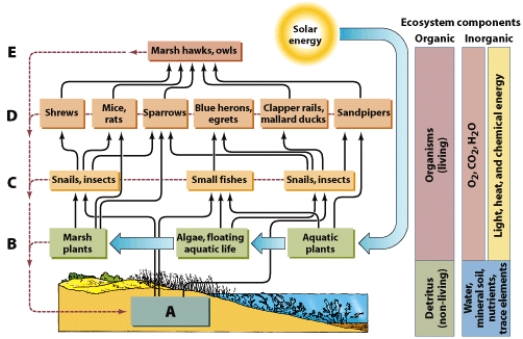
The transfer of energy in levels through an ecosystem is called:
(Multiple Choice)
4.8/5 (85)
(85) The differences that arise between parent and offspring are:
(Multiple Choice)
5.0/5 (74)
(74) The position an organism occupies within a food web is known as the _________ level.
(Short Answer)
4.9/5 (78)
(78) The functional role played by an organism or its "profession" as well as the physical space it inhabits is BEST called the:
(Multiple Choice)
4.9/5 (79)
(79) Most organisms can move from their home territory to new sites in a process called ____________.
(Short Answer)
4.9/5 (83)
(83) A collection of organisms and the environment with which they interact is called a(n):
(Multiple Choice)
4.8/5 (66)
(66) The study of the distribution patterns of organisms over space and time and of the processes that produced these patterns is called:
(Multiple Choice)
4.7/5 (67)
(67) A collection of closely related species that share a similar evolutionary history is a(n):
(Multiple Choice)
4.9/5 (63)
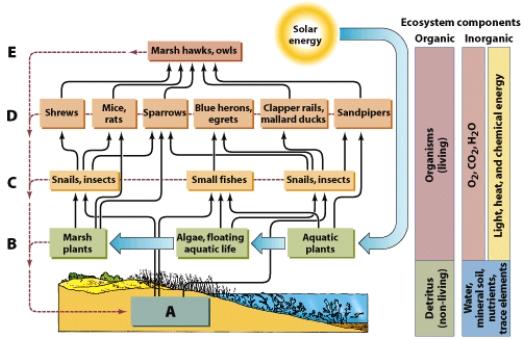
(63) 

Filters
- Essay(0)
- Multiple Choice(0)
- Short Answer(0)
- True False(0)
- Matching(0)