



 Chat with AI
Exam 15: Global Soils

Exam 1: Discovering the Earths Dimensions104 Questions
Exam 2: The Earths Global Energy Balance129 Questions
Exam 3: Air Temperature157 Questions
Exam 4: Atmospheric Moisture and Precipitation132 Questions
Exam 5: Global Atmospheric and Oceanic Circulation138 Questions
Exam 6: Weather Systems130 Questions
Exam 7: Global Climates and Climate Change148 Questions
Exam 8: Earth From the Inside Out79 Questions
Exam 9: Plate Tectonics, Earthquakes, and Volcanoes79 Questions
Exam 10: Weathering and Mass Wasting56 Questions
Exam 11: Fresh Water of the Continents67 Questions
Exam 12: Land-Forms Made by Running Water59 Questions
Exam 13: Landforms Made by Wind and Waves65 Questions
Exam 14: Glacial and Periglacial Landforms105 Questions
Exam 15: Global Soils137 Questions
Exam 16: Biogeographic Processes105 Questions
Exam 17: Global Biogeography142 Questions
Select questions type


On the illustration, the letter that represents the large clay-sized particles is: 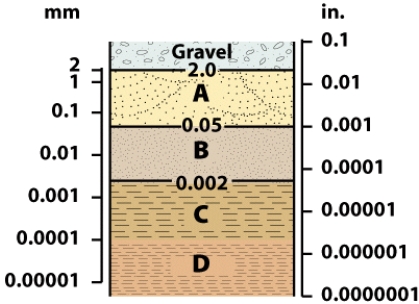
(Multiple Choice)
4.8/5  (74)
(74) A graph that shows monthly values of soil moisture gain, loss, and storage is a(n):
(Multiple Choice)
4.9/5 (81)
(81) A display of soil layers on the face of a freshly cut vertical exposure through the soil is called a(n):
(Multiple Choice)
4.9/5 (83)
(83) The fertile soil characterized by a clay-rich horizon produced by illuviation and noted for a wide distribution is:
(Multiple Choice)
5.0/5 (74)
(74) 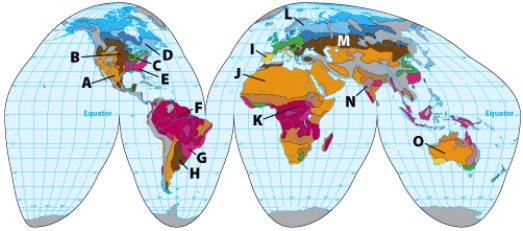
The reddish to yellowish soils that have a subsurface clay horizon, a low base status, and are typical of the southeastern United States are:
(Multiple Choice)
4.9/5 (75)
(75) The loss of moisture to the atmosphere from the soil and from plants is called:
(Multiple Choice)
4.9/5 (76)
(76) 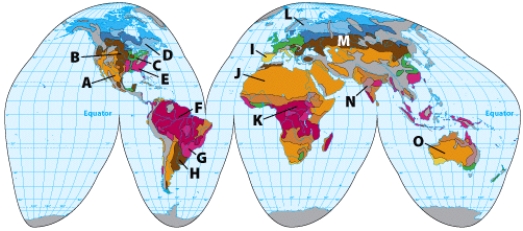
The soils associated with grasslands of the mid-latitudes are:
(Multiple Choice)
4.9/5 (64)
(64) 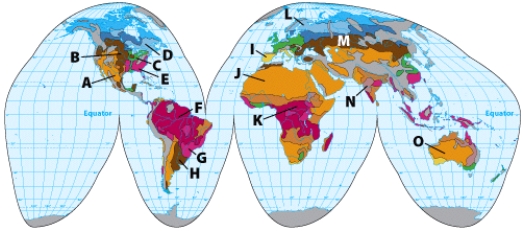
The movement of material upward or downward in the soil is called:
(Multiple Choice)
4.8/5 (79)
(79) 
Filters
- Essay(0)
- Multiple Choice(0)
- Short Answer(0)
- True False(0)
- Matching(0)