



 Chat with AI
Exam 2: The Earths Global Energy Balance

Exam 1: Discovering the Earths Dimensions104 Questions
Exam 2: The Earths Global Energy Balance129 Questions
Exam 3: Air Temperature157 Questions
Exam 4: Atmospheric Moisture and Precipitation132 Questions
Exam 5: Global Atmospheric and Oceanic Circulation138 Questions
Exam 6: Weather Systems130 Questions
Exam 7: Global Climates and Climate Change148 Questions
Exam 8: Earth From the Inside Out79 Questions
Exam 9: Plate Tectonics, Earthquakes, and Volcanoes79 Questions
Exam 10: Weathering and Mass Wasting56 Questions
Exam 11: Fresh Water of the Continents67 Questions
Exam 12: Land-Forms Made by Running Water59 Questions
Exam 13: Landforms Made by Wind and Waves65 Questions
Exam 14: Glacial and Periglacial Landforms105 Questions
Exam 15: Global Soils137 Questions
Exam 16: Biogeographic Processes105 Questions
Exam 17: Global Biogeography142 Questions
Select questions type


Energy from the sun is responsible for powering many of the natural phenomena on the earth's surface, including wind, waves, weather, and living organisms.
(True/False)
4.8/5  (86)
(86) Which of these figures best illustrates the highest sun angle at the tropic of Cancer on the June solstice? 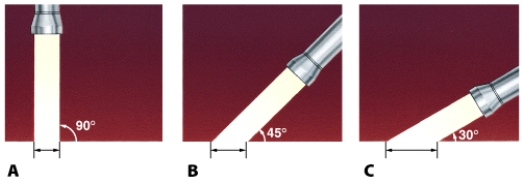
(Multiple Choice)
4.7/5 (74)
(74) In the pie chart below, the proportion of nitrogen in the atmosphere is labeled: 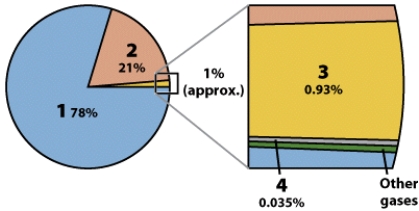
(Multiple Choice)
4.8/5 (81)
(81) Energy with wavelengths in the range of 3 to 5 micrometers is known as:
(Multiple Choice)
4.9/5 (68)
(68) ________ is/are the air pollutant that is thought to have caused the ozone hole over Antarctica.
(Multiple Choice)
5.0/5 (76)
(76) Ultraviolet radiation from the sun is mostly absorbed by _______ in the upper atmosphere.
(Short Answer)
4.8/5 (91)
(91) Which of the numbered sections on this figure corresponds with the ultraviolet portion of the electromagnetic spectrum? 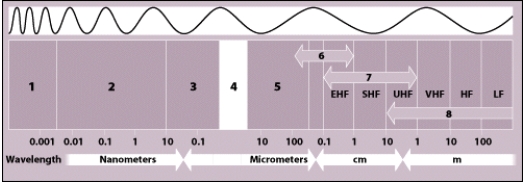
(Multiple Choice)
4.9/5 (79)
(79) The latitude zones immediately north and south of the equatorial zone are called the _______ zones.
(Short Answer)
4.8/5 (56)
(56) Energy with wavelengths in the range of 0.2 to 3 micrometers is known as:
(Multiple Choice)
4.8/5 (70)
(70) The largest portion of the sun's energy output occurs in the ultraviolet portion of the spectrum.
(True/False)
4.8/5 (86)
(86) Relatively hot objects, like the sun, primarily radiate _______ energy.
(Multiple Choice)
4.9/5 (78)
(78) Contrast the average type of radiation emitted from the sun with that from the earth.
(Essay)
5.0/5 (79)
(79) Which of the numbered sections on this figure corresponds with the radar portion of the electromagnetic spectrum? 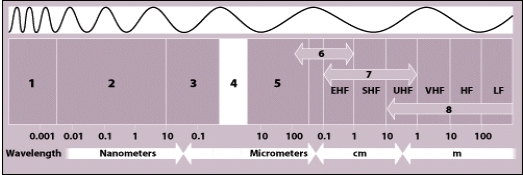
(Multiple Choice)
4.8/5 (74)
(74) On a clear day, about ____ of insolation is scattered and diffused back to space before reaching the ground.
(Multiple Choice)
4.8/5 (75)
(75) If the amount of insolation absorbed by the earth was consistently larger than the amount of longwave energy emitted by the earth, we would expect:
(Multiple Choice)
4.7/5 (70)
(70) The amount of energy radiated by the sun peaks in the ________ portion of the electromagnetic spectrum.
(Multiple Choice)
4.9/5 (78)
(78) The key factor that causes variation in insolation during the course of a day is the __________ of the Sun's rays
(Short Answer)
4.7/5 (82)
(82) Which of the numbered sections on this figure corresponds with the gamma ray portion of the electromagnetic spectrum? 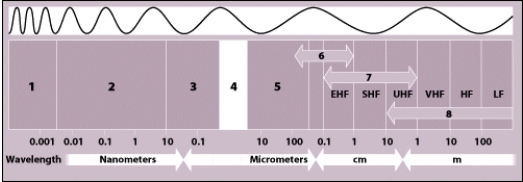
(Multiple Choice)
4.8/5 (79)
(79) 
Filters
- Essay(0)
- Multiple Choice(0)
- Short Answer(0)
- True False(0)
- Matching(0)