



 Chat with AI
Exam 2: The Earths Global Energy Balance

Exam 1: Discovering the Earths Dimensions104 Questions
Exam 2: The Earths Global Energy Balance129 Questions
Exam 3: Air Temperature157 Questions
Exam 4: Atmospheric Moisture and Precipitation132 Questions
Exam 5: Global Atmospheric and Oceanic Circulation138 Questions
Exam 6: Weather Systems130 Questions
Exam 7: Global Climates and Climate Change148 Questions
Exam 8: Earth From the Inside Out79 Questions
Exam 9: Plate Tectonics, Earthquakes, and Volcanoes79 Questions
Exam 10: Weathering and Mass Wasting56 Questions
Exam 11: Fresh Water of the Continents67 Questions
Exam 12: Land-Forms Made by Running Water59 Questions
Exam 13: Landforms Made by Wind and Waves65 Questions
Exam 14: Glacial and Periglacial Landforms105 Questions
Exam 15: Global Soils137 Questions
Exam 16: Biogeographic Processes105 Questions
Exam 17: Global Biogeography142 Questions
Select questions type


The greenhouse effect is caused by counter-radiation of longwave energy from gases like carbon dioxide and water vapor.
(True/False)
4.7/5  (87)
(87) Hot objects emit ______ energy than cold objects, and it is of _______ wavelengths.
(Multiple Choice)
5.0/5 (84)
(84) The equatorial region receives lower annual isolation levels with the earth's axis tilted than they would if the axis were perpendicular to the plane of the ecliptic.
(True/False)
4.8/5 (89)
(89) Taken together, nitrogen and oxygen account for about 99% of the gases in our atmosphere.
(True/False)
4.8/5 (66)
(66) Electromagnetic energy in the range from 0.2 to 3 micrometers is called shortwave radiation.
(True/False)
4.8/5 (82)
(82) The proportion of solar radiation that is reflected by an object is that object's ________.
(Short Answer)
4.8/5 (87)
(87) Counterradiation is the longwave energy that the earth radiates in to space to balance the shortwave energy it receives from the sun.
(True/False)
4.8/5 (81)
(81) Which of the daily solar paths shown in this figure illustrates the situation for December solstice, at a latitude of 40ᵒ north. 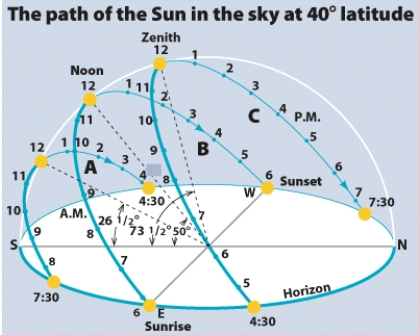
(Multiple Choice)
4.7/5 (88)
(88) Which of the following factors affects the amount of insolation received at a given location at a given time?
(Multiple Choice)
4.9/5 (84)
(84) Which of the daily solar paths shown in this figure illustrates the situation for June solstice, at a latitude of 40ᵒ north. 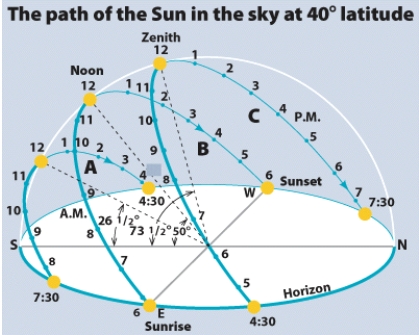
(Multiple Choice)
4.9/5 (86)
(86) Most of the energy radiated by the earth is in the form of thermal infrared radiation.
(True/False)
4.8/5 (75)
(75) On the Tropic of Capricorn, the sun will reach its highest position in the sky on the:
(Multiple Choice)
4.9/5 (79)
(79) In the pie chart below, the proportion of argon in the atmosphere is labeled: 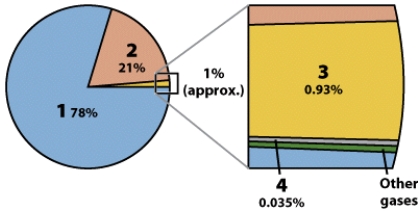
(Multiple Choice)
4.8/5 (77)
(77) As solar radiation passes through the atmosphere some of it gets scattered in all directions to create diffuse radiation.
(True/False)
4.8/5 (79)
(79) The bright white surfaces of thick low clouds reflect about _______ of incoming radiation back into space.
(Multiple Choice)
4.8/5 (98)
(98) __________ radiation is a wavelike form of energy radiated by any substance possessing heat.
(Short Answer)
4.9/5 (91)
(91) Air temperatures above low-albedo surfaces tend to be ______ than those over high-albedo surfaces.
(Multiple Choice)
4.9/5 (83)
(83) Which of the following types of electromagnetic radiation has the longest wavelength?
(Multiple Choice)
4.9/5 (82)
(82) In its gas form, oxygen does not react with other elements very easily.
(True/False)
5.0/5 (80)
(80) At the Arctic Circle, the sun will reach its highest position in the sky on the:
(Multiple Choice)
4.8/5 (80)
(80) 
Filters
- Essay(0)
- Multiple Choice(0)
- Short Answer(0)
- True False(0)
- Matching(0)