



 Chat with AI
Exam 6: Air-Sea Interface

Exam 1: Introduction to Planet Earth62 Questions
Exam 2: Plate Tectonics and the Ocean Floor61 Questions
Exam 3: Marine Provinces55 Questions
Exam 4: Marine Sediments72 Questions
Exam 5: Water and Seawater59 Questions
Exam 6: Air-Sea Interface60 Questions
Exam 7: Ocean Circulation73 Questions
Exam 8: Waves and Water Dynamics73 Questions
Exam 9: Tides62 Questions
Exam 10: The Coast: Beaches and Shoreline Processes67 Questions
Exam 11: The Coastal Oceans68 Questions
Exam 12: Marine Life and the Marine Environment74 Questions
Exam 13: Biological Productivity and Energy Transfer71 Questions
Exam 14: Animals of the Pelagic Environment59 Questions
Exam 15: Animals of the Benthic Environment70 Questions
Exam 16: The Oceans and Climate Change43 Questions
Select questions type


Near the poles, more energy is reflected back into space than is absorbed.
(True/False)
4.8/5  (96)
(96) The percentage of solar radiation absorbed by the Earth's oceans and landmasses is about:
(Multiple Choice)
4.9/5 (71)
(71) Refer to the figure below and use the numbers that correspond to global wind belts and latitudes to answer the following question(s).
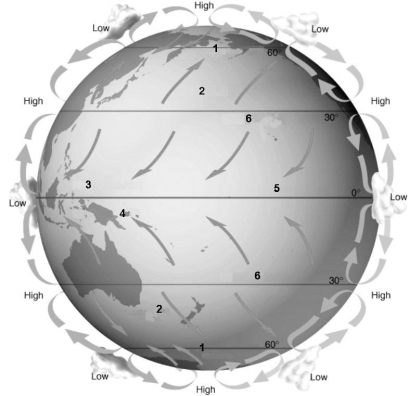 -The area of the globe (latitude) that is characterized by falling air masses and little precipitation is:
 (Multiple Choice)
4.8/5 (76)
(76) The percentage of incident light radiation reflected back to space is termed albedo.
(True/False)
4.9/5 (69)
(69) Idealized pressure belts and wind systems are significantly modified by Earth's tilted axis of rotation and:
(Multiple Choice)
5.0/5 (82)
(82) Describe the impact of cyclones on the Earth's heat budget? How are the number and frequency of cyclones related to latitude and season?
(Essay)
4.8/5 (87)
(87) The angle at which direct sunlight strikes the ocean's surface is important in determining the amount of solar energy that is absorbed.
(True/False)
4.9/5 (94)
(94) Refer to the figure below and use the numbers that correspond to global wind belts and latitudes to answer the following question(s).
-The westerlies wind belt is the area corresponding to:
-The westerlies wind belt is the area corresponding to: (Multiple Choice)
4.9/5 (88)
(88) The percentage of solar radiation directed to Earth absorbed by the clouds and the atmosphere is about:
(Multiple Choice)
4.9/5 (79)
(79) Discuss uneven solar heating as a function of latitude and how this contributes to the formation of global wind belts.
(Essay)
4.9/5 (75)
(75) The autumnal equinox occurs when the sun is directly overhead along the equator in March.
(True/False)
4.7/5 (82)
(82) Compare and contrast the formation of high pressure and low pressure atmospheric systems on precipitation and temperature in the areas where they form.
(Essay)
4.8/5 (92)
(92) The best climate models indicate that Earth's average surface temperature has risen by 5°C in the last 100 years.
(True/False)
4.9/5 (81)
(81) The wavelength of energy radiated from the Earth back into the atmosphere is longer than the incoming solar radiation.
(True/False)
4.8/5 (85)
(85) 
Filters
- Essay(0)
- Multiple Choice(0)
- Short Answer(0)
- True False(0)
- Matching(0)