



 Chat with AI
Exam 6: Air-Sea Interface

Exam 1: Introduction to Planet Earth62 Questions
Exam 2: Plate Tectonics and the Ocean Floor61 Questions
Exam 3: Marine Provinces55 Questions
Exam 4: Marine Sediments72 Questions
Exam 5: Water and Seawater59 Questions
Exam 6: Air-Sea Interface60 Questions
Exam 7: Ocean Circulation73 Questions
Exam 8: Waves and Water Dynamics73 Questions
Exam 9: Tides62 Questions
Exam 10: The Coast: Beaches and Shoreline Processes67 Questions
Exam 11: The Coastal Oceans68 Questions
Exam 12: Marine Life and the Marine Environment74 Questions
Exam 13: Biological Productivity and Energy Transfer71 Questions
Exam 14: Animals of the Pelagic Environment59 Questions
Exam 15: Animals of the Benthic Environment70 Questions
Exam 16: The Oceans and Climate Change43 Questions
Select questions type


A maritime tropical air mass is likely to be:

Free
(Multiple Choice)
4.9/5  (80)
(80) Correct Answer: Verified
E
Colder air moving over significantly warmer ocean surface water may produce:
Free
(Multiple Choice)
4.7/5 (79)
(79) Correct Answer:Verified
VerifiedE
The wind belt(s) with strong, reliable, generally easterly winds is (are) the:
Free
(Multiple Choice)
4.9/5 (65)
(65) Correct Answer:Verified
VerifiedD
Wind is initiated by thermal heating from the sun and cooling by the ocean creating a thermal convection cell.
(True/False)
4.9/5 (83)
(83) The greenhouse gas that accounts for most of the natural greenhouse effect in Earth's atmosphere is carbon dioxide.
(True/False)
4.9/5 (89)
(89) Refer to the figure below and use the numbers that correspond to global wind belts and latitudes to answer the following question(s).
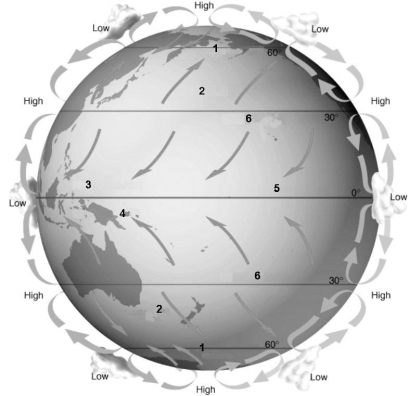 -The strongest winds on Earth are:
 (Multiple Choice)
4.9/5 (69)
(69) What are the differences between hurricanes, typhoons, and tropical cyclones?
(Essay)
4.9/5 (84)
(84) Discuss the impact of the Coriolis effect on atmospheric circulation. Provide at least two examples where the Coriolis effect significantly impacts global atmospheric circulation.
(Essay)
4.9/5 (89)
(89) Refer to the figure below, and use the information on the map corresponding to the ocean's climatic regions to answer the following question(s).
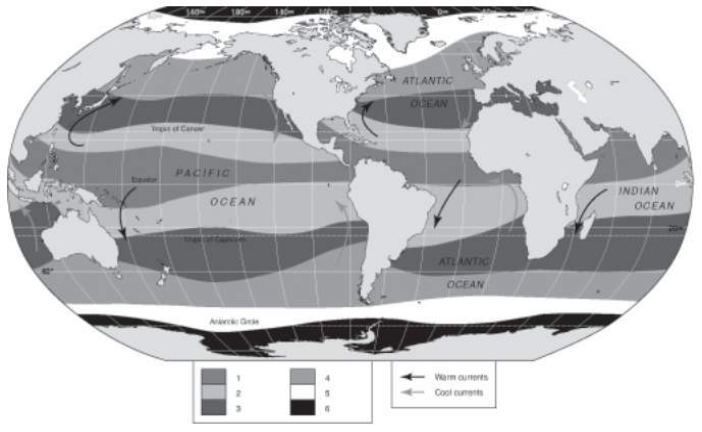 -The oceanic climate region(s) in the majority of strong cyclonic storms are produced is indicated by the number:
 (Multiple Choice)
4.8/5 (77)
(77) With respect to the amount of energy absorbed by the atmosphere, the amount of energy radiated back into space between 35°N and 40°S latitude is:
(Multiple Choice)
5.0/5 (71)
(71) With respect to incoming solar radiation, radiation emitted back into the atmosphere has:
(Multiple Choice)
4.7/5 (69)
(69) The Saffir-Simpson scale rates the relative intensity of tropical cylones.
(True/False)
4.8/5 (74)
(74) Match the appropriate phrase with correct term. You may use each answer once, more than once or not at all.
Correct Answer:Verified
VerifiedPremises:
Responses:
(Matching)
4.9/5 (65)
(65) Examine the five words and/or phrases and determine the relationship among the majority of words/phrases.
-Choose the one option that does not fit the pattern.
(Multiple Choice)
4.9/5 (74)
(74) The oceanic climate region(s) in the majority of strong cyclonic storms are produced is indicated by the number:
(Multiple Choice)
4.9/5 (89)
(89) Winds blowing from the north in the southern hemisphere will appear to :
(Multiple Choice)
4.8/5 (81)
(81) 
Filters
- Essay(0)
- Multiple Choice(0)
- Short Answer(0)
- True False(0)
- Matching(0)