



 Chat with AI
Exam 12: Inflation, Jobs, and the Business Cycle

Exam 1: What Is Economics479 Questions
Exam 2: The Economic Problem439 Questions
Exam 3: Demand and Supply515 Questions
Exam 4: Measuring GDP and Economic Growth396 Questions
Exam 5: Monitoring Jobs and Inflation407 Questions
Exam 6: Economic Growth353 Questions
Exam 7: Finance, Saving, and Investment240 Questions
Exam 8: Money, The Price Level, and Inflation583 Questions
Exam 9: The Exchange Rate and the Balance of Payments481 Questions
Exam 10: Aggregate Supply and Aggregate Demand418 Questions
Exam 11: Expenditure Multipliers454 Questions
Exam 12: Inflation, Jobs, and the Business Cycle401 Questions
Exam 13: Fiscal Policy263 Questions
Exam 14: Monetary Policy225 Questions
Exam 15: International Trade Policy197 Questions
Exam 16: Introduction23 Questions
Exam 17: Monitoring Macroeconomic Performance11 Questions
Exam 18: Macroeconomic Trends19 Questions
Exam 19: Macroeconomic Fluctuations23 Questions
Exam 20: Macroeconomic Policy25 Questions
Select questions type


"The short-run Phillips curve shows the relationship between real GDP and inflation." Is the previous statement correct or incorrect?
Briefly explain you answer.
(Essay)
5.0/5  (85)
(85) 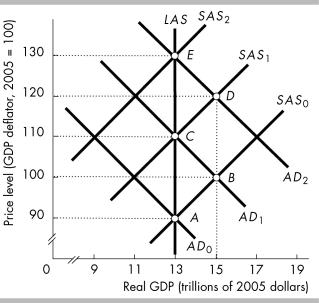 -In the above figure,if the economy moves from point A to point E,
 (Multiple Choice)
4.7/5 (89)
(89) Suppose aggregate demand increases by more than expected.Which of the following describes what will occur?
(Multiple Choice)
4.8/5 (73)
(73) Which of the following describes the Keynesian approach to the business cycle?
I. Unanticipated shocks to aggregate supply drive expansions and recessions.
II. The Keynesian theory is a real business cycle model of the economy.
III. A decrease in business confidence can trigger a recession.
(Multiple Choice)
4.7/5 (74)
(74) Movements upward along the short-run Phillips curve result from
(Multiple Choice)
4.8/5 (85)
(85) Which of the following factors could start a demand-pull inflation ?
(Multiple Choice)
4.9/5 (87)
(87) If demand pull inflation occurs when the economy is already at potential GDP,then following the initial increase in aggregate demand,the
(Multiple Choice)
4.9/5 (86)
(86) Which of the following pieces of evidence is most consistent with the real business cycle theory?
(Multiple Choice)
4.8/5 (87)
(87) In April 2008 the price of oil was approximately $130 per barrel; in April 2013,it was approximately $90 per barrel.This change in the price of oil could have started
(Multiple Choice)
4.7/5 (78)
(78) Suppose that the Federal Reserve is expected to expand the quantity of money by 5 percent but ends up expanding it by only 2 percent.If the new Keynesian theory is correct,which of the following describes the effect on the economy?
(Multiple Choice)
4.9/5 (80)
(80) Which of the following are TRUE?
I. New Keynesian economists believe that money wage rates are influenced by rational expectations of the price level.
II. New classical economists believe that money wage rates are influenced by rational expectations of the price level.
III. New classical economists believe expected changes in aggregate demand trigger business cycles.
(Multiple Choice)
4.9/5 (88)
(88)  -In the above figure,suppose that the economy currently is at point A.If the inflation rate falls and this fall is unanticipated by the public,the economy moves to a point such as point
 (Multiple Choice)
4.9/5 (80)
(80) An increase in the price of a resource such as oil I. shifts the aggregate demand curve leftward.
II) shifts the long-run aggregate supply curve rightward.
III) shifts the short-run aggregate supply curve leftward.
IV) increases the price level and decreases real GDP in the short run.
(Multiple Choice)
4.9/5 (85)
(85) 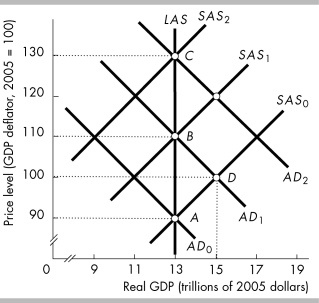 -In the above figure,the economy initially is at point A and then an increase in the quantity of money moves the economy to point D.The money wage rate will
 (Multiple Choice)
4.9/5 (83)
(83) Real business cycle theory says that the factor leading to the business cycle is changes in
(Multiple Choice)
4.9/5 (84)
(84) The data below show data for Germany including real GDP (in billions of euros) and the price level. Real GDP Price Level 2002 2088 102.6 2003 2083 103.6 2004 2105 106 2005 2121 108.2 2006 2182 109.7 2007 2237 109.5
In which of the following year(s) did Germany experience inflation?
(Multiple Choice)
4.9/5 (82)
(82) The Keynesian explanation of the business cycle is based on
(Multiple Choice)
4.9/5 (78)
(78) 
Filters
- Essay(0)
- Multiple Choice(0)
- Short Answer(0)
- True False(0)
- Matching(0)