



 Chat with AI
Exam 12: Inflation, Jobs, and the Business Cycle

Exam 1: What Is Economics479 Questions
Exam 2: The Economic Problem439 Questions
Exam 3: Demand and Supply515 Questions
Exam 4: Measuring GDP and Economic Growth396 Questions
Exam 5: Monitoring Jobs and Inflation407 Questions
Exam 6: Economic Growth353 Questions
Exam 7: Finance, Saving, and Investment240 Questions
Exam 8: Money, The Price Level, and Inflation583 Questions
Exam 9: The Exchange Rate and the Balance of Payments481 Questions
Exam 10: Aggregate Supply and Aggregate Demand418 Questions
Exam 11: Expenditure Multipliers454 Questions
Exam 12: Inflation, Jobs, and the Business Cycle401 Questions
Exam 13: Fiscal Policy263 Questions
Exam 14: Monetary Policy225 Questions
Exam 15: International Trade Policy197 Questions
Exam 16: Introduction23 Questions
Exam 17: Monitoring Macroeconomic Performance11 Questions
Exam 18: Macroeconomic Trends19 Questions
Exam 19: Macroeconomic Fluctuations23 Questions
Exam 20: Macroeconomic Policy25 Questions
Select questions type


The Keynesian explanation of the business cycle rests on several concepts,including
(Multiple Choice)
4.8/5  (85)
(85) Which of the following is TRUE regarding the monetarist theory of the business cycle?
I. Monetarists assume that the quantity of money increases at a constant rate.
II. Fluctuations in interest rates cause business cycles.
III. Changes in the growth rate of the quantity of money affect aggregate demand.
(Multiple Choice)
4.8/5 (86)
(86) The anticipated inflation rate is 5 percent.In order for purchasing power to remain constant,the money wage rate must rise by
(Multiple Choice)
4.8/5 (78)
(78) The new classical theory argues that the primary factor leading to business cycles are
(Multiple Choice)
4.8/5 (73)
(73) Suppose that last year the economy of Suffera was experiencing an expected inflation rate of 8 percent and unemployment rate of 12 percent.An unexpected increase in the inflation rate would
(Multiple Choice)
4.9/5 (68)
(68) A decrease in the expected inflation rate leads to ________ in the long-run Phillips curve and ________ in the short-run Phillips curve.
(Multiple Choice)
4.9/5 (61)
(61)  -In the above figure,the economy initially is at point A and then an increase in the quantity of money moves the economy to point D.At point D,the real wage rate has
 (Multiple Choice)
4.9/5 (87)
(87) Which of the following could NOT start a demand-pull inflation?
(Multiple Choice)
4.8/5 (71)
(71) Which of the following would shift the aggregate demand curve leftward year after year?
(Multiple Choice)
4.9/5 (70)
(70) The factor leading to business cycles in the real business cycle theory is changes in the growth rate of
(Multiple Choice)
4.7/5 (76)
(76) Compare and contrast the Keynesian and Monetarist business cycle theories.
(Essay)
4.9/5 (80)
(80) 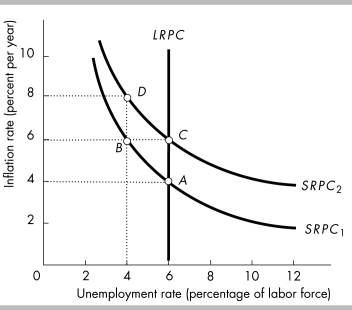 -In the above figure,suppose the economy is at point A.An expected increase in the inflation rate to 6 percent will result in a movement to point
 (Multiple Choice)
4.8/5 (81)
(81) Using the Phillips curves,what are the short-run and long-run effects of a decrease in the inflation rate?
(Essay)
4.8/5 (72)
(72) 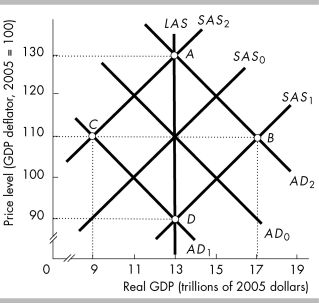 -In the above figure,suppose the economy has moved from point A to point C.According to the monetarist theory of the business cycle,what could have caused this movement?
 (Multiple Choice)
4.9/5 (78)
(78) 
Filters
- Essay(0)
- Multiple Choice(0)
- Short Answer(0)
- True False(0)
- Matching(0)