



 Chat with AI
Exam 12: Inflation, Jobs, and the Business Cycle

Exam 1: What Is Economics479 Questions
Exam 2: The Economic Problem439 Questions
Exam 3: Demand and Supply515 Questions
Exam 4: Measuring GDP and Economic Growth396 Questions
Exam 5: Monitoring Jobs and Inflation407 Questions
Exam 6: Economic Growth353 Questions
Exam 7: Finance, Saving, and Investment240 Questions
Exam 8: Money, The Price Level, and Inflation583 Questions
Exam 9: The Exchange Rate and the Balance of Payments481 Questions
Exam 10: Aggregate Supply and Aggregate Demand418 Questions
Exam 11: Expenditure Multipliers454 Questions
Exam 12: Inflation, Jobs, and the Business Cycle401 Questions
Exam 13: Fiscal Policy263 Questions
Exam 14: Monetary Policy225 Questions
Exam 15: International Trade Policy197 Questions
Exam 16: Introduction23 Questions
Exam 17: Monitoring Macroeconomic Performance11 Questions
Exam 18: Macroeconomic Trends19 Questions
Exam 19: Macroeconomic Fluctuations23 Questions
Exam 20: Macroeconomic Policy25 Questions
Select questions type


The monetarist theory of the business cycle views fluctuations in the growth rate of the quantity of money as the main source of economic fluctuations.
(True/False)
4.8/5  (75)
(75) In monetarist business cycle theory,increases in money growth temporarily ________ real GDP and ________ the price level.
(Multiple Choice)
4.9/5 (75)
(75) Demand-pull inflation results from continually increasing the quantity of money,which leads to a continually
(Multiple Choice)
4.8/5 (97)
(97) A rise in the price level because of an increase in the money wage rate
(Multiple Choice)
4.9/5 (82)
(82) 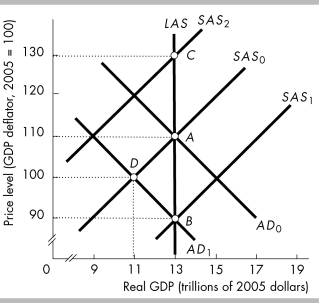 -In the above figure,the economy is initially at point A.Which point best represents the short-run response to a decrease in the growth rate of the quantity of money,according to the monetarists?
 (Multiple Choice)
4.8/5 (67)
(67) The short-run Phillips curve shows the ________ relationship between ________.
(Multiple Choice)
4.8/5 (81)
(81) The Cleveland Federal Reserve Bank's estimate of expected inflation has fallen from 3.5 percent in 2000 to 1.5 percent in 2013.This fall means that
(Multiple Choice)
4.9/5 (76)
(76) The new Keynesian cycle theory views only anticipated changes in aggregate demand as the source of business cycle economic fluctuations.
(True/False)
4.9/5 (66)
(66) For monetarists the main cause of economic fluctuations is changes in
(Multiple Choice)
4.7/5 (83)
(83) For a persistent cost-push inflation to occur,the Fed must persistently increase the quantity of money.
(True/False)
4.9/5 (83)
(83) By itself,a supply shock such as a hike in the price of oil,can
(Multiple Choice)
4.7/5 (79)
(79) Which of the diagrams in the above figure best illustrates a long-run Phillips curve?
(Multiple Choice)
4.8/5 (86)
(86) The position of the long-run Phillips curve is determined by
(Multiple Choice)
4.8/5 (83)
(83) The short-run Phillips curve intersects the long-run Phillips curve at the
(Multiple Choice)
4.9/5 (76)
(76)  -In the above figure,the economy initially is at point A and then an increase in the quantity of money moves the economy to point D.If the quantity of money remains constant,the economy will adjust with
 (Multiple Choice)
4.9/5 (76)
(76) Oil prices increase sharply,raising the price level and decreasing real GDP.The Fed has an incentive to
(Multiple Choice)
4.9/5 (71)
(71) 
Filters
- Essay(0)
- Multiple Choice(0)
- Short Answer(0)
- True False(0)
- Matching(0)