



 Chat with AI
Exam 2: Scarcity and the World of Trade-Offs

Exam 1: The Nature of Economics346 Questions
Exam 2: Scarcity and the World of Trade-Offs410 Questions
Exam 3: Demand and Supply448 Questions
Exam 4: Extensions of Demand and Supply Analysis398 Questions
Exam 5: Public Spending and Public Choice359 Questions
Exam 6: Funding the Public Sector201 Questions
Exam 7: The Macroeconomy: Unemployment, Inflation, and Deflation412 Questions
Exam 8: Global Economic Growth and Development282 Questions
Exam 9: Real GDP and the Price Level in the Long Run291 Questions
Exam 10: Classical and Keynesian Macro Analyses365 Questions
Exam 11: Consumption, Real GDP, and the Multiplier445 Questions
Exam 12: Fiscal Policy273 Questions
Exam 13: Deficit Spending and the Public Debt145 Questions
Exam 14: Money Banking and Central Banking516 Questions
Exam 15: Domestic and International Dimensions of Monetary Policy356 Questions
Exam 16: Stabilization in an Integrated World Economy305 Questions
Exam 17: Policies and Prospects for Global Economic Growth216 Questions
Exam 18: Comparative Advantage and the Open Economy314 Questions
Exam 19: Exchange Rates and the Balance of Payments300 Questions
Select questions type


Which of the following is TRUE about comparative advantage?
(Multiple Choice)
4.7/5  (81)
(81) A bowed outward production possibilities curve occurs when
(Multiple Choice)
4.9/5 (79)
(79) Which of the following statements is FALSE about opportunity cost?
(Multiple Choice)
4.8/5 (92)
(92) "Economics is the study of how people eliminate scarcity." Do you agree or disagree?
Why?
(Essay)
4.8/5 (72)
(72) A person goes to college to become an engineer. This is an example of an
(Multiple Choice)
4.9/5 (70)
(70) Which of the following statements indicates the idea of trade-offs?
(Multiple Choice)
4.8/5 (65)
(65)  -In the above figure, the opportunity cost of moving from point A to point C is
 (Multiple Choice)
4.8/5 (79)
(79) 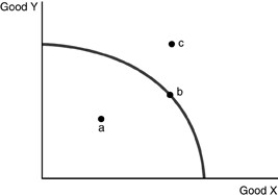 -Refer to the above figure. Which of the following statements is TRUE?
 (Multiple Choice)
4.8/5 (80)
(80) Assume that Economy A and Economy B have the same resources, but that individuals in Economy A have specialized whereas individuals in Economy B have not. Given this information, you can determine that
(Multiple Choice)
4.9/5 (80)
(80) 
Filters
- Essay(0)
- Multiple Choice(0)
- Short Answer(0)
- True False(0)
- Matching(0)