



 Chat with AI
Exam 2: Scarcity and the World of Trade-Offs

Exam 1: The Nature of Economics346 Questions
Exam 2: Scarcity and the World of Trade-Offs410 Questions
Exam 3: Demand and Supply448 Questions
Exam 4: Extensions of Demand and Supply Analysis398 Questions
Exam 5: Public Spending and Public Choice359 Questions
Exam 6: Funding the Public Sector201 Questions
Exam 7: The Macroeconomy: Unemployment, Inflation, and Deflation412 Questions
Exam 8: Global Economic Growth and Development282 Questions
Exam 9: Real GDP and the Price Level in the Long Run291 Questions
Exam 10: Classical and Keynesian Macro Analyses365 Questions
Exam 11: Consumption, Real GDP, and the Multiplier445 Questions
Exam 12: Fiscal Policy273 Questions
Exam 13: Deficit Spending and the Public Debt145 Questions
Exam 14: Money Banking and Central Banking516 Questions
Exam 15: Domestic and International Dimensions of Monetary Policy356 Questions
Exam 16: Stabilization in an Integrated World Economy305 Questions
Exam 17: Policies and Prospects for Global Economic Growth216 Questions
Exam 18: Comparative Advantage and the Open Economy314 Questions
Exam 19: Exchange Rates and the Balance of Payments300 Questions
Select questions type


When productive activities are organized according to the principle of the division of labor
(Multiple Choice)
4.8/5  (88)
(88) If Irene can make either four chairs or one table in an hour and Greg can make either three chairs or two tables in an hour, then
(Multiple Choice)
4.9/5 (86)
(86) Physical capital is distinguished from human capital because
(Multiple Choice)
4.9/5 (67)
(67) The production possibilities curve represents the maximum feasible production combinations resulting from
(Multiple Choice)
5.0/5 (72)
(72) All of the following are examples of physical capital EXCEPT
(Multiple Choice)
4.9/5 (81)
(81) Explain how comparative advantage, specialization and division of labor are related.
(Essay)
4.7/5 (76)
(76) 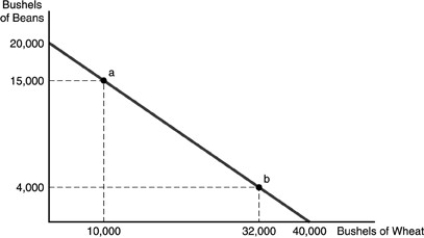 -In the above figure, the farmer faces a trade-off between beans and wheat equal to
 (Multiple Choice)
4.9/5 (73)
(73) Bill Bonecrusher graduates from college with a choice of playing professional football at $2 million a year or coaching for $50,000 a year. He decides to play football, but eight years later he quits football to make movies for $3 million a year. His opportunity cost at graduation was ________ and eight years later was ________.
(Multiple Choice)
4.7/5 (67)
(67) At a zero price, which of the following conditions is TRUE for an economic good?
(Multiple Choice)
4.9/5 (72)
(72)  -A farmer has 100 acres of land on which he can grow soybeans or corn. An acre of land yields 200 bushels of soybeans or 100 bushels of corn. The above figure refers to the farmer's
 (Multiple Choice)
4.8/5 (82)
(82) A point outside a production possibilities curve indicates
(Multiple Choice)
4.8/5 (68)
(68) 
Filters
- Essay(0)
- Multiple Choice(0)
- Short Answer(0)
- True False(0)
- Matching(0)