



 Chat with AI
Exam 21: Capital Budgeting and Cost Analysis

Exam 1: The Manager and Management Accounting195 Questions
Exam 2: An Introduction to Cost Terms and Purposes224 Questions
Exam 3: Cost-Volume-Profit Analysis211 Questions
Exam 4: Job Costing203 Questions
Exam 5: Activity-Based Costing and Activity-Based Management176 Questions
Exam 6: Master Budget and Responsibility Accounting226 Questions
Exam 7: Flexible Budgets, Direct-Cost Variances, and Management Control181 Questions
Exam 8: Flexible Budgets, Overhead Cost Variances, and Management Control176 Questions
Exam 9: Inventory Costing and Capacity Analysis210 Questions
Exam 10: Determining How Costs Behave192 Questions
Exam 11: Decision Making and Relevant Information218 Questions
Exam 12: Strategy, Balanced Scorecard, and Strategic Profitability Analysis172 Questions
Exam 13: Pricing Decisions and Cost Management210 Questions
Exam 14: Cost Allocation, Customer-Profitability Analysis, and Sales-Variance Analysis167 Questions
Exam 15: Allocation of Support-Department Costs, Common Costs, and Revenues150 Questions
Exam 16: Cost Allocation: Joint Products and Byproducts151 Questions
Exam 17: Process Costing149 Questions
Exam 18: Spoilage, Rework, and Scrap153 Questions
Exam 19: Balanced Scorecard: Quality and Time150 Questions
Exam 20: Inventory Management, Just-in-Time, and Simplified Costing Methods150 Questions
Exam 21: Capital Budgeting and Cost Analysis151 Questions
Exam 22: Management Control Systems, Transfer Pricing, and Multinational Considerations151 Questions
Exam 23: Performance Measurement, Compensation, and Multinational Considerations150 Questions
Select questions type


In the "Identify projects" stage of capital budgeting, companies gather information from all parts of the value chain to evaluate alternative projects.
(True/False)
4.7/5  (81)
(81) Which of the following methods is described as the method that measures the time it will take to recoup, in the form of future cash inflows, the total dollars invested in a project?
(Multiple Choice)
4.8/5 (79)
(79) NPV methods can be used to estimate the present value of a customer to a business so that strategic decisions can be made to retain customers and lower churn rates.
(True/False)
4.9/5 (102)
(102) Which of the following involves the process of making decisions for significant financial investments in projects to develop new products, expand production capacity, or remodel current production facilities?
(Multiple Choice)
4.7/5 (85)
(85) Depreciation results in income tax cash savings that are equal to the depreciation expense multiplied by the company's income tax rate.
(True/False)
4.8/5 (83)
(83) Accrual accounting rate of return is calculated by dividing increase in expected average annual after-tax operating income by the net initial investment.
(True/False)
4.7/5 (71)
(71) Forge Company wants to purchase a new cutting machine for its sewing plant. The investment is expected to generate annual cash inflows of $140,000. The required rate of return is 10% and the current machine is expected to last for seven years. Of the following choices, which is the dollar amount the company would be willing to spend for the machine, assuming its life is also seven years? Income taxes are not considered.
(Multiple Choice)
4.8/5 (73)
(73) Which of the following methods of capital budgeting divides the average annual accrual accounting income of a project by a measure of the investment in it?
(Multiple Choice)
4.9/5 (78)
(78) Gavin and Alex, baseball consultants, are in need of a microcomputer network for their staff. They have received three proposals, with related facts as follows:
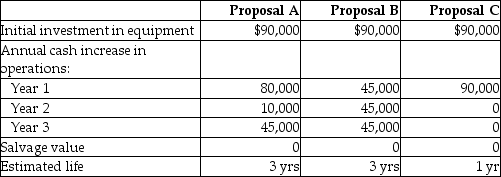 The company uses straight-line depreciation for all capital assets.
Required:
a.Compute the payback period, net present value, and accrual accounting rate of return with initial investment, for each proposal. Use a required rate of return of 14%.
b.Rank each proposal 1, 2, and 3 using each method separately. Which proposal is best? Why?
The company uses straight-line depreciation for all capital assets.
Required:
a.Compute the payback period, net present value, and accrual accounting rate of return with initial investment, for each proposal. Use a required rate of return of 14%.
b.Rank each proposal 1, 2, and 3 using each method separately. Which proposal is best? Why? (Essay)
4.8/5 (94)
(94) Which of the following methods is described as follows: "It calculates the expected monetary gain or loss from a project by discounting all expected future cash inflows and outflows to the present point in time using the required rate of return"?
(Multiple Choice)
4.8/5 (83)
(83) 
Filters
- Essay(0)
- Multiple Choice(0)
- Short Answer(0)
- True False(0)
- Matching(0)