



 Chat with AI
Exam 21: Capital Budgeting and Cost Analysis

Exam 1: The Manager and Management Accounting195 Questions
Exam 2: An Introduction to Cost Terms and Purposes224 Questions
Exam 3: Cost-Volume-Profit Analysis211 Questions
Exam 4: Job Costing203 Questions
Exam 5: Activity-Based Costing and Activity-Based Management176 Questions
Exam 6: Master Budget and Responsibility Accounting226 Questions
Exam 7: Flexible Budgets, Direct-Cost Variances, and Management Control181 Questions
Exam 8: Flexible Budgets, Overhead Cost Variances, and Management Control176 Questions
Exam 9: Inventory Costing and Capacity Analysis210 Questions
Exam 10: Determining How Costs Behave192 Questions
Exam 11: Decision Making and Relevant Information218 Questions
Exam 12: Strategy, Balanced Scorecard, and Strategic Profitability Analysis172 Questions
Exam 13: Pricing Decisions and Cost Management210 Questions
Exam 14: Cost Allocation, Customer-Profitability Analysis, and Sales-Variance Analysis167 Questions
Exam 15: Allocation of Support-Department Costs, Common Costs, and Revenues150 Questions
Exam 16: Cost Allocation: Joint Products and Byproducts151 Questions
Exam 17: Process Costing149 Questions
Exam 18: Spoilage, Rework, and Scrap153 Questions
Exam 19: Balanced Scorecard: Quality and Time150 Questions
Exam 20: Inventory Management, Just-in-Time, and Simplified Costing Methods150 Questions
Exam 21: Capital Budgeting and Cost Analysis151 Questions
Exam 22: Management Control Systems, Transfer Pricing, and Multinational Considerations151 Questions
Exam 23: Performance Measurement, Compensation, and Multinational Considerations150 Questions
Select questions type


The three common discounted cash flow methods are net present value, internal rate of return, and payback.
(True/False)
4.8/5  (83)
(83) Forise Water Company drills small commercial water wells. The company is in the process of analyzing the purchase of a new drill. Information on the proposal is provided below.
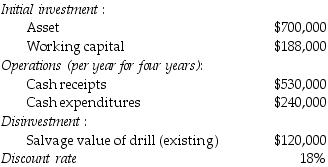 What is the net present value of the investment? Assume there is no recovery of working capital.
 (Multiple Choice)
4.8/5 (87)
(87) The Comil Corporation recently purchased a new machine for its factory operations at a cost of $328,325. The investment is expected to generate $115,000 in annual cash flows for a period of four years. The required rate of return is 13%. The old machine has a remaining life of four years. The new machine is expected to have zero value at the end of the four-year period. The disposal value of the old machine at the time of replacement is zero. What is the internal rate of return?
(Multiple Choice)
4.8/5 (60)
(60) In the net present value (NPV) method, pre-tax cash flows should be used instead of after-tax cash flows.
(True/False)
4.8/5 (77)
(77) The minimum annual acceptable rate of return on an investment is the ________.
(Multiple Choice)
4.9/5 (77)
(77) An example of a sunk cost in a capital budgeting decision for new equipment is ________.
(Multiple Choice)
4.8/5 (71)
(71) Upon which of the following items does discounted cash flow methods for capital budgeting focus?
(Multiple Choice)
4.7/5 (90)
(90) The accrual accounting rate-of-return method is similar to the internal rate-of-return method because both methods calculate a rate-of-return percentage.
(True/False)
4.8/5 (78)
(78) Unlike the payback method, which ignores cash flows after the payback period, the AARR method considers income earned throughout a project's expected useful life.
(True/False)
4.8/5 (73)
(73) Concose Park Department is considering a new capital investment. The cost of the machine is $280,000. The annual cost savings if the new machine is acquired will be $165,000. The machine will have a 3-year life and the terminal disposal value is expected to be $35,000. There are no tax consequences related to this decision. If Concose Park Department has a required rate of return of 14%, which of the following is closest to the present value of the project?
(Multiple Choice)
4.9/5 (84)
(84) As cash flows and time value of money are central to capital budgeting decisions, the AARR method is regarded as better than the IRR method.
(True/False)
4.9/5 (85)
(85) The relevant terminal disposal price of a machine equals the ________.
(Multiple Choice)
4.8/5 (70)
(70) What are the strengths and weaknesses of the accrual accounting rate-of-return (AARR) method for evaluating long-term projects?
(Essay)
4.7/5 (84)
(84) The net present value (NPV) method calculates the expected monetary gain or loss from a project by discounting all expected future cash inflows and outflows back to the present point in time using the required rate of return.
(True/False)
4.7/5 (74)
(74) The net present value method assumes that project cash flows can be reinvested at the company's ________.
(Multiple Choice)
4.9/5 (68)
(68) Which of the following is a stage of the capital budgeting process in which a firm obtains funding for the project?
(Multiple Choice)
4.9/5 (85)
(85) Which of the following projects is rejected on the basis of net present value method?
(Multiple Choice)
4.9/5 (73)
(73) 
Filters
- Essay(0)
- Multiple Choice(0)
- Short Answer(0)
- True False(0)
- Matching(0)