



 Chat with AI
Exam 18: Spoilage, Rework, and Scrap

Exam 1: The Manager and Management Accounting195 Questions
Exam 2: An Introduction to Cost Terms and Purposes224 Questions
Exam 3: Cost-Volume-Profit Analysis211 Questions
Exam 4: Job Costing203 Questions
Exam 5: Activity-Based Costing and Activity-Based Management176 Questions
Exam 6: Master Budget and Responsibility Accounting226 Questions
Exam 7: Flexible Budgets, Direct-Cost Variances, and Management Control181 Questions
Exam 8: Flexible Budgets, Overhead Cost Variances, and Management Control176 Questions
Exam 9: Inventory Costing and Capacity Analysis210 Questions
Exam 10: Determining How Costs Behave192 Questions
Exam 11: Decision Making and Relevant Information218 Questions
Exam 12: Strategy, Balanced Scorecard, and Strategic Profitability Analysis172 Questions
Exam 13: Pricing Decisions and Cost Management210 Questions
Exam 14: Cost Allocation, Customer-Profitability Analysis, and Sales-Variance Analysis167 Questions
Exam 15: Allocation of Support-Department Costs, Common Costs, and Revenues150 Questions
Exam 16: Cost Allocation: Joint Products and Byproducts151 Questions
Exam 17: Process Costing149 Questions
Exam 18: Spoilage, Rework, and Scrap153 Questions
Exam 19: Balanced Scorecard: Quality and Time150 Questions
Exam 20: Inventory Management, Just-in-Time, and Simplified Costing Methods150 Questions
Exam 21: Capital Budgeting and Cost Analysis151 Questions
Exam 22: Management Control Systems, Transfer Pricing, and Multinational Considerations151 Questions
Exam 23: Performance Measurement, Compensation, and Multinational Considerations150 Questions
Select questions type


What is the advantage and disadvantage of early inspections?

Free
(Essay)
4.7/5  (91)
(91) Correct Answer: Verified
Early inspections can help prevent any further costs being wasted on units that are already
spoiled. But conducting inspections at too early stages can result in instances of spoiled units may go undetected at later stages of the process.
Which of the following entries is correct when the costs of the rework is normal and common to all the jobs?
Free
(Multiple Choice)
4.8/5 (75)
(75) Correct Answer:Verified
VerifiedA
Abnormal spoilage is spoilage inherent in a particular production process.
Free
(True/False)
4.7/5 (83)
(83) Correct Answer:Verified
VerifiedFalse
Which of the following is true of unit costs of normal and abnormal spoilage when they are detected at the same inspection point?
(Multiple Choice)
4.8/5 (73)
(73) Scrap and rework are considered to be the same thing by managerial accountants.
(True/False)
4.9/5 (87)
(87) Outose Concept manufactures small tables in its Processing Department. Direct materials are added at the initiation of the production cycle and must be bundled in single kits for each unit. Conversion costs are incurred evenly throughout the production cycle. Before inspection, some units are spoiled due to undetectable materials defects. Spoiled units generally constitute 5% of the good units. Data for December 2017 are as follows:
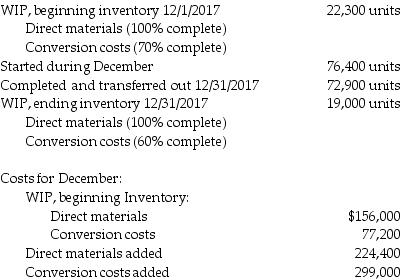 What cost is allocated to abnormal spoilage using the weighted-average process-costing method? (Round any cost per unit calculations to the nearest cent.)
 (Multiple Choice)
4.9/5 (73)
(73) How can a company account for scrap? Include in your explanation a discussion of the two aspects of accounting for scrap.
(Essay)
4.9/5 (95)
(95) When spoiled goods have a disposal value, the net cost of the spoilage is computed by ________.
(Multiple Choice)
4.8/5 (89)
(89) When a unit has to be reworked, the rework may be classified in three ways. What are those ways, and how does the accounting for each differ?
(Essay)
4.9/5 (90)
(90) The Peric Manufacturing Shop produces motorcycle parts. Typically, 22 pieces out of a job lot of 1800 parts are spoiled. Spoilage is considered a normal part of Peric's production process. Costs are assigned at the inspection point, $52.00 per unit. Spoiled pieces may be disposed at $16.00 per unit. The spoiled goods must be inventoried appropriately when the normal spoilage is detected. The current job requires the production of 3600 good parts.
Which of the following journal entries properly reflects the recording of spoiled goods?
(Multiple Choice)
4.8/5 (84)
(84) Outose Concept manufactures small tables in its Processing Department. Direct materials are added at the initiation of the production cycle and must be bundled in single kits for each unit. Conversion costs are incurred evenly throughout the production cycle. Before inspection, some units are spoiled due to undetectable materials defects. Spoiled units generally constitute 3% of the good units. Data for December 2017 are as follows:
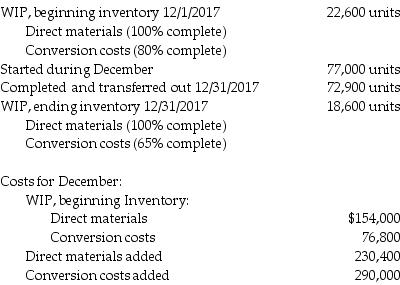 Abnormal spoilage totals ________.
 (Multiple Choice)
4.9/5 (84)
(84) Which of the following is true of the calculation of the cost per good unit (a unit that is completed and transferred out) under the weighted-average process costing method?
(Multiple Choice)
5.0/5 (81)
(81) Colil Computer Systems, Inc., manufactures printer circuit cards. All direct materials are added at the inception of the production process. During January, the accounting department noted that there was no beginning inventory. Direct materials of $301,000 were used in production during the month. Work-in-process records revealed that 12,000 card units were started in January, 6000 card units were complete, and 4000 card units were spoiled as expected. Ending work-in-process card units are complete in respect to direct materials costs. Spoilage is not detected until the process is complete.
What is the direct material cost assigned to good units completed? (Please round interim calculations to the nearest cent, and final calculations to the nearest whole dollar.)
(Multiple Choice)
4.8/5 (86)
(86) Maxire Shoes manufactures shoes. All direct materials are included at the inception of the production process. For March, there were 2,800 units in beginning inventory with a direct material cost of $1,400. Direct materials totaled $35,000 for the month. Work-in-process records revealed that 70,000 units were started in March and that 60,000 were finished. When March ended there were 12,800 units in work-in-process. Normal spoilage of 2% of units finished was incurred. Ending work-in-process units are complete in respect to direct materials costs. Spoilage is not detected until the process is complete. Endicott uses the weighted-average method.
Required:
a.What are the direct materials costs assigned to completed good units?
b.What are the direct material amounts allocated to the work-in-process ending inventory?
(Essay)
4.7/5 (73)
(73) If scrap is returned to the company's storeroom and inventoried, it should NOT have any value in the accounting records.
(True/False)
4.7/5 (79)
(79) Verer Custom Carpentry manufactures chairs in its Processing Department. Direct materials are included at the inception of the production cycle and must be bundled in single kits for each unit. Conversion costs are incurred evenly throughout the production cycle. Inspection takes place as units are placed into production. After inspection, some units are spoiled due to undetectable material defects. Spoiled units generally constitute 5% of the good units. Data provided for March 2017 are as follows:
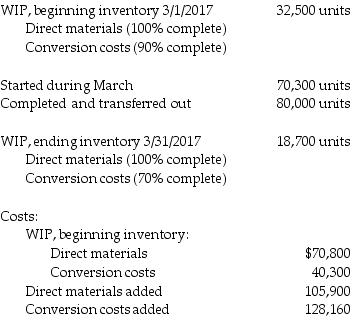 What costs are allocated to the ending work-in-process inventory for direct materials and conversion costs, respectively, using the FIFO method of process costing? (Round any cost per unit calculations to the nearest cent.)
 (Multiple Choice)
5.0/5 (85)
(85) Spoilage is typically assumed to occur at the stage of completion where inspection takes place.
(True/False)
4.9/5 (81)
(81) 
Filters
- Essay(0)
- Multiple Choice(0)
- Short Answer(0)
- True False(0)
- Matching(0)