



 Chat with AI
Exam 18: Spoilage, Rework, and Scrap

Exam 1: The Manager and Management Accounting195 Questions
Exam 2: An Introduction to Cost Terms and Purposes224 Questions
Exam 3: Cost-Volume-Profit Analysis211 Questions
Exam 4: Job Costing203 Questions
Exam 5: Activity-Based Costing and Activity-Based Management176 Questions
Exam 6: Master Budget and Responsibility Accounting226 Questions
Exam 7: Flexible Budgets, Direct-Cost Variances, and Management Control181 Questions
Exam 8: Flexible Budgets, Overhead Cost Variances, and Management Control176 Questions
Exam 9: Inventory Costing and Capacity Analysis210 Questions
Exam 10: Determining How Costs Behave192 Questions
Exam 11: Decision Making and Relevant Information218 Questions
Exam 12: Strategy, Balanced Scorecard, and Strategic Profitability Analysis172 Questions
Exam 13: Pricing Decisions and Cost Management210 Questions
Exam 14: Cost Allocation, Customer-Profitability Analysis, and Sales-Variance Analysis167 Questions
Exam 15: Allocation of Support-Department Costs, Common Costs, and Revenues150 Questions
Exam 16: Cost Allocation: Joint Products and Byproducts151 Questions
Exam 17: Process Costing149 Questions
Exam 18: Spoilage, Rework, and Scrap153 Questions
Exam 19: Balanced Scorecard: Quality and Time150 Questions
Exam 20: Inventory Management, Just-in-Time, and Simplified Costing Methods150 Questions
Exam 21: Capital Budgeting and Cost Analysis151 Questions
Exam 22: Management Control Systems, Transfer Pricing, and Multinational Considerations151 Questions
Exam 23: Performance Measurement, Compensation, and Multinational Considerations150 Questions
Select questions type


Dynalia Florists operate a flower shop. Because most of their orders are via telephone or fax, numerous orders have to be reworked. The average cost of the reworked orders is $5.25: $3.50 for labor, $1.25 for more flowers, and $0.50 for overhead. This ratio of costs holds for the average original order. On a recent day, the shop reworked 40 orders out of 250. The original cost of the 40 orders totaled $700. The average cost of all orders is $18.34, including rework, with an average selling price of $25.
Required:
Prepare the necessary journal entry to record the rework for the day if the shop charges such activities to Arrangement Department Overhead Control. Prepare a journal entry to transfer the finished goods to Finished Goods Inventory.
(Essay)
4.9/5  (79)
(79) Outose Concept manufactures small tables in its Processing Department. Direct materials are added at the initiation of the production cycle and must be bundled in single kits for each unit. Conversion costs are incurred evenly throughout the production cycle. Before inspection, some units are spoiled due to undetectable materials defects. Spoiled units generally constitute 4% of the good units. Data for December 2017 are as follows:
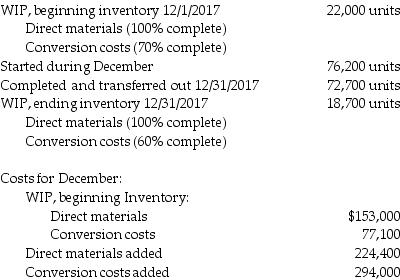 Normal spoilage totals ________.
 (Multiple Choice)
4.8/5 (74)
(74) Units spoiled due to machine breakdowns and operator errors are normal spoilage.
(True/False)
4.9/5 (90)
(90) Costs of abnormal spoilage are separately accounted for as losses of the period.
(True/False)
4.8/5 (90)
(90) Which of the following statements is true of normal spoilage?
(Multiple Choice)
4.7/5 (83)
(83) To simplify calculations under FIFO, spoiled units are accounted for as if they were started in the current period.
(True/False)
4.8/5 (92)
(92) Costs of abnormal spoilage are considered inventoriable and are written off as a period expense.
(True/False)
4.8/5 (91)
(91) Springfield Sign Shop manufactures only specific orders. It uses a standard cost system. During one large order for the airport authority, an unusual number of signs were spoiled. The normal spoilage rate is 10% of units started. The point of first inspection is half way through the process, the second is three-fourths through the process, and the final inspection is at the end of the process. Other information about the job is as follows:
Signs started3,000
Signs spoiled450
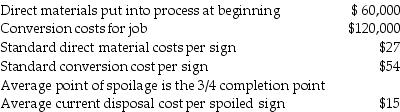 Required:
Make necessary journal entries to record all spoilage.
Required:
Make necessary journal entries to record all spoilage. (Essay)
4.8/5 (74)
(74) Colil Computer Systems, Inc., manufactures printer circuit cards. All direct materials are added at the inception of the production process. During January, the accounting department noted that there was no beginning inventory. Direct materials of $301,000 were used during the month. Work-in-process records revealed that 11,000 card units were started in January, 5500 card units were complete, and 5400 card units were spoiled as expected. Ending work-in-process card units are complete in respect to direct materials costs. Spoilage is not detected until the process is complete.
What is the amount allocated to the work-in-process ending inventory? (Round any cost per unit calculations to the nearest cent.)
(Multiple Choice)
4.8/5 (71)
(71) The first step in the five-step procedure for process costing with spoilage is to compute the output in terms of equivalent units.
(True/False)
4.9/5 (74)
(74) Reworked goods are unacceptable units of production usually NOT capable of being repaired or converted into a salable product.
(True/False)
4.7/5 (86)
(86) The downside to conducting inspections at too early a stage is that units spoiled at later stages of the process may go undetected.
(True/False)
4.9/5 (74)
(74) Identify the appropriate order of the following steps in the procedure for process costing with spoilage.
a.summarize total costs to account for
b.assign total costs to units completed, to spoiled units, and to units in ending inventory
c.summarize the flow of physical units
d.compute output in terms of equivalent units
e.compute cost per equivalent unit
Step 1 ________
Step 2 ________
Step 3 ________
Step 4 ________
Step 5 ________
(Essay)
4.9/5 (80)
(80) Costs of abnormal spoilage are usually accounted for as ________.
(Multiple Choice)
4.9/5 (89)
(89) When assigning costs, job-costing systems generally distinguish normal spoilage attributable to a specific job from normal spoilage common to all jobs.
(True/False)
4.9/5 (73)
(73) 
Filters
- Essay(0)
- Multiple Choice(0)
- Short Answer(0)
- True False(0)
- Matching(0)