



 Chat with AI
Exam 18: Spoilage, Rework, and Scrap

Exam 1: The Manager and Management Accounting195 Questions
Exam 2: An Introduction to Cost Terms and Purposes224 Questions
Exam 3: Cost-Volume-Profit Analysis211 Questions
Exam 4: Job Costing203 Questions
Exam 5: Activity-Based Costing and Activity-Based Management176 Questions
Exam 6: Master Budget and Responsibility Accounting226 Questions
Exam 7: Flexible Budgets, Direct-Cost Variances, and Management Control181 Questions
Exam 8: Flexible Budgets, Overhead Cost Variances, and Management Control176 Questions
Exam 9: Inventory Costing and Capacity Analysis210 Questions
Exam 10: Determining How Costs Behave192 Questions
Exam 11: Decision Making and Relevant Information218 Questions
Exam 12: Strategy, Balanced Scorecard, and Strategic Profitability Analysis172 Questions
Exam 13: Pricing Decisions and Cost Management210 Questions
Exam 14: Cost Allocation, Customer-Profitability Analysis, and Sales-Variance Analysis167 Questions
Exam 15: Allocation of Support-Department Costs, Common Costs, and Revenues150 Questions
Exam 16: Cost Allocation: Joint Products and Byproducts151 Questions
Exam 17: Process Costing149 Questions
Exam 18: Spoilage, Rework, and Scrap153 Questions
Exam 19: Balanced Scorecard: Quality and Time150 Questions
Exam 20: Inventory Management, Just-in-Time, and Simplified Costing Methods150 Questions
Exam 21: Capital Budgeting and Cost Analysis151 Questions
Exam 22: Management Control Systems, Transfer Pricing, and Multinational Considerations151 Questions
Exam 23: Performance Measurement, Compensation, and Multinational Considerations150 Questions
Select questions type


Samantha's Office Supplies manufactures desk organizers in its Processing Department. Direct materials are included at the inception of the production cycle and must be bundled in single kits for each unit. Conversion costs are incurred evenly throughout the production cycle. Inspection takes place as units are placed into production. After inspection, some units are spoiled due to undetectable material defects. Spoiled units generally constitute 3% of the good units. Data provided for February 2017 are as follows:
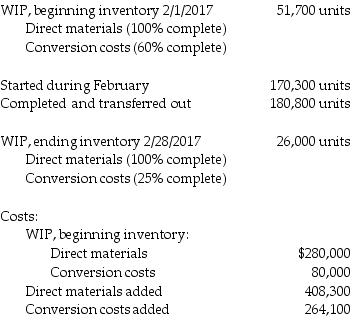 What costs would be associated with normal and abnormal spoilage, respectively, using the FIFO method of process costing? (Round any cost per unit calculations to the nearest cent.)
 (Multiple Choice)
4.8/5  (79)
(79) Colil Computer Systems, Inc., manufactures printer circuit cards. All direct materials are added at the inception of the production process. During January, the accounting department noted that there was no beginning inventory. Direct materials of $310,000 were used during the month. Work-in-process records revealed that 12,000 card units were started in January, 6000 card units were complete, and 4600 card units were spoiled as expected. Ending work-in-process card units are complete in respect to direct materials costs. Spoilage is not detected until the process is complete.
What is the direct material cost per equivalent unit? (Please round the final answer to the nearest cent.)
(Multiple Choice)
4.9/5 (87)
(87) A company produces 11,000 units of which 600 are spoiled units because the process, even though carefully and efficiently executed is unable to produce good units 100% of the time. Another 80 units are spoiled because machines broke down and there also were operator errors. What is the normal spoilage rate (round to two decimal places)
(Multiple Choice)
4.8/5 (85)
(85) A leather shoe manufacturer makes "duck" boots that consist of leather and rubber. Some of the books are defective and are sold in the factory store at deep discounts. Leather strips from the cutting process and rubber shavings are byproducts of the process. The leather strips have no use and are discarded while the rubber scraps are collected and periodically picked up by a recycling company at no cost to the shoe manufacturer. Which of the following classifications of these items would be accurate?
(Multiple Choice)
4.9/5 (91)
(91) Based on the following information from a company's process costing system that is reporting on the month of May's activity in one of its departments, which journal entries would be correct?
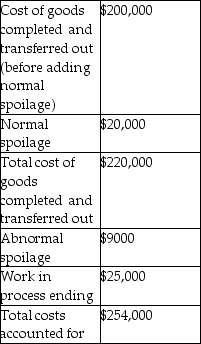
(Multiple Choice)
4.9/5 (91)
(91) The costs of normal spoilage are allocated to the units in ending work-in-process inventory, in addition to completed units if the units ________.
(Multiple Choice)
4.8/5 (72)
(72) Rework is residual material that results from manufacturing a product and can have either a high or low sales value relative to the product with which it is associated.
(True/False)
4.8/5 (72)
(72) Fish Fillet Incorporated obtains fish and then processes them into frozen fillets and then prepares the frozen fish fillets for distribution to its retail sales department. Direct materials are added at the initiation of the cycle. Conversion costs are incurred evenly throughout the production cycle. Before inspection, some fillets are spoiled due to undetectable defects. Inspection occurs when units are 45% converted. Spoiled fillets generally constitute 6% of the good fillets. Data for April 2017 are as follows:
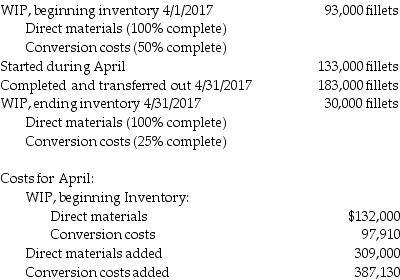 What is the number of total spoiled units?
 (Multiple Choice)
4.9/5 (75)
(75) To recognize the disposal value of normal spoilage, ________.
(Multiple Choice)
4.9/5 (85)
(85) 
Filters
- Essay(0)
- Multiple Choice(0)
- Short Answer(0)
- True False(0)
- Matching(0)