



 Chat with AI
Exam 12: Pricing and Advertising

Exam 1: Introduction43 Questions
Exam 2: Supply and Demand226 Questions
Exam 3: A Consumers Constrained Choice129 Questions
Exam 4: Demand123 Questions
Exam 5: Consumer Welfare and Policy Analysis73 Questions
Exam 6: Firms and Production111 Questions
Exam 7: Costs132 Questions
Exam 8: Competitive Firms and Markets112 Questions
Exam 9: Properties and Applications of the Competitive Model101 Questions
Exam 10: General Equilibrium and Economic Welfare108 Questions
Exam 11: Monopoly and Monopsony141 Questions
Exam 12: Pricing and Advertising91 Questions
Exam 13: Game Theory84 Questions
Exam 14: Oligopoly and Monopolistic Competition114 Questions
Exam 15: Factor Markets115 Questions
Exam 16: Uncertainty103 Questions
Exam 17: Property Rights, externalities, rivalry, and Exclusion105 Questions
Exam 18: Asymmetric Information85 Questions
Exam 19: Contracts and Moral Hazards79 Questions
Select questions type


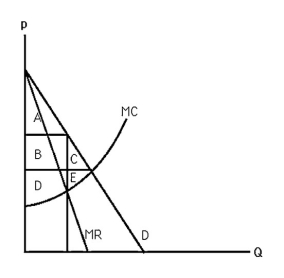 -The above figure shows the market for a particular good.If the market is controlled by a perfect-price-discriminating monopoly,compared to a monopoly who charges a single price,the change in total surplus is
 (Multiple Choice)
5.0/5  (86)
(86) A coffee shop sells a small cup of coffee at $3,while a large cup,which is twice as big,at $5.This is an example of
(Multiple Choice)
4.8/5 (84)
(84) For the following, please answer "True" or "False" and explain why.
-A mail-order clothing company offers a discount if customers purchase two shirts instead of only one.This is necessarily an example of quantity discrimination.
(True/False)
4.8/5 (63)
(63) Many theme parks charge an entrance fee and a per-ride fee equal to zero.This is an example of
(Multiple Choice)
4.8/5 (77)
(77) Consider a monopolist which sells output in two markets,the home market and the foreign market.Initially the monopolist is unable to price discriminate and sets a single price for both markets.However,the demand in the foreign market is such that at the price the monopoly sets,no goods are sold in the foreign market.If the monopolist is then able to price discriminate,will the overall deadweight loss increase or decrease? Explain.
(Essay)
4.8/5 (69)
(69)
-The above figure shows the market for a particular good.If the market is controlled by a perfect-price-discriminating monopoly,producer surplus equals
-The above figure shows the market for a particular good.If the market is controlled by a perfect-price-discriminating monopoly,producer surplus equals (Multiple Choice)
4.8/5 (77)
(77) A perfect-price-discriminating monopoly's marginal revenue curve
(Multiple Choice)
5.0/5 (67)
(67) A monopoly will not be able to perfectly price discriminate if
(Multiple Choice)
4.8/5 (76)
(76) For the following, please answer "True" or "False" and explain why.
-Firms price discriminate to maximize total revenue.
(True/False)
4.8/5 (77)
(77) If somebody posing as a vacationer were able to purchase large numbers of airline tickets from the airlines and later resell them to business travelers,
(Multiple Choice)
4.9/5 (83)
(83) Suppose all individuals are identical,and their monthly demand for Internet access from a certain leading provider can be represented as p = 5 - (1/2)q where p is price in $ per hour and q is hours per month.The firm faces a constant marginal cost of $1.If the firm will charge a monthly access fee plus a per hour rate,the monthly access fee will equal
(Multiple Choice)
4.7/5 (84)
(84) 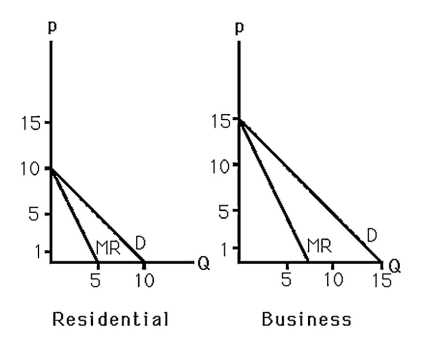 -Bob is the only carpet installer in a small isolated town.The above figure shows the demand curves of two distinct groups of customers-residential and business.Bob is likely to price discriminate because
 (Multiple Choice)
4.8/5 (83)
(83) Suppose there are two types of consumers with two different demand curves,and the marginal cost of the monopoly is $10.What could be the possible price under two-part pricing that will maximize the monopoly profit?
(Multiple Choice)
4.7/5 (80)
(80) At the current price of a good,Al's consumer surplus equals 15,and Ben's consumer surplus equals 15.By charging a two-part tariff,a monopolist could increase his profit by
(Multiple Choice)
4.9/5 (75)
(75) Relative to a single-price monopoly,the effect of group price discrimination on social welfare is
(Multiple Choice)
4.8/5 (71)
(71) An electric utility is going to use a block-pricing schedule.They plan to charge P₁ for the first Q₁ units and P₂ for the subsequent units.The units sold at P₂ are the total units sold,Q₂,minus the total units sold at P₁.The inverse demand curve is P = $100 - Q,and the marginal and average cost is $40.Use calculus to solve for P₁,P₂,Q₁,Q₂.
(Essay)
5.0/5 (79)
(79) A group price discriminator sells its product in Florida for three times the price it sets in New York.Assuming the firm faces the same constant marginal cost in each market and the price elasticity of demand in New York is -2.0,the demand in Florida
(Multiple Choice)
4.9/5 (61)
(61) Which of the following sellers is most able to perfectly price discriminate?
(Multiple Choice)
4.8/5 (67)
(67) For the following, please answer "True" or "False" and explain why.
-When a firm uses a form of quantity discrimination it is the high quantity purchasers that generate most profit.
(True/False)
4.9/5 (68)
(68) 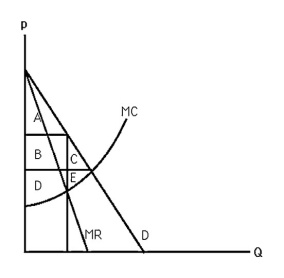 -The above figure shows the market for a given product.Defining welfare as consumer surplus plus producer surplus,calculate the social welfare associated with perfect competition,single-price monopoly,and a perfect-price-discriminating monopoly.Which market structure(s)maximize social welfare?
 (Essay)
4.7/5 (80)
(80) 
Filters
- Essay(0)
- Multiple Choice(0)
- Short Answer(0)
- True False(0)
- Matching(0)