



 Chat with AI
Exam 9: Inventory Costing and Capacity Analysis

Exam 1: The Manager and Management Accounting195 Questions
Exam 2: An Introduction to Cost Terms and Purposes224 Questions
Exam 3: Cost-Volume-Profit Analysis211 Questions
Exam 4: Job Costing203 Questions
Exam 5: Activity-Based Costing and Activity-Based Management176 Questions
Exam 6: Master Budget and Responsibility Accounting226 Questions
Exam 7: Flexible Budgets, Direct-Cost Variances, and Management Control181 Questions
Exam 8: Flexible Budgets, Overhead Cost Variances, and Management Control176 Questions
Exam 9: Inventory Costing and Capacity Analysis210 Questions
Exam 10: Determining How Costs Behave192 Questions
Exam 11: Decision Making and Relevant Information218 Questions
Exam 12: Strategy, Balanced Scorecard, and Strategic Profitability Analysis172 Questions
Exam 13: Pricing Decisions and Cost Management210 Questions
Exam 14: Cost Allocation, Customer-Profitability Analysis, and Sales-Variance Analysis167 Questions
Exam 15: Allocation of Support-Department Costs, Common Costs, and Revenues150 Questions
Exam 16: Cost Allocation: Joint Products and Byproducts151 Questions
Exam 17: Process Costing149 Questions
Exam 18: Spoilage, Rework, and Scrap153 Questions
Exam 19: Balanced Scorecard: Quality and Time150 Questions
Exam 20: Inventory Management, Just-in-Time, and Simplified Costing Methods150 Questions
Exam 21: Capital Budgeting and Cost Analysis151 Questions
Exam 22: Management Control Systems, Transfer Pricing, and Multinational Considerations151 Questions
Exam 23: Performance Measurement, Compensation, and Multinational Considerations150 Questions
Select questions type


Beginning inventory + cost of goods manufactured = Cost of goods sold + Ending inventory.
(True/False)
4.9/5  (74)
(74) Absorption costing is also referred to as super-variable costing.
(True/False)
4.9/5 (75)
(75) The use of theoretical capacity results in an unrealistically low fixed manufacturing cost per unit because it is based on ________.
(Multiple Choice)
4.9/5 (87)
(87) Jarvis Golf Company sells a special putter for $20 each. In March, it sold 28,000 putters while manufacturing 30,000. There was no beginning inventory on March 1. Production information for March was:
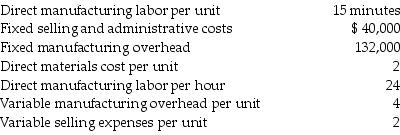 Required:
a.Compute the cost per unit under both absorption and variable costing.
b.Compute the ending inventories under both absorption and variable costing.
c.Compute operating income under both absorption and variable costing.
Required:
a.Compute the cost per unit under both absorption and variable costing.
b.Compute the ending inventories under both absorption and variable costing.
c.Compute operating income under both absorption and variable costing. (Essay)
4.9/5 (81)
(81) Should a company with high fixed costs and unused capacity raise selling prices to try to fully recoup its costs?
(Essay)
4.9/5 (91)
(91) Ways to "produce for inventory" that result in increasing operating income include ________.
(Multiple Choice)
4.9/5 (74)
(74) Which of the following measures capacity levels in terms of demand for the output of the plant?
(Multiple Choice)
4.9/5 (90)
(90) Which of the following capacity levels should a company choose, from a long-run product costing perspective, to allocate budgeted fixed manufacturing costs to products?
(Multiple Choice)
5.0/5 (87)
(87) Glossier Images Inc., produces decorative statues. Management has provided the following information:
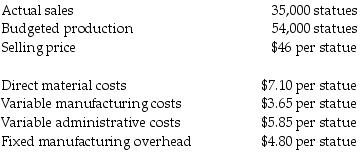 What is the total throughput contribution?
 (Multiple Choice)
4.9/5 (91)
(91) Freetown Corporation incurred fixed manufacturing costs of $26,000 during 2017. Other information for 2017 includes:
The budgeted denominator level is 2,600 units.
Units produced total 1,800 units.
Units sold total 1,200 units.
Beginning inventory was zero.
The company uses absorption costing and the fixed manufacturing cost rate is based on the budgeted denominator level. Manufacturing variances are closed to cost of goods sold.
The production-volume variance is ________. (Round any intermediary calculations to the nearest cent and your final answer to the nearest dollar.)
(Multiple Choice)
5.0/5 (85)
(85) Usually there is no production-volume variance when normal capacity utilization is used as the denominator level.
(True/False)
4.9/5 (87)
(87) Yellow Mountain Manufacturing factors practical capacity as a denominator to calculate budgeted fixed overhead. Theoretical capacity is 12,000 units per year with practical capacity of 9,000 units per year. Budgeted fixed overhead costs were $690,000 and actual overhead costs were $730,000 with actual output of 8,000 units. Which of the following statements is true?
(Multiple Choice)
4.8/5 (71)
(71) What is throughput costing? What advantages does it have over variable and absorption costing?
(Essay)
4.9/5 (76)
(76) Practical capacity rather than master-budget volume is a better way to price product and avoid downward demand spiral.
(True/False)
5.0/5 (77)
(77) Henry Chapman Manufacturing Inc. incurred the following expenses during 2017:
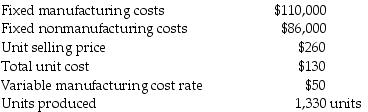 What will be the breakeven point in units if absorption costing is used? (Round your final answer up to the next whole unit.)
 (Multiple Choice)
4.8/5 (65)
(65) Jean Peck's Furniture manufactures tables for hospitality sector. It takes only bulk orders and each table is sold for $400 after negotiations. In the month of January, it manufactures 3,200 tables and sells 2,400 tables. Actual fixed costs are the same as the amount of fixed costs budgeted for the month.
The following information is provided for the month of January:
 At the end of the month Jean Peck's Furniture has an ending inventory of finished goods of 800 units. The company also incurs a sales commission of $11 per unit.
What is the cost of goods sold per unit when using absorption costing?
At the end of the month Jean Peck's Furniture has an ending inventory of finished goods of 800 units. The company also incurs a sales commission of $11 per unit.
What is the cost of goods sold per unit when using absorption costing? (Multiple Choice)
4.9/5 (79)
(79) Jupiter Corporation incurred fixed manufacturing costs of $18,000 during 2017. Other information for 2017 includes:
The budgeted denominator level is 2,400 units.
Units produced total 2,700 units.
Units sold total 1,900 units.
Variable cost per unit is $4
Beginning inventory is zero.
The fixed manufacturing cost rate is based on the budgeted denominator level.
Under absorption costing, total manufacturing costs expensed on the income statement (excluding adjustments for variances) total ________. (Round any intermediary calculations to the nearest cent and your final answer to the nearest dollar.)
(Multiple Choice)
4.8/5 (91)
(91) Hyland Resources Inc. uses practical capacity as the denominator to set the cost of supplying capacity and for the current period the budgeted cost per unit of supplying capacity was $44. Practical capacity was set at 14,000 units with theoretical capacity at 20,000 units. During the period, only 11,000 units were produced while the master budget assumed that the company would produce 13,000 units. What is value of the manufacturing resources not used during the period?
(Multiple Choice)
4.8/5 (79)
(79) When production is less than sales, operating income will be the same regardless of whether variable cost or absorption costing is used.
(True/False)
4.8/5 (64)
(64) 
Filters
- Essay(0)
- Multiple Choice(0)
- Short Answer(0)
- True False(0)
- Matching(0)