



 Chat with AI
Exam 4: Job Costing

Exam 1: The Manager and Management Accounting195 Questions
Exam 2: An Introduction to Cost Terms and Purposes224 Questions
Exam 3: Cost-Volume-Profit Analysis211 Questions
Exam 4: Job Costing203 Questions
Exam 5: Activity-Based Costing and Activity-Based Management176 Questions
Exam 6: Master Budget and Responsibility Accounting226 Questions
Exam 7: Flexible Budgets, Direct-Cost Variances, and Management Control181 Questions
Exam 8: Flexible Budgets, Overhead Cost Variances, and Management Control176 Questions
Exam 9: Inventory Costing and Capacity Analysis210 Questions
Exam 10: Determining How Costs Behave192 Questions
Exam 11: Decision Making and Relevant Information218 Questions
Exam 12: Strategy, Balanced Scorecard, and Strategic Profitability Analysis172 Questions
Exam 13: Pricing Decisions and Cost Management210 Questions
Exam 14: Cost Allocation, Customer-Profitability Analysis, and Sales-Variance Analysis167 Questions
Exam 15: Allocation of Support-Department Costs, Common Costs, and Revenues150 Questions
Exam 16: Cost Allocation: Joint Products and Byproducts151 Questions
Exam 17: Process Costing149 Questions
Exam 18: Spoilage, Rework, and Scrap153 Questions
Exam 19: Balanced Scorecard: Quality and Time150 Questions
Exam 20: Inventory Management, Just-in-Time, and Simplified Costing Methods150 Questions
Exam 21: Capital Budgeting and Cost Analysis151 Questions
Exam 22: Management Control Systems, Transfer Pricing, and Multinational Considerations151 Questions
Exam 23: Performance Measurement, Compensation, and Multinational Considerations150 Questions
Select questions type


Benny Industries allocates manufacturing overhead at a predetermined rate of 160% of direct labor cost. Any overallocated or underallocated overhead is closed to the cost of goods sold at the end of the month. Below is information on job 205 that was in process at the end of the month of October
Direct materials $4,000
Direct labor $3,000
Allocated manufacturing overhead $4,800
Jobs 206, 207, and 208 were started in November. Direct materials that were used in November were $26,000 and direct labor costs were $21,000. For the month of November, actual manufacturing overhead was $32,000. The only job still in process on the last day of November was job 104 with the following costs: $3,000 for direct materials and $1,500 for direct labor.
Required:
Calculate the cost of goods manufacturered for November.
(Essay)
4.9/5  (81)
(81) Indirect manufacturing costs should be allocated equally to each job.
(True/False)
4.9/5 (85)
(85) Which of the following includes both traced direct costs and allocated indirect costs?
(Multiple Choice)
4.9/5 (82)
(82) Overhead costs allocated each month are expected to equal actual overhead costs incurred each month.
(True/False)
5.0/5 (77)
(77) Global Manufacturing Inc. uses normal costing during the year to allocate manufacturing overhead to jobs in a job costing system. At year end, it uses the adjusted allocation rate approach to account for underallocated or overallocated overhead. During 2018, Global's manufacturing overhead was underallocated by 10%. Job 117 had the following costs:
Direct materials $1,600
Direct labor $3,400
Manufacturing overhead allocated $2,000
Which of the following would be the after adjustment cost of Job 117?
(Multiple Choice)
4.9/5 (68)
(68) Candle Corp. applies manufacturing overhead costs to products at a budgeted indirect-cost rate of $80 per direct manufacturing labor-hour. A retail outlet has requested a bid on a special order of a necklace. Estimates for this order include: Direct materials of $44,000; 300 direct manufacturing labor-hours at $25 per hour; and a 20% markup rate on total manufacturing costs.
The bid price for this special order is ________.
(Multiple Choice)
4.8/5 (79)
(79) In a job-costing system the cost object is an individual unit, batch, or lot of a distinct product or service.
(True/False)
4.8/5 (81)
(81) Which of the following is true of the Work-in-Process Control account?
(Multiple Choice)
4.8/5 (83)
(83) Bauer Manufacturing uses departmental cost driver rates to allocate manufacturing overhead costs to products. Manufacturing overhead costs are allocated on the basis of machine-hours in the Machining Department and on the basis of direct labor-hours in the Assembly Department. At the beginning of 2018, the following estimates were provided for the coming year:
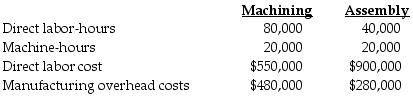 The accounting records of the company show the following data for Job #316:
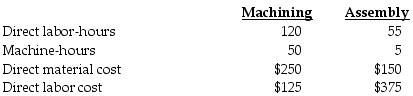 What are the total manufacturing costs of Job #316?
The accounting records of the company show the following data for Job #316:
What are the total manufacturing costs of Job #316? (Multiple Choice)
4.9/5 (72)
(72) The ending balance in Work-in-Process Control represents the total costs of all jobs that have NOT yet been completed.
(True/False)
4.9/5 (88)
(88) A company would use multiple cost-allocation bases ________.
(Multiple Choice)
4.9/5 (65)
(65) The budgeted indirect cost rate is actual indirect costs divided by budgeted quantity of the cost allocation base.
(True/False)
4.9/5 (84)
(84) River Falls Manufacturing uses a normal cost system and had the following data available for 2018:
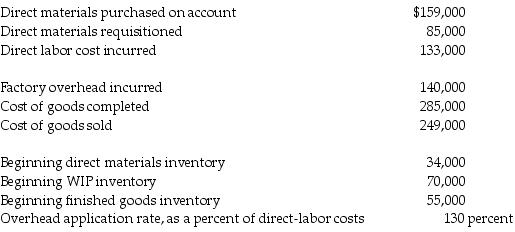 The ending balance of direct materials inventory is ________.
 (Multiple Choice)
4.8/5 (82)
(82) A local engineering firm is bidding on a design project for a new client. The total budgeted direct-labor costs for the firm are $400,000. The total budgeted indirect costs are $600,000. It is estimated that there are 8,000 billable hours in total.
Required:
a.What is the budgeted direct-labor cost rate?
b.What is the budgeted indirect-cost rate assuming direct-labor cost is the allocation base?
c.What should be the engineering firm bid on the project if the direct labor hours are estimated at 300 hours?
(Essay)
4.9/5 (77)
(77) Innovative Metal Products Company manufactures pipes and applies manufacturing costs to production at a budgeted indirect-cost rate of $12 per direct labor-hour. The following data are obtained from the accounting records for June 2018:
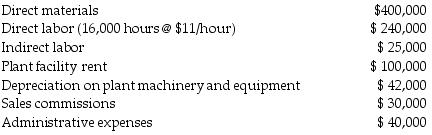 Required:
a.What actual amount of manufacturing overhead costs was incurred during June 2018?
b.What amount of manufacturing overhead was allocated to all jobs during June 2018?
c.For June 2018, was manufacturing overhead underallocated or overallocated? Explain.
Required:
a.What actual amount of manufacturing overhead costs was incurred during June 2018?
b.What amount of manufacturing overhead was allocated to all jobs during June 2018?
c.For June 2018, was manufacturing overhead underallocated or overallocated? Explain. (Essay)
4.9/5 (87)
(87) Apple Valley Corporation uses a job cost system and has two production departments, A and B. Budgeted manufacturing costs for the year are:
 The actual material and labor costs charged to Job #432 were as follows:
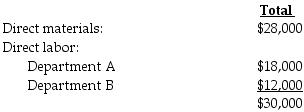 Apple Valley applies manufacturing overhead costs to jobs on the basis of direct manufacturing labor cost using departmental rates determined at the beginning of the year.
Manufacturing overhead costs allocated to Job #432 total ________.
The actual material and labor costs charged to Job #432 were as follows:
Apple Valley applies manufacturing overhead costs to jobs on the basis of direct manufacturing labor cost using departmental rates determined at the beginning of the year.
Manufacturing overhead costs allocated to Job #432 total ________. (Multiple Choice)
4.9/5 (96)
(96) Filippucci Company used a budgeted indirect-cost rate for its manufacturing operations, the amount allocated ($200,000) is different from the actual amount incurred ($225,000).
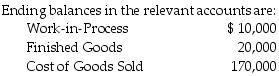 -Under the writeoff approach, the difference between Manufacturing Overhead Control and Manufacturing Overhead Allocated is adjusted in the ________.
 (Multiple Choice)
4.8/5 (87)
(87) Bauer Manufacturing uses departmental cost driver rates to allocate manufacturing overhead costs to products. Manufacturing overhead costs are allocated on the basis of machine-hours in the Machining Department and on the basis of direct labor-hours in the Assembly Department. At the beginning of 2018, the following estimates were provided for the coming year:
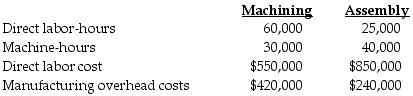 The accounting records of the company show the following data for Job #316:
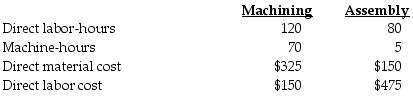 What amount of manufacturing overhead costs will be allocated to Job #316?
The accounting records of the company show the following data for Job #316:
What amount of manufacturing overhead costs will be allocated to Job #316? (Multiple Choice)
4.7/5 (85)
(85) The sum of all entries in underlying subsidiary ledgers equals the total amount in the corresponding general ledger control accounts.
(True/False)
4.7/5 (84)
(84) 
Filters
- Essay(0)
- Multiple Choice(0)
- Short Answer(0)
- True False(0)
- Matching(0)