



 Chat with AI
Exam 4: Job Costing

Exam 1: The Manager and Management Accounting195 Questions
Exam 2: An Introduction to Cost Terms and Purposes224 Questions
Exam 3: Cost-Volume-Profit Analysis211 Questions
Exam 4: Job Costing203 Questions
Exam 5: Activity-Based Costing and Activity-Based Management176 Questions
Exam 6: Master Budget and Responsibility Accounting226 Questions
Exam 7: Flexible Budgets, Direct-Cost Variances, and Management Control181 Questions
Exam 8: Flexible Budgets, Overhead Cost Variances, and Management Control176 Questions
Exam 9: Inventory Costing and Capacity Analysis210 Questions
Exam 10: Determining How Costs Behave192 Questions
Exam 11: Decision Making and Relevant Information218 Questions
Exam 12: Strategy, Balanced Scorecard, and Strategic Profitability Analysis172 Questions
Exam 13: Pricing Decisions and Cost Management210 Questions
Exam 14: Cost Allocation, Customer-Profitability Analysis, and Sales-Variance Analysis167 Questions
Exam 15: Allocation of Support-Department Costs, Common Costs, and Revenues150 Questions
Exam 16: Cost Allocation: Joint Products and Byproducts151 Questions
Exam 17: Process Costing149 Questions
Exam 18: Spoilage, Rework, and Scrap153 Questions
Exam 19: Balanced Scorecard: Quality and Time150 Questions
Exam 20: Inventory Management, Just-in-Time, and Simplified Costing Methods150 Questions
Exam 21: Capital Budgeting and Cost Analysis151 Questions
Exam 22: Management Control Systems, Transfer Pricing, and Multinational Considerations151 Questions
Exam 23: Performance Measurement, Compensation, and Multinational Considerations150 Questions
Select questions type


Apple Valley Corporation uses a job cost system and has two production departments, A and B. Budgeted manufacturing costs for the year are:
 The actual material and labor costs charged to Job #432 were as follows:
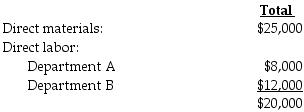 Apple Valley applies manufacturing overhead costs to jobs on the basis of direct manufacturing labor cost using departmental rates determined at the beginning of the year.
For Department B, the manufacturing overhead allocation rate is ________.
The actual material and labor costs charged to Job #432 were as follows:
Apple Valley applies manufacturing overhead costs to jobs on the basis of direct manufacturing labor cost using departmental rates determined at the beginning of the year.
For Department B, the manufacturing overhead allocation rate is ________. (Multiple Choice)
4.9/5  (79)
(79) Lancelot Manufacturing is a small textile manufacturer using machine-hours as the single indirect-cost rate to allocate manufacturing overhead costs to the various jobs contracted during the year. The following estimates are provided for the coming year for the company and for the Case High School band jacket job.
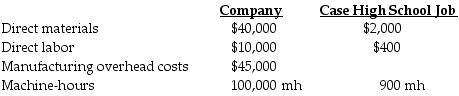 What are the total manufacturing costs of this job?
 (Multiple Choice)
5.0/5 (82)
(82) The Dougherty Furniture Company manufactures tables. In March, the two production departments had budgeted allocation bases of 4,000 machine-hours in Department 100 and 8,000 direct manufacturing labor-hours in Department 200. The budgeted manufacturing overheads for the month were $57,500 and $62,500, respectively. For Job A, the actual costs incurred in the two departments were as follows:
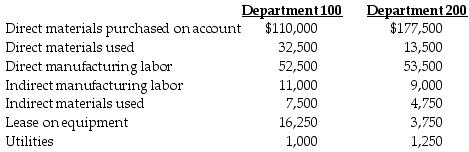 Job A incurred 800 machine-hours in Department 100 and 300 manufacturing labor-hours in Department 200. The company uses a budgeted overhead rate for applying overhead to production.
Required:
a.Determine the budgeted manufacturing overhead rate for each department.
b.Prepare the necessary journal entries to summarize the March transactions for Department 100.
c.What is the total cost of Job A?
Job A incurred 800 machine-hours in Department 100 and 300 manufacturing labor-hours in Department 200. The company uses a budgeted overhead rate for applying overhead to production.
Required:
a.Determine the budgeted manufacturing overhead rate for each department.
b.Prepare the necessary journal entries to summarize the March transactions for Department 100.
c.What is the total cost of Job A? (Essay)
4.8/5 (78)
(78) The Robinson Corporation manufactures automobile parts. During the year, the company sold $5,600,000 of parts that had a cost of $3,200,000. At year end, these are the balances for cost of goods sold and its manufacturing overhead accounts:
Cost of goods sold $3,200,000
Manufacturing overhead allocated $1,400,000
Manufacturing overhead control $1,495,000
What would be the correct journal entry to close out the overhead accounts assuming that the write-of to cost of goods sold approach is used?
(Multiple Choice)
4.8/5 (92)
(92) Benny Industries allocates manufacturing overhead at a predetermined rate of 160% of direct labor cost. Any overallocated or underallocated overhead is closed to the cost of goods sold at the end of the month. Below is information on job 205 that was in process at the end of the month of October
Direct materials $4,000
Direct labor $3,000
Allocated manufacturing overhead $4,800
Jobs 206, 207, and 208 were started in November. Direct materials that were used in November were $26,000 and direct labor costs were $21,000. For the month of November, actual manufacturing overhead was $32,000. The only job still in process on the last day of November was job 104 with the following costs: $3,000 for direct materials and $1,500 for direct labor.
Required:
a. Calculate the cost of goods manufacturered for November.
b. Calculate the amount of overallocated or underallocated manufacturing overhead that should be closed to cost of goods sold on November 30. Be sure to label the answer as either overallocated or underallocated.
c. What are the accounting entries to close the overallocated or underallocated manufacturing overhead on November 30?
(Essay)
4.9/5 (78)
(78) A ________ is anything for which a measurement of costs is desired.
(Multiple Choice)
4.9/5 (72)
(72) The adjusted allocation approach yields the benefits of ________.
(Multiple Choice)
4.8/5 (85)
(85) The budgeted indirect-cost rate for each cost pool is computed as ________.
(Multiple Choice)
4.9/5 (78)
(78) One reason for using longer time periods to calculate indirect-cost rates is seasonal cost fluctuations.
(True/False)
5.0/5 (69)
(69) Bauer Manufacturing uses departmental cost driver rates to allocate manufacturing overhead costs to products. Manufacturing overhead costs are allocated on the basis of machine-hours in the Machining Department and on the basis of direct labor-hours in the Assembly Department. At the beginning of 2018, the following estimates were provided for the coming year:
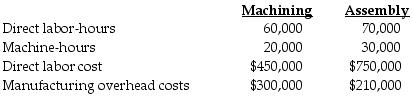 The accounting records of the company show the following data for Job #316:
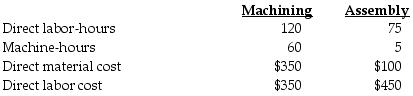 For Bauer Manufacturing, what is the annual manufacturing overhead cost-allocation rate for the Machining Department?
The accounting records of the company show the following data for Job #316:
For Bauer Manufacturing, what is the annual manufacturing overhead cost-allocation rate for the Machining Department? (Multiple Choice)
4.7/5 (97)
(97) Proration is the spreading of underallocated or overallocated overhead among ending work in process, finished goods, and costs of goods sold.
(True/False)
4.8/5 (64)
(64) Normal costing is a method of job costing that allocates an indirect cost based on the actual indirect-cost rate times the actual quantity of the cost-allocation base.
(True/False)
4.8/5 (80)
(80) For each item below indicate the source documents that would most likely authorize the journal entry in a job-costing system.
Required:
a.direct materials purchased
b.direct materials used
c.direct manufacturing labor
d.indirect manufacturing labor
e.finished goods control
f.cost of goods sold
(Essay)
4.8/5 (81)
(81) Elite Stationary Inc. employs 20 full-time employees and 10 trainees. Direct and indirect costs are applied on a professional labor-hour basis that includes both employee and trainee hours. Following is information for 2018:
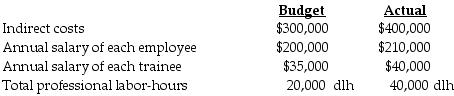 What are the budgeted direct-cost rate and the budgeted indirect-cost rate, respectively, per professional labor-hour? (Round the final answers to the nearest cent.)
 (Multiple Choice)
4.9/5 (83)
(83) 
Filters
- Essay(0)
- Multiple Choice(0)
- Short Answer(0)
- True False(0)
- Matching(0)