



 Chat with AI
Exam 7: Languages and Religion

Exam 1: Thinking Geographically70 Questions
Exam 2: Weather, Climate, and Climate Change76 Questions
Exam 3: Landforms79 Questions
Exam 4: Biosphere78 Questions
Exam 5: Population67 Questions
Exam 6: Migration79 Questions
Exam 7: Languages and Religion91 Questions
Exam 8: Political Geography76 Questions
Exam 9: Development80 Questions
Exam 10: Food and Agriculture80 Questions
Exam 11: Industry81 Questions
Exam 12: Services and Settlements79 Questions
Exam 13: Urban Patterns76 Questions
Exam 14: Resources80 Questions
Select questions type


Christians consider Saudi Arabia the Holy Land and Jerusalem the Holy City because the major events in Jesus' life, death, and Resurrection were concentrated there.
(True/False)
4.8/5  (73)
(73) Christianity first diffused from its hearth in North Africa through migration.
(True/False)
5.0/5 (76)
(76) The "peace" thesis on the origin of the Indo-European language family postulates that the first Indo-European speakers may have been the Kurgan people, who lived near the border of present-day Russia and Kazakhstan.
(True/False)
4.7/5 (85)
(85) In Africa, about 12 per cent of the people practice Animism, another name for traditional ethnic religions.
(True/False)
4.8/5 (86)
(86) Figure 7.4, English-Speaking Countries 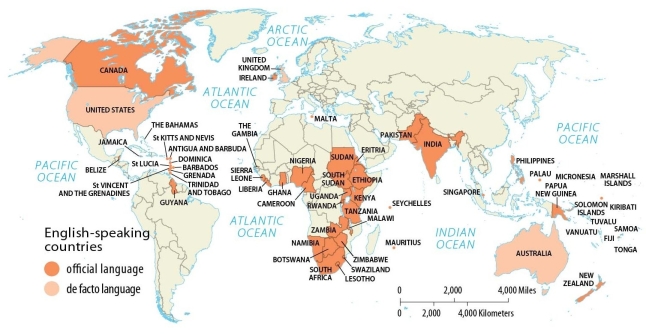 -Looking at Figure 7.4, in which of the following countries is English neither the official language nor the de facto language?
 (Multiple Choice)
4.9/5 (81)
(81) Indo-Iranian is the largest of the the Indo-European family of languages.
(True/False)
4.9/5 (82)
(82) Belgium's language boundary sharply divides the country into two regions. What are the two languages spoken in these two regions?
(Multiple Choice)
4.9/5 (84)
(84) Which of the following is closer to the actual number of languages in the world today?
(Multiple Choice)
4.8/5 (83)
(83) 
Filters
- Essay(0)
- Multiple Choice(0)
- Short Answer(0)
- True False(0)
- Matching(0)