



 Chat with AI
Exam 7: Languages and Religion

Exam 1: Thinking Geographically70 Questions
Exam 2: Weather, Climate, and Climate Change76 Questions
Exam 3: Landforms79 Questions
Exam 4: Biosphere78 Questions
Exam 5: Population67 Questions
Exam 6: Migration79 Questions
Exam 7: Languages and Religion91 Questions
Exam 8: Political Geography76 Questions
Exam 9: Development80 Questions
Exam 10: Food and Agriculture80 Questions
Exam 11: Industry81 Questions
Exam 12: Services and Settlements79 Questions
Exam 13: Urban Patterns76 Questions
Exam 14: Resources80 Questions
Select questions type


This is a collection of languages related through a common ancestral language that existed long before recorded history.
(Multiple Choice)
4.8/5  (89)
(89) Muslims regard Jerusalem as one of their holy cities, because it is the place from which Muhammad is thought to have ascended to heaven.
(True/False)
5.0/5 (77)
(77) A ________ is a regional variation of a language distinguished by distinctive vocabulary, spelling, and pronunciation.
(Multiple Choice)
4.8/5 (82)
(82) A(n) ________ is defined as a language that results from the mixing of the colonizer's language with the indigenous language of the people being dominated
(Multiple Choice)
4.8/5 (82)
(82) Figure 7.7.1, Distribution of Religions 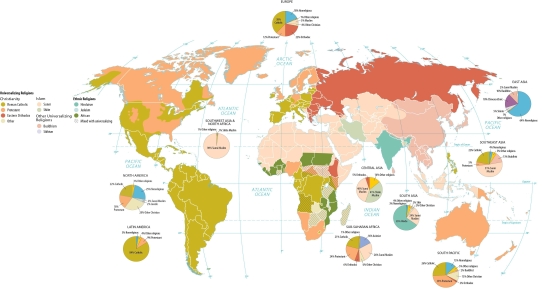 -Which of the following is NOT one of East and South Asia's ethnic religions?
 (Multiple Choice)
5.0/5 (78)
(78) What is a universalizing religion and what are the major and some minor universalizing religions in the world?
(Essay)
4.8/5 (86)
(86) In Belgium, language boundary sharply divides the country into two regions: Southern Belgians speak French and northern Belgians speak Flemish.
(True/False)
4.8/5 (91)
(91) The primary language family found in most of Mexico, the U.S. and Southern Canada is
(Multiple Choice)
4.9/5 (67)
(67) A creolized language forms when the colonized group adopts the language of the dominant group but makes some changes, such as simplifying the grammar and adding words from their former language.
(True/False)
5.0/5 (91)
(91) This region of South Asia is considered the home and origin of Sikhism.
(Multiple Choice)
4.7/5 (70)
(70) Which of the following is not a branch of the Indo-European family?
(Multiple Choice)
5.0/5 (78)
(78) Which of the following religions is NOT considered a universalizing religion?
(Multiple Choice)
4.9/5 (75)
(75) Which of the following is predominantly found in East Asia?
(Multiple Choice)
4.9/5 (79)
(79) ________ was created by the United Nations in 1947 as the only country in the world with a majority Jewish population.
(Multiple Choice)
4.7/5 (89)
(89) Jerusalem is especially holy to Jews as the location of the Temple, their center of worship in ancient times.
(True/False)
4.9/5 (84)
(84) Figure 7.7.1, Distribution of Religions
-The founder of Buddhism is ________ who was born about 563 B.C. in Lumbinī, in present-day Nepal.
-The founder of Buddhism is ________ who was born about 563 B.C. in Lumbinī, in present-day Nepal. (Multiple Choice)
4.8/5 (76)
(76) Hindus account for more than 80 percent of the population of India and Nepal.
(True/False)
4.8/5 (77)
(77) 
Filters
- Essay(0)
- Multiple Choice(0)
- Short Answer(0)
- True False(0)
- Matching(0)