



 Chat with AI
Exam 19: An Era of Totalitarianism

Exam 1: The Ancient Near East: the First Civilizations82 Questions
Exam 2: The Hebrews: a New View of God and the Individual76 Questions
Exam 3: The Greeks: From Myth to Reason95 Questions
Exam 4: Rome: From City-State to World Empire92 Questions
Exam 5: Early Christianity: a World Religion79 Questions
Exam 6: The Rise of Europe: Fusion of Classical,christian,and Germanic Traditions89 Questions
Exam 7: The Flowering and Dissolution of Medieval Civilization84 Questions
Exam 8: Transition to the Modern Age: Renaissance and Reformation91 Questions
Exam 9: Political and Economic Transformation: National States, overseas Expansion, commercial Revolution84 Questions
Exam 10: Intellectual Transformation: the Scientific Revolution and the Age of Enlightenment85 Questions
Exam 11: The Era of the French Revolution: Affirmation of Liberty and Equality92 Questions
Exam 12: The Industrial Revolution: the Transformation of Society78 Questions
Exam 13: Thought and Culture in the Early Nineteenth Century82 Questions
Exam 14: Surge of Liberalism and Nationalism: Revolution, counterrevolution, and Unification76 Questions
Exam 15: Thought and Culture in the Mid-Nineteenth Century: Realism, positivism, darwinism, and Social Criticism86 Questions
Exam 16: Europe in the Late Nineteenth Century: Modernization, nationalism, imperialism93 Questions
Exam 17: Modern Consciousness: New Views of Nature, human Nature, and the Arts77 Questions
Exam 18: World War I: the West in Despair83 Questions
Exam 19: An Era of Totalitarianism88 Questions
Exam 20: World War II: Western Civilization in the Balance56 Questions
Exam 21: Europe After World War II: Recovery and Realignment, 1945-198959 Questions
Exam 22: The Troubled Present55 Questions
Select questions type


Please define the following key terms. Show Who? What? Where? When? Why Important?
-March on Rome
(Essay)
4.7/5  (75)
(75) The authors of your text refer to each of the following as components of fascism except
(Multiple Choice)
4.7/5 (76)
(76) Please use this outline map of Europe to answer the question(s).
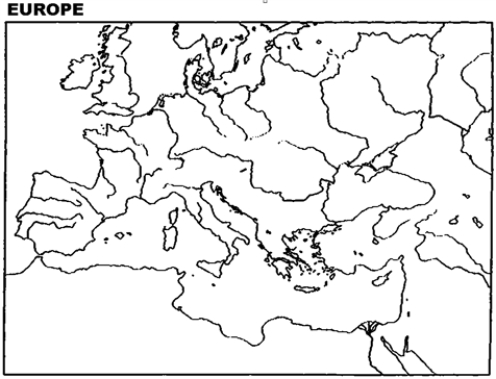 -How would you explain the basic outlook of Oswald Spengler?
 (Essay)
4.9/5 (72)
(72) The results of Stalin's collectivization included which of the following?
(Multiple Choice)
4.7/5 (82)
(82) Please define the following key terms. Show Who? What? Where? When? Why Important?
-Lenin
(Short Answer)
4.8/5 (75)
(75) Which of the following was an indictment of totalitarianism?
(Multiple Choice)
4.8/5 (67)
(67) According to the text,Mann's The Magic Mountain is an allegory for
(Multiple Choice)
4.9/5 (67)
(67) Please define the following key terms. Show Who? What? Where? When? Why Important?
-D.H.Lawrence
(Essay)
4.9/5 (90)
(90) Please use this outline map of Europe to answer the question(s).
-How were the totalitarianisms of Italy,Germany,and the Soviet Union different from one another?
-How were the totalitarianisms of Italy,Germany,and the Soviet Union different from one another? (Short Answer)
4.8/5 (76)
(76) Please define the following key terms. Show Who? What? Where? When? Why Important?
-Dadaism
(Short Answer)
4.9/5 (87)
(87) The Dawes Plan contributed to Germany economic recovery in the 1920s because it
(Multiple Choice)
4.7/5 (88)
(88) Please use this outline map of Europe to answer the question(s).
-Why was the Soviet Union so popular to so many intellectuals? Name some who criticized the communist experiment.
-Why was the Soviet Union so popular to so many intellectuals? Name some who criticized the communist experiment. (Not Answered)
This question doesn't have any answer yet
Please use this outline map of Europe to answer the question(s).
-How may one say that the experience of Nazism illustrates the dynamic power of myth? How did myth confer power on Hitler's movement?
-How may one say that the experience of Nazism illustrates the dynamic power of myth? How did myth confer power on Hitler's movement? (Essay)
4.7/5 (77)
(77) Each of the following was part of the formative experiences of Hitler except
(Multiple Choice)
4.9/5 (92)
(92) Please define the following key terms. Show Who? What? Where? When? Why Important?
-Ernest Hemingway
(Short Answer)
4.8/5 (78)
(78) Please define the following key terms. Show Who? What? Where? When? Why Important?
-Bolshevik
(Essay)
4.9/5 (86)
(86) 
Filters
- Essay(0)
- Multiple Choice(0)
- Short Answer(0)
- True False(0)
- Matching(0)