



 Chat with AI
Exam 7: The Flowering and Dissolution of Medieval Civilization

Exam 1: The Ancient Near East: the First Civilizations82 Questions
Exam 2: The Hebrews: a New View of God and the Individual76 Questions
Exam 3: The Greeks: From Myth to Reason95 Questions
Exam 4: Rome: From City-State to World Empire92 Questions
Exam 5: Early Christianity: a World Religion79 Questions
Exam 6: The Rise of Europe: Fusion of Classical,christian,and Germanic Traditions89 Questions
Exam 7: The Flowering and Dissolution of Medieval Civilization84 Questions
Exam 8: Transition to the Modern Age: Renaissance and Reformation91 Questions
Exam 9: Political and Economic Transformation: National States, overseas Expansion, commercial Revolution84 Questions
Exam 10: Intellectual Transformation: the Scientific Revolution and the Age of Enlightenment85 Questions
Exam 11: The Era of the French Revolution: Affirmation of Liberty and Equality92 Questions
Exam 12: The Industrial Revolution: the Transformation of Society78 Questions
Exam 13: Thought and Culture in the Early Nineteenth Century82 Questions
Exam 14: Surge of Liberalism and Nationalism: Revolution, counterrevolution, and Unification76 Questions
Exam 15: Thought and Culture in the Mid-Nineteenth Century: Realism, positivism, darwinism, and Social Criticism86 Questions
Exam 16: Europe in the Late Nineteenth Century: Modernization, nationalism, imperialism93 Questions
Exam 17: Modern Consciousness: New Views of Nature, human Nature, and the Arts77 Questions
Exam 18: World War I: the West in Despair83 Questions
Exam 19: An Era of Totalitarianism88 Questions
Exam 20: World War II: Western Civilization in the Balance56 Questions
Exam 21: Europe After World War II: Recovery and Realignment, 1945-198959 Questions
Exam 22: The Troubled Present55 Questions
Select questions type


Which statement best describes the accomplishments of medieval thinkers in the area of science
(Multiple Choice)
4.9/5  (70)
(70) Please define the following key terms. Show Who? What? Where? When? Why Important?
-Calais
(Essay)
4.9/5 (84)
(84) Please use this outline map of Europe to answer the question(s).
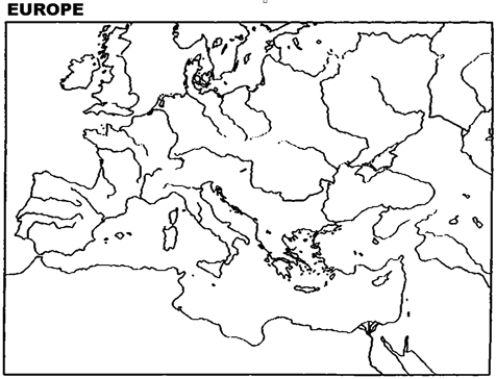 -How might Aristotle's philosophy imperil Christian thought? How successful was the church in banning Aristotelian ideas?
 (Essay)
4.7/5 (85)
(85) All of the following are true of how the concept courtly love required knights to demonstrate their worthiness except
(Multiple Choice)
4.8/5 (80)
(80) Please use this outline map of Europe to answer the question(s).
-Describe the causes of the Great Schism and discuss how it offers evidence of a deep malaise within the Roman Church.
-Describe the causes of the Great Schism and discuss how it offers evidence of a deep malaise within the Roman Church. (Essay)
4.8/5 (87)
(87) Please define the following key terms. Show Who? What? Where? When? Why Important?
-Dante Alighieri
(Essay)
4.9/5 (63)
(63) Which of the following medieval scientists was the chancellor of Oxford University?
(Multiple Choice)
5.0/5 (79)
(79) All of the following are accurate descriptions of the Great Schism except
(Multiple Choice)
4.8/5 (75)
(75) Please define the following key terms. Show Who? What? Where? When? Why Important?
-Robert Grosseteste
(Essay)
4.8/5 (73)
(73) All of the following were problems in the Late Middle Ages except
(Multiple Choice)
4.9/5 (81)
(81) Who of the following was the chief proponent of the view that faith was beyond reason?
(Multiple Choice)
4.9/5 (94)
(94) How did medieval thought connect reason and religion within their view of the universe?
(Essay)
4.9/5 (77)
(77) Please use this outline map of Europe to answer the question(s).
-Discuss the status of the papacy in the fourteenth century.Was it a period during which the papacy had to choose between spiritual and secular leadership?
-Discuss the status of the papacy in the fourteenth century.Was it a period during which the papacy had to choose between spiritual and secular leadership? (Essay)
4.9/5 (86)
(86) All of the following statements about the Hundred Years War are true except
(Multiple Choice)
4.9/5 (73)
(73) The geocentric model of the universe fit with the Christian worldview in that
(Multiple Choice)
4.8/5 (80)
(80) Please define the following key terms. Show Who? What? Where? When? Why Important?
-The Canterbury Tales
(Essay)
4.9/5 (81)
(81) 
Filters
- Essay(0)
- Multiple Choice(0)
- Short Answer(0)
- True False(0)
- Matching(0)