



 Chat with AI
Exam 1: The Ancient Near East: the First Civilizations

Exam 1: The Ancient Near East: the First Civilizations82 Questions
Exam 2: The Hebrews: a New View of God and the Individual76 Questions
Exam 3: The Greeks: From Myth to Reason95 Questions
Exam 4: Rome: From City-State to World Empire92 Questions
Exam 5: Early Christianity: a World Religion79 Questions
Exam 6: The Rise of Europe: Fusion of Classical,christian,and Germanic Traditions89 Questions
Exam 7: The Flowering and Dissolution of Medieval Civilization84 Questions
Exam 8: Transition to the Modern Age: Renaissance and Reformation91 Questions
Exam 9: Political and Economic Transformation: National States, overseas Expansion, commercial Revolution84 Questions
Exam 10: Intellectual Transformation: the Scientific Revolution and the Age of Enlightenment85 Questions
Exam 11: The Era of the French Revolution: Affirmation of Liberty and Equality92 Questions
Exam 12: The Industrial Revolution: the Transformation of Society78 Questions
Exam 13: Thought and Culture in the Early Nineteenth Century82 Questions
Exam 14: Surge of Liberalism and Nationalism: Revolution, counterrevolution, and Unification76 Questions
Exam 15: Thought and Culture in the Mid-Nineteenth Century: Realism, positivism, darwinism, and Social Criticism86 Questions
Exam 16: Europe in the Late Nineteenth Century: Modernization, nationalism, imperialism93 Questions
Exam 17: Modern Consciousness: New Views of Nature, human Nature, and the Arts77 Questions
Exam 18: World War I: the West in Despair83 Questions
Exam 19: An Era of Totalitarianism88 Questions
Exam 20: World War II: Western Civilization in the Balance56 Questions
Exam 21: Europe After World War II: Recovery and Realignment, 1945-198959 Questions
Exam 22: The Troubled Present55 Questions
Select questions type


Please define the following key terms. Show Who? What? Where? When? Why Important?
-Akkad
(Essay)
4.7/5  (80)
(80) In the Mesopotamian civilization the temple administration functioned in each of the following ways except
(Multiple Choice)
4.8/5 (86)
(86) Please define the following key terms. Show Who? What? Where? When? Why Important?
-Hyksos
(Essay)
4.8/5 (82)
(82) Provisions related to business transactions in the Code of Hammurabi indicate that in ancient Mesopotamia
(Multiple Choice)
4.9/5 (91)
(91) Please define the following key terms. Show Who? What? Where? When? Why Important?
-Ma'at
(Essay)
4.9/5 (69)
(69) In explaining natural phenomena,ancient Egyptians and Mesopotamians would refer to
(Multiple Choice)
4.8/5 (75)
(75) Please use this outline map of the Near East to answer the question(s).
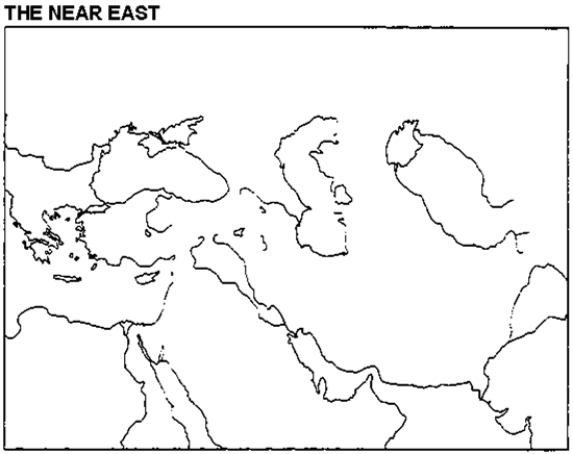 -On the map of the Near East,use different colors to sketch in the areas where the Mesopotamian and Egyptian civilizations were found.
 (Not Answered)
This question doesn't have any answer yet
Humankind during the Paleolithic Age illustrated each of the following developments except
(Multiple Choice)
4.9/5 (76)
(76) Which religion became the counterpart to Persian political and cultural universalism?
(Multiple Choice)
5.0/5 (85)
(85) The authors define all of the following as characteristics of early civilization except
(Multiple Choice)
4.8/5 (76)
(76) Please define the following key terms. Show Who? What? Where? When? Why Important?
-satrap
(Essay)
4.8/5 (79)
(79) Significant features of the Paleolithic Age include each of the following except that
(Multiple Choice)
4.8/5 (65)
(65) Mesopotamian mathematicians made advancements in math except
(Multiple Choice)
4.7/5 (76)
(76) To which of the following did Egypt finally lose its independence?
(Multiple Choice)
4.7/5 (86)
(86) Compared to Assyrian rule,Persian rule over the Near East was
(Multiple Choice)
4.9/5 (95)
(95) 
Filters
- Essay(0)
- Multiple Choice(0)
- Short Answer(0)
- True False(0)
- Matching(0)