



 Chat with AI
Exam 22: Gas Exchange

Exam 1: Biology: Exploring Life48 Questions
Exam 2: The Chemical Basis of Life72 Questions
Exam 3: The Molecules of Cells85 Questions
Exam 4: A Tour of the Cell90 Questions
Exam 5: The Working Cell80 Questions
Exam 6: How Cells Harvest Chemical Energy82 Questions
Exam 7: Photosynthesis: Using Light to Make Food81 Questions
Exam 8: The Cellular Basis of Reproduction and Inheritance78 Questions
Exam 9: Patterns of Inheritance77 Questions
Exam 10: Molecular Biology of the Gene82 Questions
Exam 11: How Genes Are Controlled81 Questions
Exam 12: DNA Technology and Genomics78 Questions
Exam 13: How Populations Evolve64 Questions
Exam 14: The Origin of Species58 Questions
Exam 15: Tracing Evolutionary History82 Questions
Exam 16: Microbial Life: Prokaryotes and Protists84 Questions
Exam 17: The Evolution of Plant and Fungal Diversity79 Questions
Exam 18: The Evolution of Invertebrate Diversity72 Questions
Exam 19: The Evolution of Vertebrate Diversity72 Questions
Exam 20: Unifying Concepts of Animal Structure and Function63 Questions
Exam 21: Nutrition and Digestion91 Questions
Exam 22: Gas Exchange66 Questions
Exam 23: Circulation77 Questions
Exam 24: the Immune System79 Questions
Exam 25: Control of Body Temperature and Water Balance63 Questions
Exam 26: Hormones and the Endocrine System60 Questions
Exam 27: Reproduction and Embryonic Development71 Questions
Exam 28: Nervous Systems70 Questions
Exam 29: the Senses60 Questions
Exam 30: How Animals Move69 Questions
Exam 31: Plant Structure, Growth, and Reproduction79 Questions
Exam 32: Plant Nutrition and Transport65 Questions
Exam 33: Control Systems in Plants58 Questions
Exam 34: the Biosphere: an Introduction to Earths Diverse Environments63 Questions
Exam 35: Behavioral Adaptations to the Environment52 Questions
Exam 36: Population Ecology53 Questions
Exam 37: Communities and Ecosystems60 Questions
Exam 38: Conservation Biology57 Questions
Select questions type


Pulmonary fibrosis is a lung disease that is characterized by damage and scarring of lung tissue. This results in the lungs becoming stiff and inelastic. What function is most likely to be impaired in someone with pulmonary fibrosis?
(Multiple Choice)
4.9/5  (86)
(86) After reading the paragraphs below, answer the questions that follow.
Physicians routinely give their patients pulmonary function tests in order to measure characteristics of lung function. The most common of these tests, spirometry, measures both the volume and the speed of air entering and exiting the lungs. In this test, a person first breathes normally while breathing into a spirometer, a machine that measures air volume and air speed. Then the person takes the deepest breath possible and exhales as hard as possible for 6 seconds into the spirometer. The resulting data are plotted on a graph of volume (y axis) versus time (x axis). Spirometry is useful not only for assessing lung function in healthy patients but also for characterizing patients with lung conditions such as pulmonary fibrosis, asthma, or emphysema.
A sample graph for a healthy adult male is shown below. Normal breathing occurs between points A and B, a maximal inhalation occurs at point C, and a maximal exhalation occurs at point D. Normal breathing resumes between points E and F.
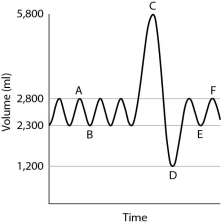 -For this data set, what is the vital capacity?
 (Multiple Choice)
4.9/5 (78)
(78) The maximum amount of air that a human can inhale and exhale is called the
(Multiple Choice)
4.8/5 (78)
(78) Which of the following statements regarding breathing and circulation in insects is false?
(Multiple Choice)
4.7/5 (77)
(77) After reading the paragraphs below, answer the questions that follow.
Many amphibians (including many frogs, toads, and salamanders) spend the early part of their lives in water but live on land as adults. The adults of many species return to water to breed and lay their eggs. Frogs have small lungs and supplement their oxygen intake by breathing through the skin. Although large frogs have more total surface area than smaller frogs, the larger frogs have a lower surface area/volume ratio (less skin surface relative to their total body volume). To keep their respiratory surfaces moist, frogs are generally found in wet or very moist locations.
In an experiment designed to investigate oxygen consumption in relation to body size, frogs from five different species were weighed and placed in a respirometer (a machine that measures oxygen consumption) for 1 hour. The table shows the results of the experiment.
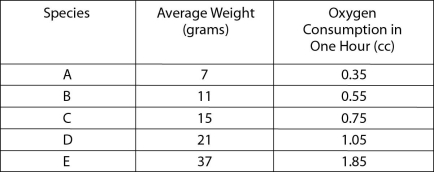 -If you could alter the shape of a frog so that it was long and thin instead of compact, the frog's oxygen transfer efficiency would
 (Multiple Choice)
5.0/5 (86)
(86) What part of the human brain contains the primary breathing control center?
(Multiple Choice)
4.8/5 (82)
(82) Most CO₂ is transported to the lungs in which of the following ways?
(Multiple Choice)
4.9/5 (71)
(71) Which of the following options correctly lists the direction of carbon dioxide travel as it leaves the body?
(Multiple Choice)
4.8/5 (75)
(75) The organization of blood and water flow in a fish's gills increases the fish's ability to
(Multiple Choice)
4.7/5 (92)
(92) Compared to the vital capacity, how much air can lungs actually hold?
(Multiple Choice)
4.8/5 (79)
(79) When you hyperventilate (breathe too fast), respiratory alkalosis (elevated blood pH)can occur, which can cause you to faint. A common but potentially dangerous method to reverse respiratory alkalosis is to hold a paper bag over your mouth and take normal breaths, thereby rebreathing the exhaled air. How might this method reverse respiratory alkalosis?
(Multiple Choice)
4.9/5 (79)
(79) The flow rate of a gas through a tube is proportional to the diameter of the tube. Through which structure in the human respiratory system does air flow the fastest?
(Multiple Choice)
4.9/5 (77)
(77) Cigarette smoking can sometimes lead to development of a "smoker's cough," which results from paralysis of cilia in the airways. Why would the paralysis of cilia lead to smoker's cough?
(Multiple Choice)
4.9/5 (81)
(81) What name is given to the sheet of muscle that helps move air in and out of the lungs?
(Multiple Choice)
4.7/5 (76)
(76) Which of the following organisms has a respiratory system that does not require assistance from a circulatory system for gas exchange?
(Multiple Choice)
4.8/5 (84)
(84) Consider an animal that exchanges gases through its skin. Which of the following body shapes would provide the most surface area for gas exchange?
(Multiple Choice)
4.8/5 (78)
(78) After reading the paragraphs below, answer the questions that follow.
Many amphibians (including many frogs, toads, and salamanders) spend the early part of their lives in water but live on land as adults. The adults of many species return to water to breed and lay their eggs. Frogs have small lungs and supplement their oxygen intake by breathing through the skin. Although large frogs have more total surface area than smaller frogs, the larger frogs have a lower surface area/volume ratio (less skin surface relative to their total body volume). To keep their respiratory surfaces moist, frogs are generally found in wet or very moist locations.
In an experiment designed to investigate oxygen consumption in relation to body size, frogs from five different species were weighed and placed in a respirometer (a machine that measures oxygen consumption) for 1 hour. The table shows the results of the experiment.
-You have obtained a frog from a species closely related to the frogs used in the preceding study. If the frog weighs 30 grams, what do you expect its oxygen consumption in 1 hour to be?
-You have obtained a frog from a species closely related to the frogs used in the preceding study. If the frog weighs 30 grams, what do you expect its oxygen consumption in 1 hour to be? (Multiple Choice)
4.9/5 (82)
(82) 
Filters
- Essay(0)
- Multiple Choice(0)
- Short Answer(0)
- True False(0)
- Matching(0)