



 Chat with AI
Exam 19: The Evolution of Vertebrate Diversity

Exam 1: Biology: Exploring Life48 Questions
Exam 2: The Chemical Basis of Life72 Questions
Exam 3: The Molecules of Cells85 Questions
Exam 4: A Tour of the Cell90 Questions
Exam 5: The Working Cell80 Questions
Exam 6: How Cells Harvest Chemical Energy82 Questions
Exam 7: Photosynthesis: Using Light to Make Food81 Questions
Exam 8: The Cellular Basis of Reproduction and Inheritance78 Questions
Exam 9: Patterns of Inheritance77 Questions
Exam 10: Molecular Biology of the Gene82 Questions
Exam 11: How Genes Are Controlled81 Questions
Exam 12: DNA Technology and Genomics78 Questions
Exam 13: How Populations Evolve64 Questions
Exam 14: The Origin of Species58 Questions
Exam 15: Tracing Evolutionary History82 Questions
Exam 16: Microbial Life: Prokaryotes and Protists84 Questions
Exam 17: The Evolution of Plant and Fungal Diversity79 Questions
Exam 18: The Evolution of Invertebrate Diversity72 Questions
Exam 19: The Evolution of Vertebrate Diversity72 Questions
Exam 20: Unifying Concepts of Animal Structure and Function63 Questions
Exam 21: Nutrition and Digestion91 Questions
Exam 22: Gas Exchange66 Questions
Exam 23: Circulation77 Questions
Exam 24: the Immune System79 Questions
Exam 25: Control of Body Temperature and Water Balance63 Questions
Exam 26: Hormones and the Endocrine System60 Questions
Exam 27: Reproduction and Embryonic Development71 Questions
Exam 28: Nervous Systems70 Questions
Exam 29: the Senses60 Questions
Exam 30: How Animals Move69 Questions
Exam 31: Plant Structure, Growth, and Reproduction79 Questions
Exam 32: Plant Nutrition and Transport65 Questions
Exam 33: Control Systems in Plants58 Questions
Exam 34: the Biosphere: an Introduction to Earths Diverse Environments63 Questions
Exam 35: Behavioral Adaptations to the Environment52 Questions
Exam 36: Population Ecology53 Questions
Exam 37: Communities and Ecosystems60 Questions
Exam 38: Conservation Biology57 Questions
Select questions type


Amphibians were diverse and abundant in the lush swamp forests of the ________, which is sometimes referred to as the age of the amphibians.
(Multiple Choice)
4.9/5  (79)
(79) Complete the analogy: ________ are to plant evolution as ________ is/are to vertebrate evolution.
(Multiple Choice)
4.7/5 (101)
(101) According to this figure, which two groups are most closely related? 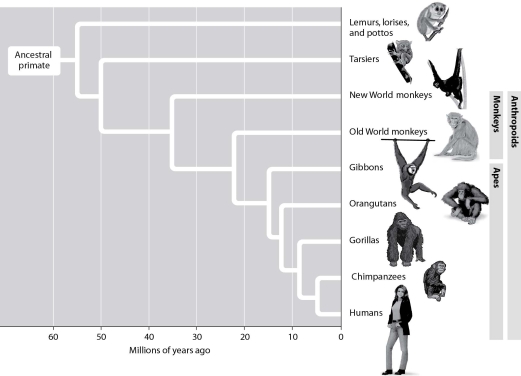
(Multiple Choice)
4.9/5 (79)
(79) ________ spend almost all of their time on the ground, instead of in trees.
(Multiple Choice)
4.8/5 (84)
(84) Reptiles are not able to eat as frequently as mammals and birds can eat. This is due to a trait that mammals and birds share but that reptiles do not have. What is this trait?
(Multiple Choice)
4.8/5 (74)
(74) Which of the following statements best describes the current scientific view of birds?
(Multiple Choice)
4.8/5 (88)
(88) The American brook lamprey is a freshwater lamprey that lives in streams. Lampreys move streambed stones to make a nest in which to lay their eggs. Which defining feature of the lamprey might enable it to move these stones?
(Multiple Choice)
4.9/5 (74)
(74) Like many insects, some amphibians undergo ________ in their life cycle as they have distinct larval and adult stages.
(Multiple Choice)
4.9/5 (83)
(83) Of all of the chordate groups, why are there only two amniote groups (reptilia and mammalia)?
(Multiple Choice)
4.8/5 (76)
(76) Use the figure below to answer the following questions.
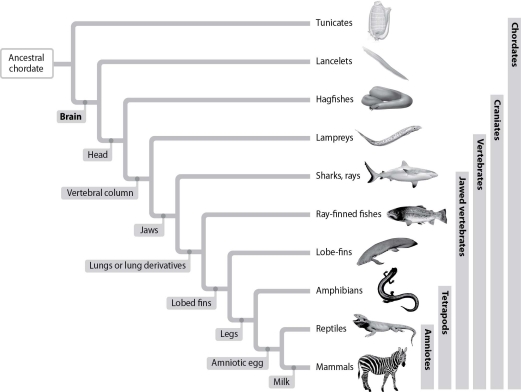 -The main difference between the earliest evolved tetrapods and the most recently evolved tetrapods is that
 (Multiple Choice)
4.8/5 (74)
(74) Which part of the body is likely to be much more diverse in mammals compared to that in other groups?
(Multiple Choice)
4.8/5 (75)
(75) 
Filters
- Essay(0)
- Multiple Choice(0)
- Short Answer(0)
- True False(0)
- Matching(0)