



 Chat with AI
Exam 36: Population Ecology

Exam 1: Biology: Exploring Life48 Questions
Exam 2: The Chemical Basis of Life72 Questions
Exam 3: The Molecules of Cells85 Questions
Exam 4: A Tour of the Cell90 Questions
Exam 5: The Working Cell80 Questions
Exam 6: How Cells Harvest Chemical Energy82 Questions
Exam 7: Photosynthesis: Using Light to Make Food81 Questions
Exam 8: The Cellular Basis of Reproduction and Inheritance78 Questions
Exam 9: Patterns of Inheritance77 Questions
Exam 10: Molecular Biology of the Gene82 Questions
Exam 11: How Genes Are Controlled81 Questions
Exam 12: DNA Technology and Genomics78 Questions
Exam 13: How Populations Evolve64 Questions
Exam 14: The Origin of Species58 Questions
Exam 15: Tracing Evolutionary History82 Questions
Exam 16: Microbial Life: Prokaryotes and Protists84 Questions
Exam 17: The Evolution of Plant and Fungal Diversity79 Questions
Exam 18: The Evolution of Invertebrate Diversity72 Questions
Exam 19: The Evolution of Vertebrate Diversity72 Questions
Exam 20: Unifying Concepts of Animal Structure and Function63 Questions
Exam 21: Nutrition and Digestion91 Questions
Exam 22: Gas Exchange66 Questions
Exam 23: Circulation77 Questions
Exam 24: the Immune System79 Questions
Exam 25: Control of Body Temperature and Water Balance63 Questions
Exam 26: Hormones and the Endocrine System60 Questions
Exam 27: Reproduction and Embryonic Development71 Questions
Exam 28: Nervous Systems70 Questions
Exam 29: the Senses60 Questions
Exam 30: How Animals Move69 Questions
Exam 31: Plant Structure, Growth, and Reproduction79 Questions
Exam 32: Plant Nutrition and Transport65 Questions
Exam 33: Control Systems in Plants58 Questions
Exam 34: the Biosphere: an Introduction to Earths Diverse Environments63 Questions
Exam 35: Behavioral Adaptations to the Environment52 Questions
Exam 36: Population Ecology53 Questions
Exam 37: Communities and Ecosystems60 Questions
Exam 38: Conservation Biology57 Questions
Select questions type


Which of the following statements about insecticides is true?
(Multiple Choice)
4.7/5  (95)
(95) Which of the following organisms best illustrates K-selection?
(Multiple Choice)
4.7/5 (91)
(91) The African country of Nigeria had a 4.55% population growth rate from 2005 to 2010, the highest in the world. Which of the following statements is consistent with this fact?
(Multiple Choice)
4.8/5 (76)
(76) After reading the paragraph below, answer the questions that follow.
You are a member of an African family that has been displaced from their home by civil war, so you are trying to select a new country in which to settle to gain better economic opportunities. You know that Nigeria is a large country with rich natural resources, so you are considering it for your new home. Among the data you find while researching Nigeria is the following diagram of the current age structure of the country.
 -The age structure data for Nigeria shows that the country has many more individuals under the age of 15 than over the age of 40. What does this imply about the future population of Nigeria?
 (Multiple Choice)
4.9/5 (70)
(70) An ecologist hypothesizes that predation by a particular owl species is the major factor controlling the population of a particular rabbit species. If this is the case, which of the following population effects could be expected in this rabbit-owl pair?
(Multiple Choice)
5.0/5 (79)
(79) A population of deer has a per capita rate of increase of 0.1 deer per year. If there are initially 300 deer in the population, and the population is growing exponentially, how many deer will be in the population after one year?
(Multiple Choice)
4.8/5 (87)
(87) According to this graph of the population growth of fur seals, in what year did the population first reach its carrying capacity? 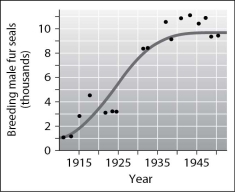
(Multiple Choice)
5.0/5 (92)
(92) If a population has a birth rate of 40 individuals per 1,000 per year and a death rate of 30 individuals per 1,000 per year, how will the population change each year? (Assume that the population is below carrying capacity and that there is no immigration or emigration.)
(Multiple Choice)
4.8/5 (78)
(78) Which of the following is most clearly a case of density-dependent population regulation?
(Multiple Choice)
4.8/5 (79)
(79) A newly mated queen ant establishes an ant nest in an unoccupied patch of suitable habitat. The population of the nest grows quickly at first, then levels off at carrying capacity. Which of the following models best describes its population growth?
(Multiple Choice)
4.7/5 (82)
(82) If most of the individuals of a human population are in their pre-reproductive years, you would expect the population size to ________ after 20 years.
(Multiple Choice)
4.9/5 (84)
(84) 
Filters
- Essay(0)
- Multiple Choice(0)
- Short Answer(0)
- True False(0)
- Matching(0)