



 Chat with AI
Exam 36: Population Ecology

Exam 1: Biology: Exploring Life48 Questions
Exam 2: The Chemical Basis of Life72 Questions
Exam 3: The Molecules of Cells85 Questions
Exam 4: A Tour of the Cell90 Questions
Exam 5: The Working Cell80 Questions
Exam 6: How Cells Harvest Chemical Energy82 Questions
Exam 7: Photosynthesis: Using Light to Make Food81 Questions
Exam 8: The Cellular Basis of Reproduction and Inheritance78 Questions
Exam 9: Patterns of Inheritance77 Questions
Exam 10: Molecular Biology of the Gene82 Questions
Exam 11: How Genes Are Controlled81 Questions
Exam 12: DNA Technology and Genomics78 Questions
Exam 13: How Populations Evolve64 Questions
Exam 14: The Origin of Species58 Questions
Exam 15: Tracing Evolutionary History82 Questions
Exam 16: Microbial Life: Prokaryotes and Protists84 Questions
Exam 17: The Evolution of Plant and Fungal Diversity79 Questions
Exam 18: The Evolution of Invertebrate Diversity72 Questions
Exam 19: The Evolution of Vertebrate Diversity72 Questions
Exam 20: Unifying Concepts of Animal Structure and Function63 Questions
Exam 21: Nutrition and Digestion91 Questions
Exam 22: Gas Exchange66 Questions
Exam 23: Circulation77 Questions
Exam 24: the Immune System79 Questions
Exam 25: Control of Body Temperature and Water Balance63 Questions
Exam 26: Hormones and the Endocrine System60 Questions
Exam 27: Reproduction and Embryonic Development71 Questions
Exam 28: Nervous Systems70 Questions
Exam 29: the Senses60 Questions
Exam 30: How Animals Move69 Questions
Exam 31: Plant Structure, Growth, and Reproduction79 Questions
Exam 32: Plant Nutrition and Transport65 Questions
Exam 33: Control Systems in Plants58 Questions
Exam 34: the Biosphere: an Introduction to Earths Diverse Environments63 Questions
Exam 35: Behavioral Adaptations to the Environment52 Questions
Exam 36: Population Ecology53 Questions
Exam 37: Communities and Ecosystems60 Questions
Exam 38: Conservation Biology57 Questions
Select questions type


Examine the age structure of Germany in the figure below. Which of the following statements is not supported by the age structure? 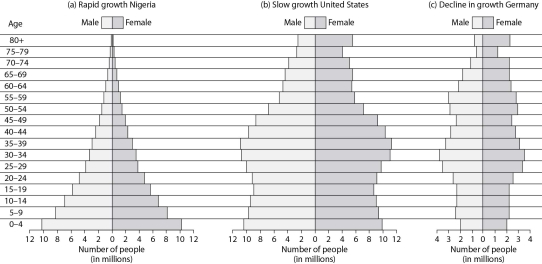
(Multiple Choice)
4.8/5  (80)
(80) A demographic tool used to predict a population's future growth is
(Multiple Choice)
4.8/5 (80)
(80) A survivorship curve that involves producing very few offspring, each of which has a high probability of surviving to adulthood, is typical of
(Multiple Choice)
4.8/5 (79)
(79) A population of fungi in a yard produces 10 mushrooms in year 1, 20 in year 2, and 40 in year 3. If this trend continues, by year 5 there will be ________ mushrooms.
(Multiple Choice)
4.9/5 (93)
(93) A group of individuals of a single species that occupy the same general area defines a
(Multiple Choice)
4.9/5 (86)
(86) In the logistic growth model, as population size increases, birth rates
(Multiple Choice)
4.9/5 (72)
(72) The human population on Earth is expected to reach 9.5 billion people by
(Multiple Choice)
4.7/5 (65)
(65) In terms of population dynamics, what is "boom-and-bust" cycling?
(Multiple Choice)
4.9/5 (74)
(74) A Type I survivorship curve is associated with which of the following life history traits?
(Multiple Choice)
4.9/5 (88)
(88) The maximum number of individuals a habitat can support is called its
(Multiple Choice)
4.8/5 (76)
(76) According to this graph of population growth in Mexico, in what year was the rate of population increase in Mexico the greatest? 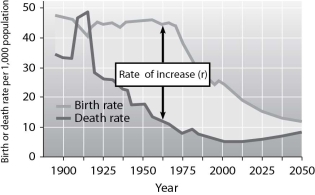
(Multiple Choice)
4.9/5 (80)
(80) Which of the following statements regarding logistic growth is true?
(Multiple Choice)
4.9/5 (90)
(90) You drive through Iowa in the spring and notice that along a stretch of several kilometers, every third fence post has a male redwing blackbird perched on it defending its nesting territory. This is an example of
(Multiple Choice)
4.8/5 (76)
(76) Which of the following will likely decrease a population's size?
(Multiple Choice)
4.8/5 (73)
(73) Which of the following is a practical application of population ecology that will result in population decline?
(Multiple Choice)
4.8/5 (78)
(78) Guppies from Trinidad form two distinct populations that differ in several life history traits. These traits appear to relate to the local predator populations, pike-cichlids or killifish. Which of the following experiments would best test the heritability of these traits?
(Multiple Choice)
4.8/5 (82)
(82) Which of the following statements about human demographic trends is true?
(Multiple Choice)
4.9/5 (76)
(76) 
Filters
- Essay(0)
- Multiple Choice(0)
- Short Answer(0)
- True False(0)
- Matching(0)