



 Chat with AI
Exam 11: How Genes Are Controlled

Exam 1: Biology: Exploring Life48 Questions
Exam 2: The Chemical Basis of Life72 Questions
Exam 3: The Molecules of Cells85 Questions
Exam 4: A Tour of the Cell90 Questions
Exam 5: The Working Cell80 Questions
Exam 6: How Cells Harvest Chemical Energy82 Questions
Exam 7: Photosynthesis: Using Light to Make Food81 Questions
Exam 8: The Cellular Basis of Reproduction and Inheritance78 Questions
Exam 9: Patterns of Inheritance77 Questions
Exam 10: Molecular Biology of the Gene82 Questions
Exam 11: How Genes Are Controlled81 Questions
Exam 12: DNA Technology and Genomics78 Questions
Exam 13: How Populations Evolve64 Questions
Exam 14: The Origin of Species58 Questions
Exam 15: Tracing Evolutionary History82 Questions
Exam 16: Microbial Life: Prokaryotes and Protists84 Questions
Exam 17: The Evolution of Plant and Fungal Diversity79 Questions
Exam 18: The Evolution of Invertebrate Diversity72 Questions
Exam 19: The Evolution of Vertebrate Diversity72 Questions
Exam 20: Unifying Concepts of Animal Structure and Function63 Questions
Exam 21: Nutrition and Digestion91 Questions
Exam 22: Gas Exchange66 Questions
Exam 23: Circulation77 Questions
Exam 24: the Immune System79 Questions
Exam 25: Control of Body Temperature and Water Balance63 Questions
Exam 26: Hormones and the Endocrine System60 Questions
Exam 27: Reproduction and Embryonic Development71 Questions
Exam 28: Nervous Systems70 Questions
Exam 29: the Senses60 Questions
Exam 30: How Animals Move69 Questions
Exam 31: Plant Structure, Growth, and Reproduction79 Questions
Exam 32: Plant Nutrition and Transport65 Questions
Exam 33: Control Systems in Plants58 Questions
Exam 34: the Biosphere: an Introduction to Earths Diverse Environments63 Questions
Exam 35: Behavioral Adaptations to the Environment52 Questions
Exam 36: Population Ecology53 Questions
Exam 37: Communities and Ecosystems60 Questions
Exam 38: Conservation Biology57 Questions
Select questions type


E. coli can synthesize the amino acid threonine or absorb it from the environment. In the thr operon, the repressor is active when it is bound to threonine. If an E. coli bacterium is in an environment where threonine is absent, will transcription of threonine synthesis genes take place? Why or why not?
(Multiple Choice)
4.9/5  (77)
(77) There is a mutation in the operator of the lac operon in a cell such that the lac repressor always stays bound to the operator. If lactose is added to the cell, what will happen?
(Multiple Choice)
4.7/5 (88)
(88) What is the proper order of events in the expression of a eukaryotic protein?
(Multiple Choice)
4.7/5 (77)
(77) In terms of gene regulation, what do eukaryotes and prokaryotes have in common?
(Multiple Choice)
4.8/5 (85)
(85) A single cell, the zygote, can develop into an entirely new organism with many different specialized cells. Which of the following statements about this process is false?
(Multiple Choice)
4.8/5 (72)
(72) The figure below shows a normal cell transduction pathway. If the receptor wasn't there, which of the following is the most likely outcome? 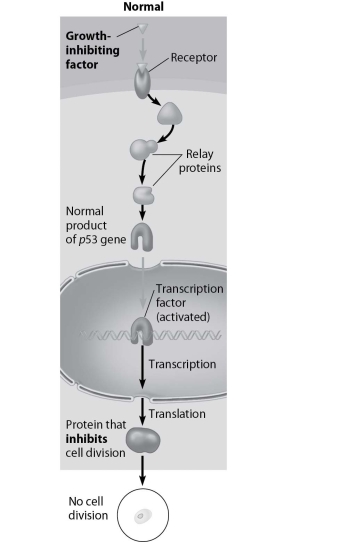
(Multiple Choice)
4.8/5 (73)
(73) Which of the following statements about microarrays is false?
(Multiple Choice)
4.8/5 (88)
(88) Which of the following processes occurs when a salamander regenerates a lost limb?
(Multiple Choice)
4.9/5 (82)
(82) A cell has a mutation in both alleles of its p53 gene that causes the p53 protein to be three times as effective as normal. What do you predict would happen to this cell?
(Multiple Choice)
4.8/5 (90)
(90) What is the correct order of structures in a chromosome from smallest to largest?
(Multiple Choice)
4.8/5 (94)
(94) Which of the following permits a single gene to code for more than one polypeptide?
(Multiple Choice)
4.8/5 (88)
(88) After reading the paragraph below, answer the questions that follow.
All apples in the United States, regardless of variety or where they're purchased, are produced by cloning. For more than 2,000 years, apple growers around the world have used a type of cloning called grafting to produce larger, better-tasting apples. Why has cloning become the primary method of apple growing? Apples grown from seeds usually don't produce apples with the same taste and appearance as that of the parent tree because there's a high degree of genetic variability among the seeds. Making identical genetic copies of the preferred fruit is the only way to get reliable apple quality.
In grafting, the shoots and branches of the desired fruit, called a scion, are attached onto the trunk and root system of a previously existing tree, called the rootstock. Both components of the graft are needed because the rootstock controls gene expression in the scion, triggering production of apples that match the cloned scion.
Grafting research can be used to produce some interesting tree combinations that are beneficial for intensive agriculture. For example, if you graft the root of a small tree variety, such as the crab apple, onto the shoot from a larger apple tree, such as the Gala, you can produce Gala apples on a much smaller tree. Other scientists are trying to create disease-resistant varieties that would need fewer pesticides. This is beneficial for the environment and also lowers the price of apples in the grocery store.
-All of the trees in an orchard were derived from the same rootstock, but half had scion "A" grafted and the other half had a different scion, scion "B," grafted. The trees that were grafted with scion "A" developed large fruits. What characteristics do you think the fruit from the trees that were grafted with scion "B" will have and why?
(Multiple Choice)
4.8/5 (84)
(84) Which of the following mechanisms of controlling gene expression occurs outside of the nucleus?
(Multiple Choice)
4.9/5 (73)
(73) 
Filters
- Essay(0)
- Multiple Choice(0)
- Short Answer(0)
- True False(0)
- Matching(0)