



 Chat with AI
Exam 32: Plant Nutrition and Transport

Exam 1: Biology: Exploring Life48 Questions
Exam 2: The Chemical Basis of Life72 Questions
Exam 3: The Molecules of Cells85 Questions
Exam 4: A Tour of the Cell90 Questions
Exam 5: The Working Cell80 Questions
Exam 6: How Cells Harvest Chemical Energy82 Questions
Exam 7: Photosynthesis: Using Light to Make Food81 Questions
Exam 8: The Cellular Basis of Reproduction and Inheritance78 Questions
Exam 9: Patterns of Inheritance77 Questions
Exam 10: Molecular Biology of the Gene82 Questions
Exam 11: How Genes Are Controlled81 Questions
Exam 12: DNA Technology and Genomics78 Questions
Exam 13: How Populations Evolve64 Questions
Exam 14: The Origin of Species58 Questions
Exam 15: Tracing Evolutionary History82 Questions
Exam 16: Microbial Life: Prokaryotes and Protists84 Questions
Exam 17: The Evolution of Plant and Fungal Diversity79 Questions
Exam 18: The Evolution of Invertebrate Diversity72 Questions
Exam 19: The Evolution of Vertebrate Diversity72 Questions
Exam 20: Unifying Concepts of Animal Structure and Function63 Questions
Exam 21: Nutrition and Digestion91 Questions
Exam 22: Gas Exchange66 Questions
Exam 23: Circulation77 Questions
Exam 24: the Immune System79 Questions
Exam 25: Control of Body Temperature and Water Balance63 Questions
Exam 26: Hormones and the Endocrine System60 Questions
Exam 27: Reproduction and Embryonic Development71 Questions
Exam 28: Nervous Systems70 Questions
Exam 29: the Senses60 Questions
Exam 30: How Animals Move69 Questions
Exam 31: Plant Structure, Growth, and Reproduction79 Questions
Exam 32: Plant Nutrition and Transport65 Questions
Exam 33: Control Systems in Plants58 Questions
Exam 34: the Biosphere: an Introduction to Earths Diverse Environments63 Questions
Exam 35: Behavioral Adaptations to the Environment52 Questions
Exam 36: Population Ecology53 Questions
Exam 37: Communities and Ecosystems60 Questions
Exam 38: Conservation Biology57 Questions
Select questions type


Plants are sometimes used for phytoremediation in areas where the soil has been contaminated with heavy metals. Suppose the Acme Remediation Company is proposing to remediate a contaminated area that you wish to restore. Acme presents you with the following data as evidence of their company's ability to remediate soil.
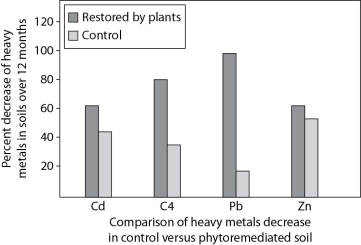 -Which would provide the best evidence that Acme's phytoremediation really works?
 (Multiple Choice)
4.9/5  (74)
(74) The term "carnivorous" as applied to carnivorous plants is not considered accurate by some biologists because
(Multiple Choice)
4.7/5 (94)
(94) In evaluating the economic feasibility of genetically modified crops, which of the following is least likely to be a concern?
(Multiple Choice)
4.9/5 (81)
(81) Which of the following essential nutrients is most likely to leach from the soil?
(Multiple Choice)
4.8/5 (73)
(73) A gardener planted large, healthy flower bulbs in her garden. When spring arrived, green shoots emerged from the bulbs, and some of them, but not all, produced flowers. She decided to dig up a few bulbs that flowered and a few that didn't to see if she could see what the difference was. She was stunned to find that none of the bulbs looked healthy; they all appeared much smaller. What had happened?
(Multiple Choice)
4.9/5 (78)
(78) Under which of the following weather conditions would transpiration be most rapid?
(Multiple Choice)
4.9/5 (70)
(70) A peanut farmer decides that she can make more money growing cotton and so plants her fields with cotton. The terrific yield of her fields is so encouraging that she continues to plant cotton for several more years, but each year her cotton yield decreases. What advice could you give her to increase her yield?
(Multiple Choice)
4.8/5 (87)
(87) The existence of a hydrostatic pressure gradient in phloem tubes can be accounted for by
(Multiple Choice)
4.9/5 (73)
(73) Which of the following would be the best way to determine if aphids must actively draw phloem sap into their digestive tract or if hydrostatic pressure in the phloem tube could force the sap into them?
(Multiple Choice)
4.9/5 (89)
(89) Which of the following options best describes the mechanism that causes a stoma to open?
(Multiple Choice)
4.9/5 (82)
(82) 
Filters
- Essay(0)
- Multiple Choice(0)
- Short Answer(0)
- True False(0)
- Matching(0)