



 Chat with AI
Exam 28: Nervous Systems

Exam 1: Biology: Exploring Life48 Questions
Exam 2: The Chemical Basis of Life72 Questions
Exam 3: The Molecules of Cells85 Questions
Exam 4: A Tour of the Cell90 Questions
Exam 5: The Working Cell80 Questions
Exam 6: How Cells Harvest Chemical Energy82 Questions
Exam 7: Photosynthesis: Using Light to Make Food81 Questions
Exam 8: The Cellular Basis of Reproduction and Inheritance78 Questions
Exam 9: Patterns of Inheritance77 Questions
Exam 10: Molecular Biology of the Gene82 Questions
Exam 11: How Genes Are Controlled81 Questions
Exam 12: DNA Technology and Genomics78 Questions
Exam 13: How Populations Evolve64 Questions
Exam 14: The Origin of Species58 Questions
Exam 15: Tracing Evolutionary History82 Questions
Exam 16: Microbial Life: Prokaryotes and Protists84 Questions
Exam 17: The Evolution of Plant and Fungal Diversity79 Questions
Exam 18: The Evolution of Invertebrate Diversity72 Questions
Exam 19: The Evolution of Vertebrate Diversity72 Questions
Exam 20: Unifying Concepts of Animal Structure and Function63 Questions
Exam 21: Nutrition and Digestion91 Questions
Exam 22: Gas Exchange66 Questions
Exam 23: Circulation77 Questions
Exam 24: the Immune System79 Questions
Exam 25: Control of Body Temperature and Water Balance63 Questions
Exam 26: Hormones and the Endocrine System60 Questions
Exam 27: Reproduction and Embryonic Development71 Questions
Exam 28: Nervous Systems70 Questions
Exam 29: the Senses60 Questions
Exam 30: How Animals Move69 Questions
Exam 31: Plant Structure, Growth, and Reproduction79 Questions
Exam 32: Plant Nutrition and Transport65 Questions
Exam 33: Control Systems in Plants58 Questions
Exam 34: the Biosphere: an Introduction to Earths Diverse Environments63 Questions
Exam 35: Behavioral Adaptations to the Environment52 Questions
Exam 36: Population Ecology53 Questions
Exam 37: Communities and Ecosystems60 Questions
Exam 38: Conservation Biology57 Questions
Select questions type


You are practicing throwing baseballs long distances with the members of your baseball team. At the same time that your partner throws the ball to you, another player across from you throws his baseball off-target, and it heads straight toward you. You hold your baseball glove up to catch your partner's ball, and you instinctively throw up your other arm to protect your face from the other incoming ball. The protective action of throwing up your arm is an example of a(n)
(Multiple Choice)
4.8/5  (76)
(76) Which of the following statements about resting potential is true?
(Multiple Choice)
4.8/5 (83)
(83) Which of the following statements about Alzheimer's disease is true?
(Multiple Choice)
4.9/5 (77)
(77) What part of the brain sorts incoming information, such as touch signals from your hand, into categories before relaying it to the cerebral cortex?
(Multiple Choice)
4.8/5 (72)
(72) The sophisticated behavior of mammals and birds is directly related to
(Multiple Choice)
4.9/5 (76)
(76) Suppose that you have a younger sibling who excels in mathematics and logic but has extreme difficulty remembering the faces of people she meets, even if she sees them again only a few hours after first meeting them. What other evidence would indicate that your sibling is left-brained?
(Multiple Choice)
4.9/5 (77)
(77) After reading the paragraphs below, answer the questions that follow.
You recently sprayed your apartment with insecticide to remove an infestation of cockroaches. In your kitchen, you noticed some roaches lying on their backs twitching furiously before they died. This aroused your curiosity, so you decided to investigate exactly how the insecticide works on the nervous system.
In your research, you discover that the insecticide you used contains a permanent acetylcholinesterase inhibitor. Acetylcholine is a neurotransmitter that stimulates skeletal muscle to contract. Acetylcholinesterase removes acetylcholine from the synapse after the signal is received. Exposure to high pesticide concentrations has a similar effect on humans, which can also be caused by exposure to the nerve gas Sarin and other chemical agents.
-Why did the insecticide cause uncontrollable twitching in the roaches?
(Multiple Choice)
4.9/5 (67)
(67) Use the figure below to answer the following questions.
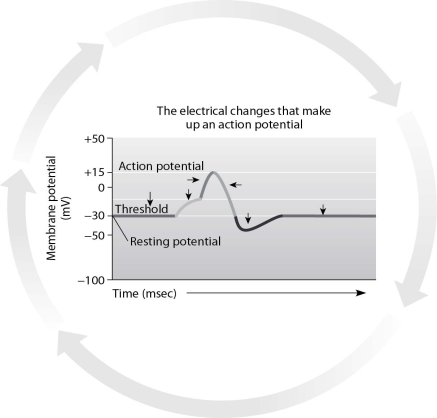 -What is the minimum change in the membrane's voltage that must occur to generate the action potential?
 (Multiple Choice)
4.8/5 (74)
(74) When the human brain's normal electrical activity is suddenly altered, a seizure can result. Seizures cause several behavioral and physical complications such as sudden mood changes, muscle spasms, or uncontrollable body shaking. Seizure impulses often start in one hemisphere of the brain and travel to the other. Which of the following surgical treatments would reduce the severity of seizures?
(Multiple Choice)
4.9/5 (78)
(78) Which of the following statements regarding the brain is true?
(Multiple Choice)
4.9/5 (89)
(89) Use the figure below to answer the following questions.
-Why do the two parts of the graph marked with arrows look identical?
-Why do the two parts of the graph marked with arrows look identical? (Multiple Choice)
4.7/5 (71)
(71) A physician friend of yours is telling you about a patient with a head injury who suddenly stopped breathing. Your friend explains that the bony rim was pressing against the breathing center. You guess that the "bony rim" (whatever that is)must have been exerting pressure in the region of the
(Multiple Choice)
4.9/5 (63)
(63) 
Filters
- Essay(0)
- Multiple Choice(0)
- Short Answer(0)
- True False(0)
- Matching(0)