



 Chat with AI
Exam 5: The Working Cell

Exam 1: Biology: Exploring Life48 Questions
Exam 2: The Chemical Basis of Life72 Questions
Exam 3: The Molecules of Cells85 Questions
Exam 4: A Tour of the Cell90 Questions
Exam 5: The Working Cell80 Questions
Exam 6: How Cells Harvest Chemical Energy82 Questions
Exam 7: Photosynthesis: Using Light to Make Food81 Questions
Exam 8: The Cellular Basis of Reproduction and Inheritance78 Questions
Exam 9: Patterns of Inheritance77 Questions
Exam 10: Molecular Biology of the Gene82 Questions
Exam 11: How Genes Are Controlled81 Questions
Exam 12: DNA Technology and Genomics78 Questions
Exam 13: How Populations Evolve64 Questions
Exam 14: The Origin of Species58 Questions
Exam 15: Tracing Evolutionary History82 Questions
Exam 16: Microbial Life: Prokaryotes and Protists84 Questions
Exam 17: The Evolution of Plant and Fungal Diversity79 Questions
Exam 18: The Evolution of Invertebrate Diversity72 Questions
Exam 19: The Evolution of Vertebrate Diversity72 Questions
Exam 20: Unifying Concepts of Animal Structure and Function63 Questions
Exam 21: Nutrition and Digestion91 Questions
Exam 22: Gas Exchange66 Questions
Exam 23: Circulation77 Questions
Exam 24: the Immune System79 Questions
Exam 25: Control of Body Temperature and Water Balance63 Questions
Exam 26: Hormones and the Endocrine System60 Questions
Exam 27: Reproduction and Embryonic Development71 Questions
Exam 28: Nervous Systems70 Questions
Exam 29: the Senses60 Questions
Exam 30: How Animals Move69 Questions
Exam 31: Plant Structure, Growth, and Reproduction79 Questions
Exam 32: Plant Nutrition and Transport65 Questions
Exam 33: Control Systems in Plants58 Questions
Exam 34: the Biosphere: an Introduction to Earths Diverse Environments63 Questions
Exam 35: Behavioral Adaptations to the Environment52 Questions
Exam 36: Population Ecology53 Questions
Exam 37: Communities and Ecosystems60 Questions
Exam 38: Conservation Biology57 Questions
Select questions type


You are adrift in the Atlantic Ocean and, being thirsty, drink the surrounding seawater. As a result,
(Multiple Choice)
4.9/5  (78)
(78) Certain cells that line the stomach synthesize a digestive enzyme and secrete it into the stomach. This enzyme is a protein. Which of the following processes could be responsible for its secretion?
(Multiple Choice)
5.0/5 (80)
(80) A group of single cell organisms collected from the ocean was brought into the lab for examination. The lab assistant was concerned that the water had become full of toxic waste products and so added clean water to the culture. All of the organisms died, and when she looked at them under the microscope, all she could see were bits and pieces of them scattered throughout the water. What likely happened?
(Multiple Choice)
4.9/5 (83)
(83) Which of the following statements regarding diffusion is false?
(Multiple Choice)
4.8/5 (76)
(76) Which part of the ATP molecule breaks free of the rest when an ATP molecule is used for energy? 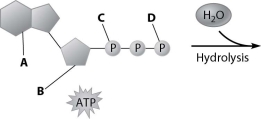
(Multiple Choice)
4.8/5 (82)
(82) Which of the following statements regarding enzymes is true?
(Multiple Choice)
4.9/5 (80)
(80) After reading the paragraph below, answer the questions that follow.
Americans spend up to $100 billion annually for bottled water (41 billion gallons). The only beverages with higher sales are carbonated soft drinks. Recent news stories have highlighted the fact that most bottled water comes from municipal water supplies (the same source as your tap water), although it may undergo an extra purification step called reverse osmosis.
Imagine two tanks that are separated by a membrane that's permeable to water, but not to the dissolved minerals present in the water. Tank A contains tap water and tank B contains the purified water. Under normal conditions, the purified water would cross the membrane to dilute the more concentrated tap water solution. In the reverse osmosis process, pressure is applied to the tap water tank to force the water molecules across the membrane into the pure water tank.
-After the reverse osmosis system has been operating for 30 minutes, the solution in tank A would
(Multiple Choice)
4.7/5 (80)
(80) Plasma membranes are selectively permeable. This means that
(Multiple Choice)
4.8/5 (80)
(80) After reading the paragraph below, answer the questions that follow.
Americans spend up to $100 billion annually for bottled water (41 billion gallons). The only beverages with higher sales are carbonated soft drinks. Recent news stories have highlighted the fact that most bottled water comes from municipal water supplies (the same source as your tap water), although it may undergo an extra purification step called reverse osmosis.
Imagine two tanks that are separated by a membrane that's permeable to water, but not to the dissolved minerals present in the water. Tank A contains tap water and tank B contains the purified water. Under normal conditions, the purified water would cross the membrane to dilute the more concentrated tap water solution. In the reverse osmosis process, pressure is applied to the tap water tank to force the water molecules across the membrane into the pure water tank.
-If you shut off the system and pressure was no longer applied to tank A, you would expect
(Multiple Choice)
4.9/5 (70)
(70) Diffusion does not require the cell to expend ATP. Therefore, diffusion is considered a type of
(Multiple Choice)
4.9/5 (85)
(85) A steer must eat at least 100 pounds of grain to gain less than 10 pounds of muscle tissue. This illustrates
(Multiple Choice)
4.9/5 (81)
(81) Figure A. Changes in permeability of tubules in the kidney in response to the hormone vasopressin (AVP), which aids in osmoregulation.
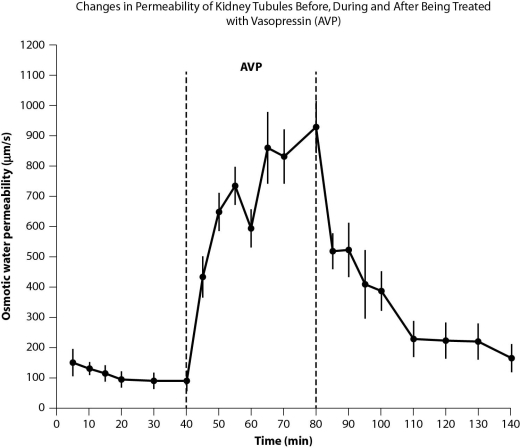 Figure B. Density of aquaporins in kidney tubule cells before, during, and after administration of vasopressin.
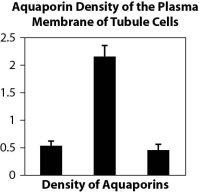 Figure C. Permeability of tissues to water before, during, and after administration of vasopressin.
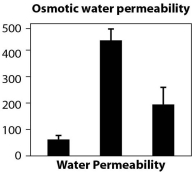 The following questions relate to these data indicating how the tubules in the kidney respond to the administration of the hormone vasopressin.
-Using the data from the graphs and what you know about membranes and metabolic pathways, predict which of the following is the likely reason why actions of aquaporins in a membrane can change so rapidly.
Figure B. Density of aquaporins in kidney tubule cells before, during, and after administration of vasopressin.
Figure C. Permeability of tissues to water before, during, and after administration of vasopressin.
The following questions relate to these data indicating how the tubules in the kidney respond to the administration of the hormone vasopressin.
-Using the data from the graphs and what you know about membranes and metabolic pathways, predict which of the following is the likely reason why actions of aquaporins in a membrane can change so rapidly. (Multiple Choice)
4.7/5 (82)
(82) 
Filters
- Essay(0)
- Multiple Choice(0)
- Short Answer(0)
- True False(0)
- Matching(0)