



 Chat with AI
Exam 23: Circulation

Exam 1: Biology: Exploring Life48 Questions
Exam 2: The Chemical Basis of Life72 Questions
Exam 3: The Molecules of Cells85 Questions
Exam 4: A Tour of the Cell90 Questions
Exam 5: The Working Cell80 Questions
Exam 6: How Cells Harvest Chemical Energy82 Questions
Exam 7: Photosynthesis: Using Light to Make Food81 Questions
Exam 8: The Cellular Basis of Reproduction and Inheritance78 Questions
Exam 9: Patterns of Inheritance77 Questions
Exam 10: Molecular Biology of the Gene82 Questions
Exam 11: How Genes Are Controlled81 Questions
Exam 12: DNA Technology and Genomics78 Questions
Exam 13: How Populations Evolve64 Questions
Exam 14: The Origin of Species58 Questions
Exam 15: Tracing Evolutionary History82 Questions
Exam 16: Microbial Life: Prokaryotes and Protists84 Questions
Exam 17: The Evolution of Plant and Fungal Diversity79 Questions
Exam 18: The Evolution of Invertebrate Diversity72 Questions
Exam 19: The Evolution of Vertebrate Diversity72 Questions
Exam 20: Unifying Concepts of Animal Structure and Function63 Questions
Exam 21: Nutrition and Digestion91 Questions
Exam 22: Gas Exchange66 Questions
Exam 23: Circulation77 Questions
Exam 24: the Immune System79 Questions
Exam 25: Control of Body Temperature and Water Balance63 Questions
Exam 26: Hormones and the Endocrine System60 Questions
Exam 27: Reproduction and Embryonic Development71 Questions
Exam 28: Nervous Systems70 Questions
Exam 29: the Senses60 Questions
Exam 30: How Animals Move69 Questions
Exam 31: Plant Structure, Growth, and Reproduction79 Questions
Exam 32: Plant Nutrition and Transport65 Questions
Exam 33: Control Systems in Plants58 Questions
Exam 34: the Biosphere: an Introduction to Earths Diverse Environments63 Questions
Exam 35: Behavioral Adaptations to the Environment52 Questions
Exam 36: Population Ecology53 Questions
Exam 37: Communities and Ecosystems60 Questions
Exam 38: Conservation Biology57 Questions
Select questions type


Whether there is a net flow of fluid into or out of a capillary at a given point along its length depends upon
(Multiple Choice)
4.9/5  (72)
(72) You are dissecting a "mystery animal" in biology lab and discover that it has a series of closed blood vessels, a pair of lungs, two atria, and a single ventricle. What animal are you dissecting?
(Multiple Choice)
4.7/5 (82)
(82) Oxygen-poor blood is carried from the heart of a mammal to the lungs via the
(Multiple Choice)
4.7/5 (81)
(81) As blood moves away from the heart toward the tissues, the relative size of blood vessels ________, the blood pressure ________, and the velocity of blood flow ________.
(Multiple Choice)
4.9/5 (76)
(76) To view the path of blood flow through the heart and body, scientists and physicians perform an angiogram by injecting a dye into the blood and monitoring its movement. Imagine that this dye was injected into the pulmonary vein. Which of the following is the correct order of structures that the dye will flow through?
(Multiple Choice)
4.9/5 (79)
(79) In which part of this figure would blood have the lowest oxygen content? 
(Multiple Choice)
4.8/5 (73)
(73) After reading the paragraphs below, answer the questions that follow.
To evaluate cardiac function, scientists and physicians measure both the pressure and the volume inside the heart. When both pressure and volume data are plotted on the same graph, the resulting graph is called a pressure-volume loop. To create a pressure-volume loop, a catheter (a thin tube) is inserted into the vessels of the heart, and measurements of both left ventricular pressure and left ventricular volume are taken. The data are plotted on a graph, and cardiac function can then be evaluated from the distribution of the data and the shape of the loop.
The figure below shows a typical left ventricle pressure-volume loop for a healthy young adult. The cardiac cycle proceeds counterclockwise. Each complete turn around the loop (for example, starting at point A and ending back at point A) represents one complete cardiac cycle.
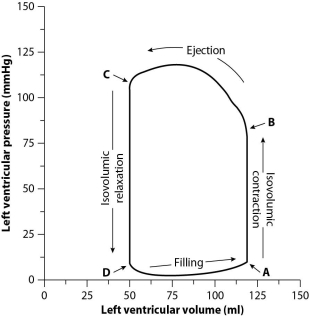 -If the time it takes to go around the loop is 1 second, what is the cardiac output in units of liters per minute?
 (Multiple Choice)
4.8/5 (86)
(86) How long do human red blood cells circulate in the blood before they wear out and have to be replaced?
(Multiple Choice)
4.9/5 (85)
(85) One way that substances move between blood and interstitial fluid is by
(Multiple Choice)
4.7/5 (85)
(85) Which of the following statements about blood clotting is true?
(Multiple Choice)
4.8/5 (75)
(75) Plasma proteins are involved in all of the following activities except
(Multiple Choice)
4.8/5 (87)
(87) Hematocrit is the percentage of red blood cells in the blood. In adult humans, hematocrit is roughly 40-45%, but it can be much higher or lower in other animals. Consider the Weddell seal, a mammal that can dive and hold its breath underwater for upwards of 80 minutes. What is the hematocrit level of a Weddell seal, and why?
(Multiple Choice)
4.8/5 (80)
(80) 
Filters
- Essay(0)
- Multiple Choice(0)
- Short Answer(0)
- True False(0)
- Matching(0)