



 Chat with AI
Exam 10: Food, Soil, and Pest Management

Exam 1: Environmental Problems, Their Causes, and Sustainability89 Questions
Exam 2: Science, Matter, and Energy107 Questions
Exam 3: Ecosystems: What Are They and How Do They Work177 Questions
Exam 4: Biodiversity and Evolution94 Questions
Exam 5: Biodiversity, Species Interactions, and Population Control93 Questions
Exam 6: The Human Population and Urbanization126 Questions
Exam 7: Climate and Biodiversity137 Questions
Exam 8: Sustaining Biodiversity: the Species Approach103 Questions
Exam 9: Sustaining Biodiversity: the Ecosystem Approach84 Questions
Exam 10: Food, Soil, and Pest Management120 Questions
Exam 11: Water Resources and Water Pollution133 Questions
Exam 12: Geology and Nonrenewable Mineral Resources99 Questions
Exam 13: Energy110 Questions
Exam 14: Environmental Hazards and Human Health97 Questions
Exam 15: Air Pollution, Climate Change, and Ozone Depletion136 Questions
Exam 16: Solid and Hazardous Waste100 Questions
Exam 17: Environmental Economics, Politics, and Worldviews97 Questions
Select questions type


Health problems faced by those who are overfed are completely different from the health problems faced by those who are underfed.
(True/False)
4.9/5  (69)
(69) Multiple cropping is a high-input approach that dramatically increased yields of food crops between 1950 and 1970.
(True/False)
4.8/5 (95)
(95) A benefit of intense industrialized agriculture in the United States is that it maximizes yields on acres in production so that large areas of forest, grasslands, and wetlands can remain unconverted.
(True/False)
4.8/5 (82)
(82) ____________________ reduces soil oxygen levels, causes accumulation of gases toxic to plants, and alters the concentration of nutrients around plant roots.
(Short Answer)
5.0/5 (88)
(88) Which statement is the best fit to describe an aspect of industrialized agriculture?
(Multiple Choice)
4.8/5 (86)
(86) Indicate whether the processes listed below are used in industrialized agriculture or organic agriculture.
-locally oriented
(Multiple Choice)
4.7/5 (80)
(80) A disadvantage to the green revolution is the intensive use of commercial inorganic fertilizers.
(True/False)
4.9/5 (77)
(77) Over time, the extensive addition of water through irrigation practices can actually lead to desertification.
(True/False)
4.9/5 (77)
(77) Which of the following types of agriculture is most characteristic of developed countries?
(Multiple Choice)
4.9/5 (76)
(76) 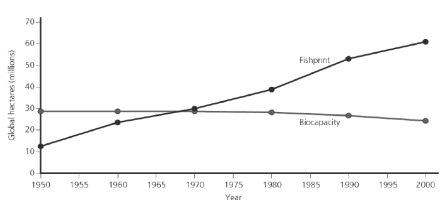 -For a given theoretical country, assume the productivity in metric tons per hectare remains stable, and the weighting factor remains the same, but the metric tons of fish harvested per year is reduced by 50%.
a.How will this affect the fishprint for this country?
-For a given theoretical country, assume the productivity in metric tons per hectare remains stable, and the weighting factor remains the same, but the metric tons of fish harvested per year is reduced by 50%.
a.How will this affect the fishprint for this country? (Essay)
4.8/5 (68)
(68) Which of the following is the root cause of food insecurity?
(Multiple Choice)
4.9/5 (72)
(72) The largest contributor to the ecological foot print of most individuals in affluent nations is
(Multiple Choice)
4.8/5 (77)
(77) Indicate whether the processes listed below are used in industrialized agriculture or organic agriculture.
-uses antibiotics to produce meat
(Multiple Choice)
4.9/5 (87)
(87) There are sufficient food resources being produced to meet the basic nutritional requirements of every person on the planet.
(True/False)
4.8/5 (81)
(81) Malnourished individuals may become more prone to infections, and eventually may develop a specific deficiency disease.
(True/False)
4.8/5 (82)
(82) Pesticides have a positive benefit in terms of public health because fungi, insects, and noncrop plants can contaminate crops with many natural toxins.
(True/False)
4.9/5 (92)
(92) Plantation agriculture is used primarily to reduce soil erosion and restore soil fertility.
(True/False)
4.7/5 (79)
(79) It takes about one unit of nonrenewable fossil fuel energy to put one unit of food energy on the table.
(True/False)
4.8/5 (90)
(90) 
Filters
- Essay(0)
- Multiple Choice(0)
- Short Answer(0)
- True False(0)
- Matching(0)