



 Chat with AI
Exam 9: Sustaining Biodiversity: the Ecosystem Approach

Exam 1: Environmental Problems, Their Causes, and Sustainability89 Questions
Exam 2: Science, Matter, and Energy107 Questions
Exam 3: Ecosystems: What Are They and How Do They Work177 Questions
Exam 4: Biodiversity and Evolution94 Questions
Exam 5: Biodiversity, Species Interactions, and Population Control93 Questions
Exam 6: The Human Population and Urbanization126 Questions
Exam 7: Climate and Biodiversity137 Questions
Exam 8: Sustaining Biodiversity: the Species Approach103 Questions
Exam 9: Sustaining Biodiversity: the Ecosystem Approach84 Questions
Exam 10: Food, Soil, and Pest Management120 Questions
Exam 11: Water Resources and Water Pollution133 Questions
Exam 12: Geology and Nonrenewable Mineral Resources99 Questions
Exam 13: Energy110 Questions
Exam 14: Environmental Hazards and Human Health97 Questions
Exam 15: Air Pollution, Climate Change, and Ozone Depletion136 Questions
Exam 16: Solid and Hazardous Waste100 Questions
Exam 17: Environmental Economics, Politics, and Worldviews97 Questions
Select questions type


Which of the following is a secondary cause of forest degradation rather than a basic cause?
(Multiple Choice)
4.9/5  (72)
(72) A plant called kenaf would help to reduce the pressure to cut trees because its fiber is very useful for
(Multiple Choice)
4.9/5 (84)
(84) Which of the following are ecological services provided by grasslands?
(Multiple Choice)
4.8/5 (77)
(77) Which common problem of U.S. a.cities is now a problem in United States national parks?
(Multiple Choice)
4.7/5 (76)
(76) The Truckee River flows out of Lake Tahoe in California, and travels northeast to drain into Pyramid Lake in Nevada.
a.The Truckee River corridor used to have a thriving cottonwood forest along its banks.
a.The tall cottonwoods arched over the river and created shade that maintained an optimal water temperature for the native trout.
a.In addition, the trees created a habitat for a number of other plants and animal species.
a.In the late 1900's, after a century of water diversions from the river, the younger cottonwoods were unable to grow because of the dry banks.
a.The cottonwood canopy was non-existent in most sections of the river.Recently, however, the native cui-ui fish in Pyramid Lake was listed as endangered.
a.Part of the recovery plan for the fish included substantial runs of water down the Truckee River.
a.After the higher water runs had been taking place for several years, a younger age category of cottonwood trees was observed to be thriving in sections of the river.What does this scenario tell us about the two different approaches to saving species?
(Essay)
5.0/5 (83)
(83) Using the graph pictured below that shows the tons of cod catch in the North Atlantic from 1900 on, match the appropriate letter with the description given. 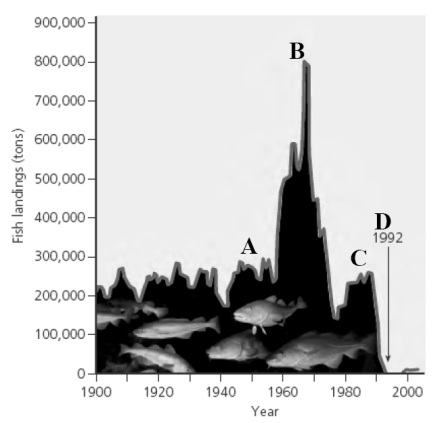 -What area on the graph represents the point when fishermen began to use bottom trawlers to catch fish?
 (Short Answer)
4.9/5 (70)
(70) Uncut forests or regenerated forests that have not been significantly impacted by humans or natural disasters for several hundred years or more are known as ____________________.
(Short Answer)
4.9/5 (90)
(90) Today, forests in the United States cover ____________________ area than they did in 1920.
(Short Answer)
4.9/5 (80)
(80) According to the National Park Service, air pollution degrades scenic views in U.S.
a.national parks more than ____________________ of the time.
(Short Answer)
4.9/5 (94)
(94) Costa Rica's largest source of income is its $1 billion-a-year tourism industry, two-thirds of which is ____________________.
(Short Answer)
4.9/5 (65)
(65) Which of the following is a fish harvesting method used for harvesting schools of fish in shallow or surface waters, which has caused the death of large numbers of dolphins?
(Multiple Choice)
4.7/5 (68)
(68) Match the items listed below with the appropriate choice
-On the tree harvesting methods figure, choose the method in which an appropriate number of individual trees are left across an area to provide seed for the production of the next crop of trees.
(Multiple Choice)
4.9/5 (69)
(69) Removing dams and allowing rivers to flow freely can help restore biodiversity.
(True/False)
4.7/5 (76)
(76) Introduction of the gray wolf to Yellowstone National Park caused the squirrel population to increase.
(True/False)
4.9/5 (93)
(93) The Green Belt Movement, founded by Wangari Maathai, combines tree planting and preservation with
(Multiple Choice)
4.8/5 (82)
(82) Reintroduction of the wolf eventually reduced attacks on domestic cattle by what other species?
(Multiple Choice)
4.9/5 (84)
(84) 
Filters
- Essay(0)
- Multiple Choice(0)
- Short Answer(0)
- True False(0)
- Matching(0)