



 Chat with AI
Exam 23: The Respiratory System

Exam 1: An Introduction to Anatomy and Physiology82 Questions
Exam 2: The Chemical Level of Organization165 Questions
Exam 3: The Cellular Level of Organization183 Questions
Exam 4: The Tissue Level of Organization121 Questions
Exam 5: The Integumentary System112 Questions
Exam 6: Osseous Tissue and Bone Structure139 Questions
Exam 7: The Axial Skeleton142 Questions
Exam 8: The Appendicular Skeleton115 Questions
Exam 9: Joints127 Questions
Exam 10: Muscle Tissue136 Questions
Exam 11: The Muscular System163 Questions
Exam 12: Neural Tissue168 Questions
Exam 13: The Spinal Cord, spinal Nerves, and Spinal Reflexes111 Questions
Exam 14: The Brain and Cranial Nerves179 Questions
Exam 15: Sensory Pathways and the Somatic Nervous System120 Questions
Exam 16: The Autonomic Nervous System and Higher-Order Functions124 Questions
Exam 17: The Special Senses166 Questions
Exam 18: The Endocrine System183 Questions
Exam 19: Blood158 Questions
Exam 20: The Heart172 Questions
Exam 21: Blood Vessels and Circulation219 Questions
Exam 22: The Lymphatic System and Immunity161 Questions
Exam 23: The Respiratory System193 Questions
Exam 24: The Digestive System208 Questions
Exam 25: Metabolism and Energetics135 Questions
Exam 26: The Urinary System129 Questions
Exam 27: Fluid, electrolyte, and Acid-Base Balance61 Questions
Exam 28: The Reproductive System197 Questions
Exam 29: Development and Inheritance140 Questions
Select questions type


The portion of the nasal cavity contained within the flexible tissues of the external nose is the
(Multiple Choice)
4.8/5  (65)
(65) Blocking afferent action potentials from the chemoreceptors in the carotid and aortic bodies would interfere with the brain's ability to regulate breathing in response to
(Multiple Choice)
4.8/5 (71)
(71) Primary bronchi are to ________ as secondary bronchi are to ________.
(Multiple Choice)
4.8/5 (75)
(75) Which of the following statements about the chloride shift is false?
(Multiple Choice)
4.9/5 (69)
(69) Roughly ________ terminal bronchioles arise from each tertiary bronchus.
(Multiple Choice)
4.7/5 (80)
(80) Ventilation performed by contraction of the external intercostals muscle is known as ________ breathing.
(Multiple Choice)
4.8/5 (87)
(87) 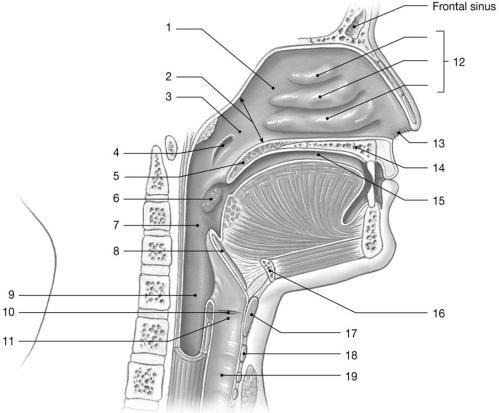 Figure 23-1 The Upper Airways
Use Figure 23-1 to answer the following questions:
-Identify the structure labeled "7."
Figure 23-1 The Upper Airways
Use Figure 23-1 to answer the following questions:
-Identify the structure labeled "7." (Multiple Choice)
4.9/5 (75)
(75) The unit of measurement for pressure preferred by many respiratory therapists is
(Multiple Choice)
4.8/5 (74)
(74) Which of the following descriptions best matches the term external intercostal?
(Multiple Choice)
4.9/5 (82)
(82)
Figure 23-1 The Upper Airways
Use Figure 23-1 to answer the following questions:
-Which structure vibrates to produce sound?
Figure 23-1 The Upper Airways
Use Figure 23-1 to answer the following questions:
-Which structure vibrates to produce sound? (Multiple Choice)
4.8/5 (84)
(84) ________ involves active inspiratory and expiratory movements and calls on accessory muscles to assist with inhalation,while exhalation involves contraction of the internal intercostal muscles and sometimes abdominal muscles,too.
(Multiple Choice)
4.9/5 (79)
(79) The airway that connects the larynx to the bronchial tree is the
(Multiple Choice)
4.7/5 (79)
(79)
Figure 23-1 The Upper Airways
Use Figure 23-1 to answer the following questions:
-What is the function of the structures labeled "12"?
Figure 23-1 The Upper Airways
Use Figure 23-1 to answer the following questions:
-What is the function of the structures labeled "12"? (Multiple Choice)
4.8/5 (81)
(81) 
Filters
- Essay(0)
- Multiple Choice(0)
- Short Answer(0)
- True False(0)
- Matching(0)