



 Chat with AI
Exam 23: The Respiratory System

Exam 1: An Introduction to Anatomy and Physiology82 Questions
Exam 2: The Chemical Level of Organization165 Questions
Exam 3: The Cellular Level of Organization183 Questions
Exam 4: The Tissue Level of Organization121 Questions
Exam 5: The Integumentary System112 Questions
Exam 6: Osseous Tissue and Bone Structure139 Questions
Exam 7: The Axial Skeleton142 Questions
Exam 8: The Appendicular Skeleton115 Questions
Exam 9: Joints127 Questions
Exam 10: Muscle Tissue136 Questions
Exam 11: The Muscular System163 Questions
Exam 12: Neural Tissue168 Questions
Exam 13: The Spinal Cord, spinal Nerves, and Spinal Reflexes111 Questions
Exam 14: The Brain and Cranial Nerves179 Questions
Exam 15: Sensory Pathways and the Somatic Nervous System120 Questions
Exam 16: The Autonomic Nervous System and Higher-Order Functions124 Questions
Exam 17: The Special Senses166 Questions
Exam 18: The Endocrine System183 Questions
Exam 19: Blood158 Questions
Exam 20: The Heart172 Questions
Exam 21: Blood Vessels and Circulation219 Questions
Exam 22: The Lymphatic System and Immunity161 Questions
Exam 23: The Respiratory System193 Questions
Exam 24: The Digestive System208 Questions
Exam 25: Metabolism and Energetics135 Questions
Exam 26: The Urinary System129 Questions
Exam 27: Fluid, electrolyte, and Acid-Base Balance61 Questions
Exam 28: The Reproductive System197 Questions
Exam 29: Development and Inheritance140 Questions
Select questions type


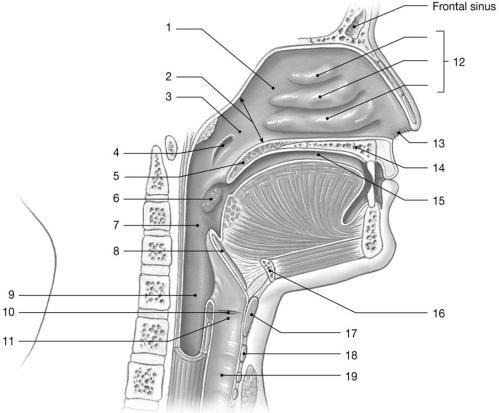 Figure 23-1 The Upper Airways
Use Figure 23-1 to answer the following questions:
-Identify the structure labeled "2."
Figure 23-1 The Upper Airways
Use Figure 23-1 to answer the following questions:
-Identify the structure labeled "2." (Multiple Choice)
4.9/5  (77)
(77)  Figure 23-2 Mechanics of Ventilation
Use Figure 23-2 to answer the following questions:
-Which muscle(s)produce(s)the movement labeled "1"?
Figure 23-2 Mechanics of Ventilation
Use Figure 23-2 to answer the following questions:
-Which muscle(s)produce(s)the movement labeled "1"? (Multiple Choice)
5.0/5 (87)
(87) The partial pressure of carbon dioxide in venous blood is approximately
(Multiple Choice)
4.8/5 (81)
(81) Decompression sickness is a painful condition that develops when a person is exposed to a sudden drop in atmospheric pressure.Bubbles of ________ gas are responsible for the problem.
(Multiple Choice)
4.9/5 (87)
(87) Which of the following factors would increase the amount of oxygen discharged by hemoglobin to peripheral tissues?
(Multiple Choice)
4.9/5 (89)
(89) When the diaphragm and external intercostal muscles contract,
(Multiple Choice)
4.9/5 (64)
(64) Air entering the body is filtered,warmed,and humidified by the
(Multiple Choice)
4.8/5 (74)
(74) The normal rate and depth of breathing is established by the ________ center(s).
(Multiple Choice)
4.7/5 (73)
(73) All of the following provide chemoreceptor input to the respiratory centers of the medulla oblongata except the
(Multiple Choice)
5.0/5 (74)
(74) During a choking episode,most foreign objects are lodged in the ________ bronchus due to its larger diameter and steeper angle.
(Multiple Choice)
4.8/5 (89)
(89) The right lung is to ________ as the left lung is to ________.
(Multiple Choice)
4.8/5 (85)
(85) Ralph is taking scuba diving classes and is warned not to hold his breath when ascending from depth but to continuously release air from his mouth.What is the basis of this instruction and what is the risk if it is ignored?
(Essay)
4.8/5 (83)
(83) The normal respiratory rate of a resting adult ranges from ________ breaths each minute,or roughly one for every four heartbeats.
(Multiple Choice)
4.8/5 (85)
(85) The ________ is shared by the respiratory and digestive systems.
(Multiple Choice)
4.8/5 (82)
(82) About 70% of carbon dioxide is transported in deoxygenated blood
(Multiple Choice)
4.9/5 (75)
(75) 
Filters
- Essay(0)
- Multiple Choice(0)
- Short Answer(0)
- True False(0)
- Matching(0)