



 Chat with AI
Exam 20: The Heart

Exam 1: An Introduction to Anatomy and Physiology81 Questions
Exam 2: The Chemical Level of Organization167 Questions
Exam 3: The Cellular Level of Organization186 Questions
Exam 4: The Tissue Level of Organization122 Questions
Exam 5: The Integumentary System111 Questions
Exam 6: Osseous Tissue and Bone Structure143 Questions
Exam 7: The Axial Skeleton148 Questions
Exam 8: The Appendicular Skeleton113 Questions
Exam 9: Articulations126 Questions
Exam 10: Muscle Tissue135 Questions
Exam 11: The Muscular System164 Questions
Exam 12: Neural Tissue168 Questions
Exam 13: The Spinal Cord, spinal Nerves, and Spinal Reflexes111 Questions
Exam 14: The Brain and Cranial Nerves179 Questions
Exam 15: Neural Integration I: Sensory Pathways and the Somatic Nervous System120 Questions
Exam 16: Neural Integration Ii: the Autonomic Nervous System and127 Questions
Exam 17: The Special Senses166 Questions
Exam 18: The Endocrine System179 Questions
Exam 19: Blood146 Questions
Exam 20: The Heart172 Questions
Exam 21: Blood Vessels and Circulation223 Questions
Exam 22: The Lymphatic System and Immunity161 Questions
Exam 23: The Respiratory System193 Questions
Exam 24: The Digestive System208 Questions
Exam 25: Metabolism and Energetics135 Questions
Exam 26: The Urinary System123 Questions
Exam 27: Fluid, electrolyte, and Acid-Base Balance59 Questions
Exam 28: The Reproductive System196 Questions
Exam 29: Development and Inheritance140 Questions
Select questions type


Blood returning to the heart from the systemic circuit first enters the
(Multiple Choice)
5.0/5  (92)
(92) 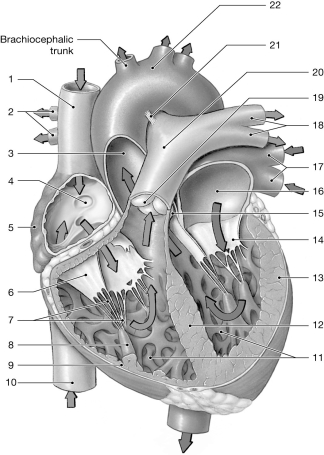 Figure 20-1 The Heart
Use Figure 20-1 to answer the following question:
-Identify the structure labeled "19."
Figure 20-1 The Heart
Use Figure 20-1 to answer the following question:
-Identify the structure labeled "19." (Multiple Choice)
4.8/5 (98)
(98) The relaxation phase of the cardiac cycle is called ________.
(Short Answer)
4.8/5 (102)
(102) Drugs known as calcium channel blockers such as nifedipine can be used to
(Multiple Choice)
4.8/5 (71)
(71) Oxygen is removed from blood as it flows through the ________ circuit.
(Short Answer)
4.7/5 (77)
(77) Tetanic muscle contractions don't occur in a normal cardiac muscle because
(Multiple Choice)
4.9/5 (78)
(78) Oxygen is added to blood as it flows through the ________ circuit.
(Short Answer)
4.9/5 (73)
(73)
Figure 20-1 The Heart
Use Figure 20-1 to answer the following question:
-Identify the structure labeled "8."
Figure 20-1 The Heart
Use Figure 20-1 to answer the following question:
-Identify the structure labeled "8." (Multiple Choice)
4.7/5 (65)
(65) Muscular ridges on the inner surface of the ventricles are called ________.
(Short Answer)
4.9/5 (69)
(69) 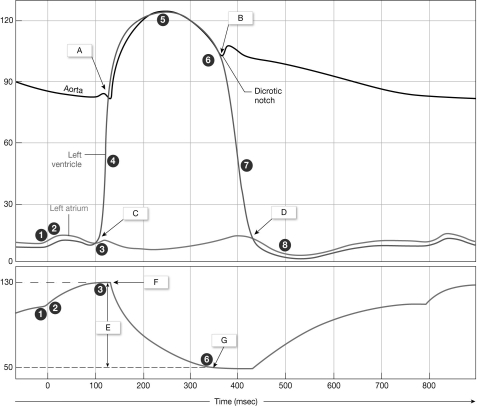 Figure 20-2 Cardiac Cycle
Use Figure 20-2 to answer the following question:
-What occurs at the area labeled "B" on the graph?
Figure 20-2 Cardiac Cycle
Use Figure 20-2 to answer the following question:
-What occurs at the area labeled "B" on the graph? (Multiple Choice)
4.8/5 (88)
(88) Cardiac muscle cells and skeletal muscle cells differ in a few ways.Which of the following is not one of them?
(Multiple Choice)
4.8/5 (89)
(89) A fine tubular wire mesh called a ________ may be inserted into a coronary vessel,holding it open.
(Short Answer)
4.9/5 (70)
(70) The systolic part (both atrial and ventricular)of a cardiac cycle lasts on average
(Multiple Choice)
4.7/5 (77)
(77) Pacemaker cells isolated from the SA node generate action potentials at ________ beats per minute.
(Multiple Choice)
4.8/5 (82)
(82) 
Filters
- Essay(0)
- Multiple Choice(0)
- Short Answer(0)
- True False(0)
- Matching(0)