



 Chat with AI
Exam 20: The Heart

Exam 1: An Introduction to Anatomy and Physiology81 Questions
Exam 2: The Chemical Level of Organization167 Questions
Exam 3: The Cellular Level of Organization186 Questions
Exam 4: The Tissue Level of Organization122 Questions
Exam 5: The Integumentary System111 Questions
Exam 6: Osseous Tissue and Bone Structure143 Questions
Exam 7: The Axial Skeleton148 Questions
Exam 8: The Appendicular Skeleton113 Questions
Exam 9: Articulations126 Questions
Exam 10: Muscle Tissue135 Questions
Exam 11: The Muscular System164 Questions
Exam 12: Neural Tissue168 Questions
Exam 13: The Spinal Cord, spinal Nerves, and Spinal Reflexes111 Questions
Exam 14: The Brain and Cranial Nerves179 Questions
Exam 15: Neural Integration I: Sensory Pathways and the Somatic Nervous System120 Questions
Exam 16: Neural Integration Ii: the Autonomic Nervous System and127 Questions
Exam 17: The Special Senses166 Questions
Exam 18: The Endocrine System179 Questions
Exam 19: Blood146 Questions
Exam 20: The Heart172 Questions
Exam 21: Blood Vessels and Circulation223 Questions
Exam 22: The Lymphatic System and Immunity161 Questions
Exam 23: The Respiratory System193 Questions
Exam 24: The Digestive System208 Questions
Exam 25: Metabolism and Energetics135 Questions
Exam 26: The Urinary System123 Questions
Exam 27: Fluid, electrolyte, and Acid-Base Balance59 Questions
Exam 28: The Reproductive System196 Questions
Exam 29: Development and Inheritance140 Questions
Select questions type


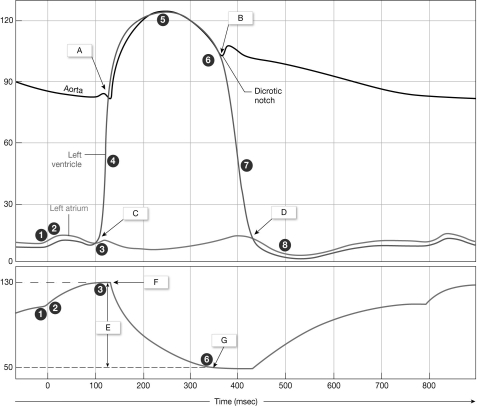 Figure 20-2 Cardiac Cycle
Use Figure 20-2 to answer the following question:
-What occurs at the circled label "7" on the graph?
Figure 20-2 Cardiac Cycle
Use Figure 20-2 to answer the following question:
-What occurs at the circled label "7" on the graph? (Multiple Choice)
4.8/5  (85)
(85) The structure that permits blood flow from the right atrium to the left atrium in the fetal circulation is the
(Multiple Choice)
4.8/5 (73)
(73)
Figure 20-2 Cardiac Cycle
Use Figure 20-2 to answer the following question:
-What occurs at the circled label "4" on the graph?
Figure 20-2 Cardiac Cycle
Use Figure 20-2 to answer the following question:
-What occurs at the circled label "4" on the graph? (Multiple Choice)
4.8/5 (88)
(88) The ________ is a remnant of an important fetal blood vessel that once linked the pulmonary and systemic circuits.
(Short Answer)
4.8/5 (88)
(88) A patient has an end-diastolic volume of 125 ml. A heart attack has weakened her left ventricle so it can pump a stroke volume of only 40 ml. Calculate her end-systolic volume.
(Multiple Choice)
5.0/5 (91)
(91)
Figure 20-2 Cardiac Cycle
Use Figure 20-2 to answer the following question:
-What volume is labeled "G" on the graph?
Figure 20-2 Cardiac Cycle
Use Figure 20-2 to answer the following question:
-What volume is labeled "G" on the graph? (Multiple Choice)
4.7/5 (84)
(84) In the middle of the thoracic cavity is a region occupied by the heart,great vessels,thymus,esophagus,and trachea called the
(Multiple Choice)
4.9/5 (86)
(86) Depolarization of the ventricles is represented on an electrocardiogram by the
(Multiple Choice)
5.0/5 (85)
(85) The right pulmonary veins carry ________ blood to the ________ .
(Multiple Choice)
4.9/5 (85)
(85) If a patient's resting cardiac output is 5.6 l/min and on a stress test she elevated her heart rate to a maximum of 176 beats/min with a stroke volume of 115 ml/beat,what is her cardiac reserve? Show your work.
(Essay)
4.9/5 (89)
(89) Each of the following factors will increase cardiac output,except
(Multiple Choice)
4.7/5 (82)
(82) The ________ lines the chambers of the heart,covers the heart valves,and is continuous with the endothelium.
(Short Answer)
4.9/5 (74)
(74) 
Filters
- Essay(0)
- Multiple Choice(0)
- Short Answer(0)
- True False(0)
- Matching(0)