



 Chat with AI
Exam 20: The Heart

Exam 1: An Introduction to Anatomy and Physiology81 Questions
Exam 2: The Chemical Level of Organization167 Questions
Exam 3: The Cellular Level of Organization186 Questions
Exam 4: The Tissue Level of Organization122 Questions
Exam 5: The Integumentary System111 Questions
Exam 6: Osseous Tissue and Bone Structure143 Questions
Exam 7: The Axial Skeleton148 Questions
Exam 8: The Appendicular Skeleton113 Questions
Exam 9: Articulations126 Questions
Exam 10: Muscle Tissue135 Questions
Exam 11: The Muscular System164 Questions
Exam 12: Neural Tissue168 Questions
Exam 13: The Spinal Cord, spinal Nerves, and Spinal Reflexes111 Questions
Exam 14: The Brain and Cranial Nerves179 Questions
Exam 15: Neural Integration I: Sensory Pathways and the Somatic Nervous System120 Questions
Exam 16: Neural Integration Ii: the Autonomic Nervous System and127 Questions
Exam 17: The Special Senses166 Questions
Exam 18: The Endocrine System179 Questions
Exam 19: Blood146 Questions
Exam 20: The Heart172 Questions
Exam 21: Blood Vessels and Circulation223 Questions
Exam 22: The Lymphatic System and Immunity161 Questions
Exam 23: The Respiratory System193 Questions
Exam 24: The Digestive System208 Questions
Exam 25: Metabolism and Energetics135 Questions
Exam 26: The Urinary System123 Questions
Exam 27: Fluid, electrolyte, and Acid-Base Balance59 Questions
Exam 28: The Reproductive System196 Questions
Exam 29: Development and Inheritance140 Questions
Select questions type


As blood leaves the right ventricle it passes through the ________ and then into the pulmonary trunk.
(Multiple Choice)
5.0/5  (79)
(79) The heart pumps approximately ________ liters of blood each day.
(Multiple Choice)
4.8/5 (75)
(75) The cardiac ________ is the difference between the resting and maximal cardiac output.
(Short Answer)
4.8/5 (86)
(86) As a result of the long refractory period in the cardiac action potential,cardiac muscle cannot exhibit
(Multiple Choice)
4.9/5 (78)
(78) Intercalated discs serve to transfer ________ from cell to cell.
(Multiple Choice)
4.8/5 (87)
(87) The cardioacceleratory center activates sympathetic neurons and the cardioinhibitory center controls parasympathetic neurons.
(Multiple Choice)
4.8/5 (66)
(66) 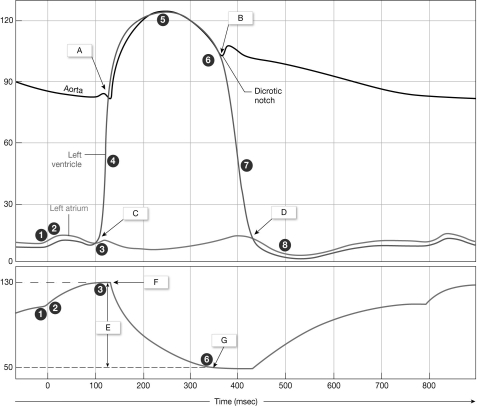 Figure 20-2 Cardiac Cycle
Use Figure 20-2 to answer the following question:
-What volume is labeled "F" on the graph?
Figure 20-2 Cardiac Cycle
Use Figure 20-2 to answer the following question:
-What volume is labeled "F" on the graph? (Multiple Choice)
4.7/5 (74)
(74) The ________ valve prevents backward flow into the left atrium.
(Multiple Choice)
4.8/5 (82)
(82) The space between the pleural cavities is called the ________.
(Short Answer)
4.8/5 (87)
(87) Most of the mass of the heart lies to the ________ of the midline.
(Short Answer)
4.9/5 (65)
(65)
Figure 20-2 Cardiac Cycle
Use Figure 20-2 to answer the following question:
-What occurs at the area labeled "D" on the graph?
Figure 20-2 Cardiac Cycle
Use Figure 20-2 to answer the following question:
-What occurs at the area labeled "D" on the graph? (Multiple Choice)
4.8/5 (88)
(88)
Figure 20-2 Cardiac Cycle
Use Figure 20-2 to answer the following question:
-What volume is labeled "E" on the graph?
Figure 20-2 Cardiac Cycle
Use Figure 20-2 to answer the following question:
-What volume is labeled "E" on the graph? (Multiple Choice)
5.0/5 (86)
(86) 
Filters
- Essay(0)
- Multiple Choice(0)
- Short Answer(0)
- True False(0)
- Matching(0)