



 Chat with AI
Exam 11: Capital Budgeting and Risk

Exam 1: The Role and Objective of Financial Management81 Questions
Exam 2: The Domestic and International Financial Marketplace78 Questions
Exam 3: Evaluation of Financial Performance104 Questions
Exam 4: Financial Planning and Forecasting67 Questions
Exam 5: The Time Value of Money113 Questions
Exam 6: Fixed Income Securities: Characteristics and Valuation126 Questions
Exam 7: Common Stock: Characteristics, Valuation, and Issuance114 Questions
Exam 8: Analysis of Risk and Return114 Questions
Exam 9: Capital Budgeting and Cash Flow Analysis92 Questions
Exam 10: Capital Budgeting: Decision Criteria and Real Option Considerations106 Questions
Exam 11: Capital Budgeting and Risk78 Questions
Exam 12: The Cost of Capital104 Questions
Exam 13: Capital Structure Concepts75 Questions
Exam 14: Capital Structure Management in Practice85 Questions
Exam 15: Dividend Policy96 Questions
Exam 16: Working Capital Policy and Short-term Financing81 Questions
Exam 17: The Management of Cash and Marketable Securities80 Questions
Exam 18: Management of Accounts Receivable and Inventories80 Questions
Exam 19: Lease and Intermediate-term Financing52 Questions
Exam 20: Financing With Derivatives80 Questions
Exam 21: Risk Management49 Questions
Exam 22: International Financial Management51 Questions
Exam 23: Corporate Restructuring75 Questions
Exam 24: Continuous Compounding and Discounting28 Questions
Exam 25: Mutually Exclusive Investments Having Unequal Lives21 Questions
Exam 26: Breakeven Analysis23 Questions
Exam 27: Bond Refunding Analysis19 Questions
Exam 28: Taxes19 Questions
Select questions type


Determine the pure project beta of a project that has 45% debt and 55% equity. The beta for the company is 1.6 and a tax rate of 40%.
(Multiple Choice)
4.9/5  (78)
(78) The ____ of a firm is a weighted average of the ____ of the individual assets in the firm.
(Multiple Choice)
4.9/5 (68)
(68) The certainty equivalent approach adjusts the ____ for risk in the ____ of the net present value equation.
(Multiple Choice)
4.8/5 (93)
(93) Technico plans to start a new product division that will have a capital structure of 70 percent debt and 30 percent equity. The levered beta for this division has been estimated to be 2.02. What will be Technico's weighted cost of capital for this new division if the after-tax cost of debt is 7 percent, the risk-free rate is 8 percent, and the market risk premium is 5 percent?
(Multiple Choice)
4.9/5 (77)
(77) Faris currently has a capital structure of 40 percent debt and 60 percent equity, but is considering a new product that will be produced and marketed by a separate division. The new division will have a capital structure of 70 percent debt and 30 percent equity. Faris has a current beta of 1.1, but is not sure what the beta for the new division will be. AMX is a firm that produces a product similar to the product under consideration by Faris. AMX has a beta of 1.6, a capital structure of 40 percent debt and 60 percent equity and a marginal tax rate of 40 percent. If Faris' tax rate is 40 percent, estimate the levered beta for the new product division?
(Multiple Choice)
4.9/5 (91)
(91) What is the reason companies utilize the certainty equivalent approach in evaluating projects?
(Essay)
4.8/5 (68)
(68) MedChem has a capital structure of 60% equity and 40% debt and a current beta of 1.2. MedChem is considering an investment project in a new line of business that has an expected internal rate of return of 16%. The typical firm already in the line of business that MedChem is considering expanding into has a beta of 1.5 and a capital structure that has 55% debt and 45% equity. The marginal tax rate for all these firms, including MedChem, is 40%. If the current risk-free rate is 7% and the expected market risk premium is 8%, should MedChem expand into the new line? Assume that MedChem will retain its current capital structure.
(Multiple Choice)
4.9/5 (86)
(86) The ____ approach is widely used by firms that attempt to consider differential project risk in their capital budgeting procedures.
(Multiple Choice)
4.9/5 (84)
(84) Which of the following statements is correct about adjusting for beta risk in capital budgeting?
(Multiple Choice)
4.9/5 (77)
(77) IKON is financed entirely with equity and its beta is 1.31. If the current risk-free rate is 6.25% and the expected market return is 12.8%, what is IKON's required rate of return on a project of average risk?
(Multiple Choice)
4.9/5 (93)
(93) A project has an expected NPV of $50,000 with a standard deviation of the NPV of $20,000. Assume that NPV is normally distributed. What is the probability that the project will have a net present value greater than $60,000?
(Multiple Choice)
4.8/5 (80)
(80) The most expensive method of adjusting for total project risk in the evaluation of capital budgeting projects is the
(Multiple Choice)
4.9/5 (68)
(68) The certainty equivalent factors used in capital budgeting analysis are equal to the ____ divided by ____.
(Multiple Choice)
4.7/5 (85)
(85) SCAN is a multi-divisional utility company. SCAN has four divisions with the following betas and proportions of the firm's total assets:  The risk-free rate is 8 percent and the market risk premium is 5 percent. If SCAN is considering a residential development, what should the firm use as its cost of equity in evaluating this project?
 (Multiple Choice)
4.9/5 (83)
(83) All of the following techniques are used to measure total project risk EXCEPT:
(Multiple Choice)
4.8/5 (76)
(76) A major disadvantage of the risk-adjusted discount rate approach is that it
(Multiple Choice)
4.7/5 (87)
(87) Smart Bumpkins wants to increase production by adding new equipment. The cost of the upgrade is $190,000 and expected cash flows from the new upgrade are expected to be as follows over the next 6 years and the risk free rate is 5%. Should the company upgrade? 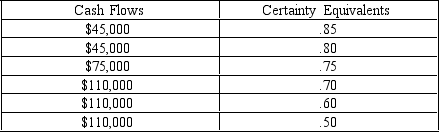
(Multiple Choice)
4.7/5 (81)
(81) The ____ the amount of debt in a firm's capital structure, the ____ will be the firm's beta.
(Multiple Choice)
4.8/5 (87)
(87) Project C has been classified into risk class II by the analyst of a major firm. The risk premium required for projects in this risk class is 8%. The current risk-free rate measured by the analyst is 10%. If the project has an estimated return of 20%, the analyst would recommend
(Multiple Choice)
4.9/5 (90)
(90) The Bull Company, a lawn mower manufacturer, is considering the introduction of a new model. The initial outlay required is $22 million. Net cash flows over the 4-year life cycle and the corresponding certainty-equivalents of the new model are as follows:  The firm's cost of capital is 14% and the risk-free rate is 6%. Bull uses the certainty-equivalent approach in evaluating above-average risk investments such as this one. What is the project's certainty-equivalent NPV?
 (Multiple Choice)
4.8/5 (84)
(84) 
Filters
- Essay(0)
- Multiple Choice(0)
- Short Answer(0)
- True False(0)
- Matching(0)