



 Chat with AI
Exam 12: The Cost of Capital

Exam 1: The Role and Objective of Financial Management81 Questions
Exam 2: The Domestic and International Financial Marketplace78 Questions
Exam 3: Evaluation of Financial Performance104 Questions
Exam 4: Financial Planning and Forecasting67 Questions
Exam 5: The Time Value of Money113 Questions
Exam 6: Fixed Income Securities: Characteristics and Valuation126 Questions
Exam 7: Common Stock: Characteristics, Valuation, and Issuance114 Questions
Exam 8: Analysis of Risk and Return114 Questions
Exam 9: Capital Budgeting and Cash Flow Analysis92 Questions
Exam 10: Capital Budgeting: Decision Criteria and Real Option Considerations106 Questions
Exam 11: Capital Budgeting and Risk78 Questions
Exam 12: The Cost of Capital104 Questions
Exam 13: Capital Structure Concepts75 Questions
Exam 14: Capital Structure Management in Practice85 Questions
Exam 15: Dividend Policy96 Questions
Exam 16: Working Capital Policy and Short-term Financing81 Questions
Exam 17: The Management of Cash and Marketable Securities80 Questions
Exam 18: Management of Accounts Receivable and Inventories80 Questions
Exam 19: Lease and Intermediate-term Financing52 Questions
Exam 20: Financing With Derivatives80 Questions
Exam 21: Risk Management49 Questions
Exam 22: International Financial Management51 Questions
Exam 23: Corporate Restructuring75 Questions
Exam 24: Continuous Compounding and Discounting28 Questions
Exam 25: Mutually Exclusive Investments Having Unequal Lives21 Questions
Exam 26: Breakeven Analysis23 Questions
Exam 27: Bond Refunding Analysis19 Questions
Exam 28: Taxes19 Questions
Select questions type


Temple Company's common stock dividends have grown over the past 5-year period from $0.60 per share to $0.89 (today). Assume that Temple's dividends are expected to grow at this rate for the foreseeable future. Temple's stock is currently selling for $12 per share. New common stock can be sold to net the company $11 per share. Determine the costs of internal and external equity to Temple.

Free
(Multiple Choice)
5.0/5  (84)
(84) Correct Answer: Verified
C
Whipple Industries, Inc. is in the process of determining its optimal capital budget for next year. The following investment projects are under consideration:  The firm's marginal cost of capital schedule is as follows:
 Determine Whipple's optimal capital budget (in dollars) for the coming year.
The firm's marginal cost of capital schedule is as follows:
Determine Whipple's optimal capital budget (in dollars) for the coming year.Free
(Multiple Choice)
4.9/5 (89)
(89) Correct Answer:Verified
VerifiedA
What does the optimal capital budget maximize? How it is determined?
Free
(Essay)
4.9/5 (96)
(96) Correct Answer:Verified
VerifiedThe optimal capital budget meximizes the value of the firm and occurs at the point where the firm's investmnt opportunity curve and weighted marginal cost of capital curve intersect.
What is the cost of equity for Fat Rat Laboratories, Inc.? The stock has the following dividends, the stock sells for $70 with flotation costs of $6 and it expects to pay a dividend of $3.20 next year (rounded). 
(Multiple Choice)
4.9/5 (85)
(85) The Allegheny Valley Power Company common stock has a beta of 0.80. If the current risk-free rate is 6.5% and the expected return on the stock market as a whole is 16%, determine the cost of equity capital for the firm (using the CAPM).
(Multiple Choice)
4.9/5 (78)
(78) If a firm will use only equity funds during the current capital budgeting period then the ____ is the correct capital cost to use for computing the cost of funds for the firm.
(Multiple Choice)
4.8/5 (86)
(86) According to Value Line, Bestway has a beta of 1.15. If 3-month Treasury bills currently yield 7.9 percent and the market risk premium is estimated to be 8.3 percent, what is Bestway's cost of equity capital?
(Multiple Choice)
4.8/5 (74)
(74) If a firm is losing money then the after-tax cost of debt is
(Multiple Choice)
4.9/5 (77)
(77) There are two primary ways that capital is raised. Which of the following statements is/are correct?
I. Capital is raised internally by using retained earnings.
II. Capital is raised externally by selling fixed assets.
(Multiple Choice)
4.7/5 (70)
(70) Calculate the after-tax cost of preferred stock for Ohio Valley Power Company, which is planning to sell $100 million of $3.25 cumulative preferred stock to the public at a price of $25 per share. Flotation costs are $1.00 per share. Ohio Valley has a marginal income tax rate of 40%.
(Multiple Choice)
4.8/5 (91)
(91) A firm is determining its cost of common stock equity. It last paid a divided of $.52, the dividends are growing at 5%, flotation costs are $2 per share and the firm will net $72 per share upon the sale of the stock. What is the firm's cost of common equity?
(Multiple Choice)
4.8/5 (82)
(82) In determining the cost of debt, several factors must be considered. All of the following are those factors EXCEPT:
(Multiple Choice)
4.8/5 (72)
(72) Groves, Inc. pays an annual dividend of $1.22. This dividend is expected to continue growing at a rate of about 5 percent each year. The firm is in a fairly risky business and has a beta of 1.45. The expected market rate of return is 13.5 percent, and the risk-free rate is 9.3 percent. What is the cost of equity for Groves?
(Multiple Choice)
4.9/5 (81)
(81) The following financial information is available on Rawls Manufacturing Company:  Rawls can issue new common stock to net the company $44 per share. Determine the cost of internal equity capital using the capital asset pricing model approach. (Compute answer to the nearest 0.1%).
 (Multiple Choice)
5.0/5 (69)
(69) Break points can be determined by dividing the amount of funds available from each financing source at a fixed cost by the ____ proportion for that financing source.
(Multiple Choice)
4.9/5 (65)
(65) The most appropriate weights to use in calculating a firm's cost of capital are the proportions of the components in the firm's ____ capital structure.
(Multiple Choice)
4.7/5 (88)
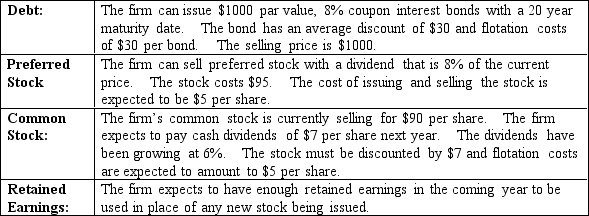
(88) What is the cost of retained earnings for Foggy Futures Weather Forecasters? The firm is in the 40% tax bracket. The optimal capital structure is listed below: 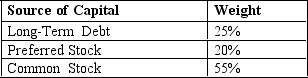
(Multiple Choice)
4.8/5 (76)
(76) The constant growth valuation model approach to calculating the cost of equity assumes that
(Multiple Choice)
4.9/5 (75)
(75) Which of the following statements regarding the cost of capital is/are correct? I. The weighted cost of capital is the discount rate used when computing the net present value.
II) The after-tax cost of capital is weighted by the proportions of the capital components in the firm's long-range target capital structure.
(Multiple Choice)
4.8/5 (87)
(87) 
Filters
- Essay(0)
- Multiple Choice(0)
- Short Answer(0)
- True False(0)
- Matching(0)