



 Chat with AI
Exam 11: Capital Budgeting and Risk

Exam 1: The Role and Objective of Financial Management81 Questions
Exam 2: The Domestic and International Financial Marketplace78 Questions
Exam 3: Evaluation of Financial Performance104 Questions
Exam 4: Financial Planning and Forecasting67 Questions
Exam 5: The Time Value of Money113 Questions
Exam 6: Fixed Income Securities: Characteristics and Valuation126 Questions
Exam 7: Common Stock: Characteristics, Valuation, and Issuance114 Questions
Exam 8: Analysis of Risk and Return114 Questions
Exam 9: Capital Budgeting and Cash Flow Analysis92 Questions
Exam 10: Capital Budgeting: Decision Criteria and Real Option Considerations106 Questions
Exam 11: Capital Budgeting and Risk78 Questions
Exam 12: The Cost of Capital104 Questions
Exam 13: Capital Structure Concepts75 Questions
Exam 14: Capital Structure Management in Practice85 Questions
Exam 15: Dividend Policy96 Questions
Exam 16: Working Capital Policy and Short-term Financing81 Questions
Exam 17: The Management of Cash and Marketable Securities80 Questions
Exam 18: Management of Accounts Receivable and Inventories80 Questions
Exam 19: Lease and Intermediate-term Financing52 Questions
Exam 20: Financing With Derivatives80 Questions
Exam 21: Risk Management49 Questions
Exam 22: International Financial Management51 Questions
Exam 23: Corporate Restructuring75 Questions
Exam 24: Continuous Compounding and Discounting28 Questions
Exam 25: Mutually Exclusive Investments Having Unequal Lives21 Questions
Exam 26: Breakeven Analysis23 Questions
Exam 27: Bond Refunding Analysis19 Questions
Exam 28: Taxes19 Questions
Select questions type


Rolling in Dough Cookie Corporation is trying to determine its certainty equivalent NPV. What is the CNPV if the risk free ratel is 2% and the initial investment is $19,000 (rounded)? 

Free
(Multiple Choice)
4.7/5  (74)
(74) Correct Answer: Verified
B
The net present value of a project is normally distributed with an expected value of $52,000 and a standard deviation of $31,515. Determine the probability that the project will have a net present value of less than zero.
Free
(Multiple Choice)
4.9/5 (74)
(74) Correct Answer:Verified
VerifiedC
Quick Flick is considering two investments. Both require a net investment of $120,000 and have the following net cash flows: 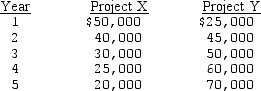 Quick uses a combination of the net present value approach and the payback approach to evaluate investment alternatives. The firm uses a discount rate of 14 percent and requires that all projects have a payback period no longer than 3 years. Which investment or investments should Quick accept?
 (Multiple Choice)
4.7/5 (91)
(91) A simulation analysis for a new acquisition has indicated that the expected NPV is $50 million with a standard deviation of $40 million. Assume that NPV is normally distributed. What is the probability that the project will be unacceptable?
(Multiple Choice)
4.8/5 (76)
(76) The certainty equivalent factors used to adjust the cash flows for risk can range from
(Multiple Choice)
4.7/5 (83)
(83) Haulin'It Towing Company is considering adding more tow trucks to its fleet. The cost of the new trucks is $150,000. The project will utilize the risk adjusted discount, the firm has a beta of 1.3, the risk free rate is 7% and the return in the market is 15%. Should Haulin' It add the additional trucks if the expected increased revenues will be as follows? 
(Multiple Choice)
4.8/5 (83)
(83) DKA uses the certainty equivalent approach to deal with total project risk and is considering a project with the following: 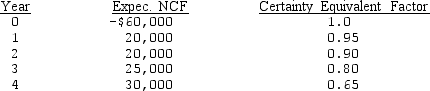 What is the certainty equivalent NPV for this project if the risk-free rate is 8% and the required return on the market portfolio is 15%?
 (Multiple Choice)
4.7/5 (85)
(85) What item has made sensitivity analysis simple and inexpensive?
(Multiple Choice)
4.8/5 (85)
(85) The Chris-Kraft Co. is financed entirely with equity and the firm has a beta of 1.25. The current risk-free rate is 7 percent and the expected market return is 15 percent. Chris-Kraft is considering an investment project with a risk that matches the firm's average risk, requires a net investment of $70,000, and has net cash flows of $18,000 per year for 8 years. Should Chris-Kraft invest in the project?
(Multiple Choice)
4.9/5 (86)
(86) With the risk adjusted discount rate approach, in the context of total risk, the discount rates used in evaluating cash flows are determined ____.
(Multiple Choice)
4.8/5 (92)
(92) Which of the following is/are a risk associated with projects that must be considered when determining the net present value?
I. Financial risk
II. Pure project risk
(Multiple Choice)
4.8/5 (82)
(82) M-tel is financed entirely with equity and the firm's stock has a beta of 0.85. M-tel is considering investing in a project that is expected to have a beta of 1.3. The project requires an initial outlay of $6 million and is expected to generate after-tax net cash flows of $1.3 million each year for 8 years. Calculate the NPV of the project. Assume the risk-free rate is 7% and the expected market return is 14%. (Note: Problem requires either calculator use or interpolation from the tables. The suggested solutions use calculator accuracy.)
(Multiple Choice)
4.9/5 (87)
(87) The type of analysis that models some event and requires that estimates be made of the probability distribution of each cash flow element is:
(Multiple Choice)
4.7/5 (82)
(82) A major problem with using the risk-adjusted discount rate approach is the determination of
(Multiple Choice)
4.9/5 (68)
(68) The net present value/payback approach is a useful approach when
(Multiple Choice)
4.8/5 (81)
(81) ____ are needed for sensitivity analysis and have made the application simple and inexpensive.
(Multiple Choice)
5.0/5 (74)
(74) Determine the coefficient of variation for the following annual cash in flows from an investment project: 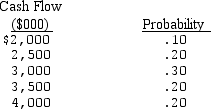
(Multiple Choice)
4.8/5 (80)
(80) SCAN is a multi-divisional utility company. SCAN has four divisions with the following betas and proportions of the firm's total assets:  What is the firm's weighted average beta?
 (Multiple Choice)
4.9/5 (67)
(67) 
Filters
- Essay(0)
- Multiple Choice(0)
- Short Answer(0)
- True False(0)
- Matching(0)