



 Chat with AI
Exam 15: A Brief History of Life on Earth

Exam 1: Earth As a Planet85 Questions
Exam 2: Earth Materials75 Questions
Exam 3: How Old Is Old the Rock Record and Geologic Time72 Questions
Exam 4: Plate Tectonics74 Questions
Exam 5: Earthquakes and Earths Interior72 Questions
Exam 6: Volcanoes and Igneous Rocks80 Questions
Exam 7: Weathering and Erosion73 Questions
Exam 8: From Sediment to Sedimentary Rock75 Questions
Exam 9: Folds, faults, and Geological Maps75 Questions
Exam 10: Metamorphism: New Rock From Old76 Questions
Exam 11: Water on and Under the Ground75 Questions
Exam 12: The Ocean and the Atmosphere75 Questions
Exam 13: Climatic Extremes: Deserts and Glaciers74 Questions
Exam 14: Earths Climates: Past, present, future80 Questions
Exam 15: A Brief History of Life on Earth75 Questions
Exam 16: Understanding Earths Resources75 Questions
Select questions type


The mass extinction event at the end of the Mesozoic Era (the K-T extinction)is hypothesized as the result of extraterrestrial impact.Discuss the evidences and consequences of such an impact.
(Essay)
4.9/5  (86)
(86) After the Neandertals disappeared,the oldest group of Homo sapiens appeared in Europe approximately _____ years ago.
(Multiple Choice)
4.8/5 (92)
(92) The Earth's secondary atmosphere most likely developed from _____.
(Multiple Choice)
4.8/5 (82)
(82) The earliest skeletal animals were arthropods in the Cambrian Period.What are arthropods and which creatures are typical examples?
(Essay)
4.9/5 (83)
(83) The concept of a "species" is a population of genetically related individuals that can _____.
(Multiple Choice)
4.8/5 (82)
(82) How does the scientific use of the term "theory" differ from everyday use?
(Essay)
4.9/5 (95)
(95) A modern view of evolution,involving persistence of species for long times without change followed by rapid change,is called ______.
(Short Answer)
4.8/5 (85)
(85) The process in which sunlight breaks down water molecules into hydrogen and oxygen is called _____.
(Short Answer)
4.7/5 (90)
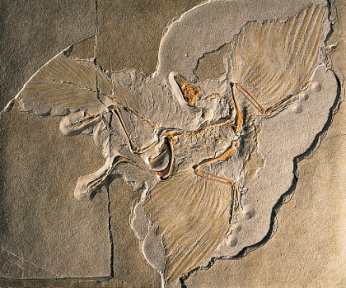
(90) The detailed impressions of feathers in this fossil identify it as a dinosaur.
(True/False)
4.7/5 (78)
(78) Which of the following did NOT lead to conditions that were hostile to life on the early Earth,before 3.8 billion years ago?
(Multiple Choice)
4.9/5 (84)
(84) The Burgess Shale in British Columbia is famous for containing _____.
(Multiple Choice)
4.7/5 (86)
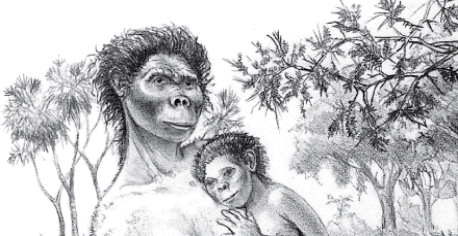
(86) The fossil called "Lucy," as reconstructed below,is a specimen of the early hominid genus _____.
(Short Answer)
4.8/5 (95)
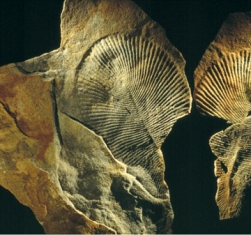
(95) What were the oldest multicellular fossils,such as the Dickinsoniashown below,and where were they found?
(Essay)
4.8/5 (78)
(78) The earliest eukaryotic multicellular life is found near the end of the _____ Eon.
(Short Answer)
4.9/5 (92)
(92) A type of sedimentary rock formed during the transition from a reducing to an oxidizing atmosphere is known asbanded ______ formation.
(Short Answer)
4.7/5 (81)
(81) How does the early history of atmospheric oxygen track with the history of life?
(Essay)
4.9/5 (64)
(64) 
Filters
- Essay(0)
- Multiple Choice(0)
- Short Answer(0)
- True False(0)
- Matching(0)